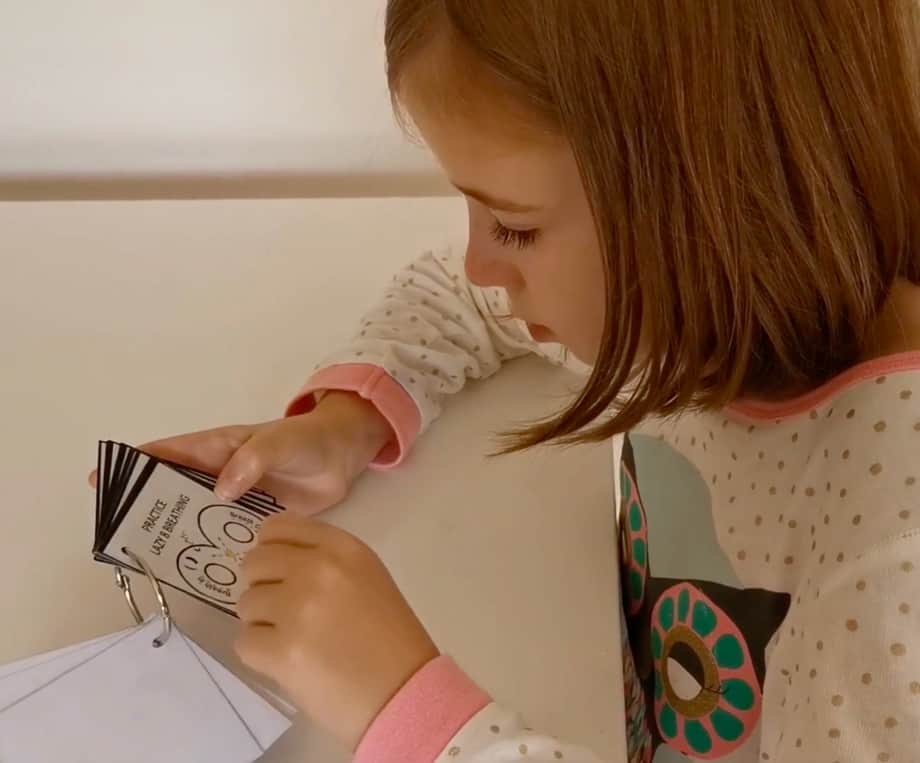
Lazy 8 Breathing and other shape breathing exercises are simple and effective calming strategies for kids that combine deep breathing with tracing shapes, helping children focus their attention while calming their bodies.
In this post, you’ll learn about the benefits of deep breathing, why breathing techniques work, and why the Lazy 8 Breathing technique has worked so well for us.
I’ll also share other breathing exercises using shapes such as square breathing, triangle breathing, star breathing, and rainbow breathing.
At the end of the article, you can download a FREE printable PDF with four shape breathing exercises for kids, including Lazy 8 Breathing, Square Breathing, Star Breathing, and Rainbow Breathing.

Each exercise is included in two formats: a worksheet version and a breathing card, so you can choose the one that best fits your child or classroom needs.
Why Deep Breathing Helps Kids Calm Down
Deep breathing has multiple benefits. It can:
- Reduce stress and anxious feelings
- Lower physical tension
- Help reduce pain sensation
- Decrease the intensity of strong emotions
- Improve focus and concentration
When children feel angry or anxious, their bodies go into a state of high alert. Their heart rate increases, muscles tense up, and their nervous system becomes activated. Deep breathing helps activate the body’s calming response, reducing physiological arousal and making it easier to regain control.
In psychological practice, training in deep breathing is often used either as a standalone technique to manage excessive physiological arousal or as part of a broader relaxation approach.
However, is it easy to start a breathing exercise during a meltdown?
Convincing an anxious or angry kid to start deep breathing isn’t that simple.
I used to find it mission impossible (scenes of my ten-year-old come to my mind!).
He would barely reach the third inspiration before accelerating the process so that he could continue with his emotional outburst.
The good news is that we eventually found a calming technique that worked exceptionally well for us, more on that in a moment.
Before that, it’s worth saying that introducing deep breathing during calm moments makes a big difference. When breathing feels playful and familiar, children are more likely to use it later.
Some simple ways to practice include:
- making soap bubbles
- breathing in while pretending to smell a flower and breathing out as if they blew a candle
- pretending to inflate a balloon slowly.
But what truly made the difference for us was combining breathing with movement and visual focus.
The Lazy 8 Breathing technique, which we’ll explore next, worked exceptionally well because it engaged both the body and attention at the same time.
The same principle applies to other shape breathing exercises in this post, where tracing a shape helps guide and slow the breath.
(Disclosure: We are a participant in the Amazon Services LLC Associates Program, an affiliate advertising program designed to provide a means for us to earn fees by linking to Amazon.com and affiliated sites. As an Amazon Associate, I earn from qualifying purchases. You can also read our Disclosure & Disclaimer policy here)
Lazy 8 Breathing Exercise for Kids
Lazy 8 Breathing is one of our favorite breathing exercises for kids.
It is part of The Zones of Regulation by Leah Kuypers, a curriculum designed to help children develop self-regulation and emotional control skills.
How do you practice the Lazy 8 Breathing exercise?
This breathing technique is very simple.
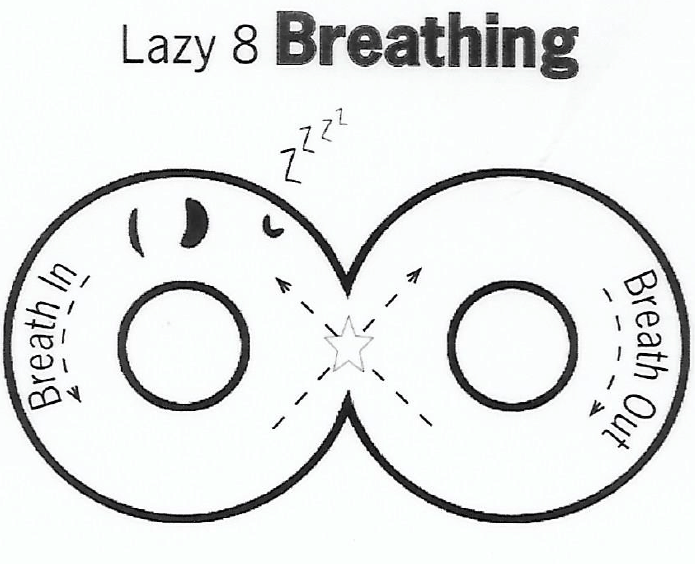
Your child traces the shape of a sideways eight (the infinity symbol) with their finger while coordinating their breath:
- Breathe in slowly while tracing the first half of the 8
- Breathe out slowly while tracing the second half
That’s it.
The combination of tracing and breathing provides structure and pacing, which makes it easier for children to slow down than simply telling them to “take a deep breath.”
Lazy 8 Breathing is also included in my list of anger management activities for kids, where you’ll find additional printable calm-down strategies.
Why does the Lazy 8 Breathing technique work for us?
Adding to the benefits of deep breathing, there are two reasons why the Lazy 8 Breathing exercise works so well for us:
- It works partly as a distraction strategy:
It removes the focus from the anger or anxiety outburst, moving the attention towards a totally different activity - This new activity requires concentration and precision.
Tracing the shape requires visual-motor coordination (the ability to coordinate vision with the movements of the body or parts of the body).
The kid needs to coordinate his vision with the movement of his hand/finger tracing the shape.
So, using the Lazy 8 Breathing (or any other shape) creates a more demanding activity than just asking your child to breathe in and out. Part of your child’s resources (energy, attention) are engaged now in the breathing activity.
If your child has issues with hand-eye coordination or fine motor skills, this type of exercise will require a certain effort.
But I think this is partly why it worked so well for us. Our child had motor skills issues, and this breathing exercise required him to completely redirect his attention and efforts into the Lazy 8 Breathing exercise.

Another reason we love this technique is how practical it is. Lazy 8 Breathing can be performed easily and discreetly anywhere.
We keep a laminated A4 sheet at home, but you can also carry a smaller version in your wallet and use it when you are away from home. And if your child is a bit older than mine (and less troublesome!), he can probably carry it in his pocket.
Using Shapes to Guide Kids through Breathing Exercises
Shape breathing exercises help children pace their breath by tracing a visual outline while inhaling and exhaling. The shape provides structure and rhythm, making it easier for kids to slow down and stay focused.
You can use many different shapes to teach this technique, including:
- Triangle breathing
- Square breathing
- Star breathing
- Rainbow breathing
- Five Finger Breathing (hand tracing)
You have probably seen many other variations using hearts, spirals, rectangles, or any other shape you can imagine. The truth is that almost any shape can work.
As long as the shape is something your child enjoys and it helps scaffold the breathing process by guiding when to breathe in and when to breathe out, it can be an effective calming strategy.
As you can see, Lazy 8 Breathing is simply one example of how shapes can be used to guide deep breathing.
Here are a few other examples:
Square Breathing

In Square Breathing, children trace the four equal sides of a square while coordinating their breath. They can breathe in along one side and breathe out along the next, or add a pause at each corner by holding their breath briefly before continuing.
Both versions are included in the printable, so you can choose the one that best fits your child’s age and needs.
Star Breathing

With Star Breathing, children trace the points of a star, breathing in along one line and breathing out along the next. The repeated points naturally create a steady breathing pattern.
Rainbow Breathing

With Rainbow Breathing, children follow the curved lines of a rainbow shape, breathing in and out as they move across each color. The long arcs naturally encourage slower, deeper breaths.
Five Finger Breathing (Hand Breathing)
Another popular variation is Five Finger Breathing, where children trace the outline of their hand while coordinating their breath, breathing in as they trace a finger up and breathing out as they trace it down.
Since this technique is so portable and easy to use anywhere, I’ve shared a separate step-by-step guide and printable visuals for Five Finger Breathing.
Other Fun Breathing Techniques for Kids
Deep breathing is one of the most powerful coping tools I know for helping kids manage anger, anxiety, and other big emotions. Because of that, I’ve explored several other breathing techniques that you may also find helpful.
Here are two additional approaches you can try:
Belly Breathing (diaphragmatic breathing or abdominal breathing)
In diaphragmatic breathing, the breathing is done by contracting the diaphragm. The air enters the lungs, the chest does not rise but the belly pushes outwards.
It is really easy to teach when you ask your child to put one hand on their belly and the other one on their chest so that they can track how the former comes out when they breathe in, while the latter does not move.
Learn how to teach kids belly breathing with two fun exercises.
Yoga Breathing Techniques
Even if you are unfamiliar with yoga techniques, there are really easy and fun ways to approach yoga breathing exercises.
Teaching breathing techniques using “animal breathing” is a really cool and fun way to around an exercise that could otherwise feel a bit “boring”.
Check out my post on yoga breathing for kids to learn a few really fun exercises (printable poster included in that post)
Belly Breathing (diaphragmatic breathing or abdominal breathing)
In diaphragmatic breathing, the breathing is done by contracting the diaphragm. The air enters the lungs, the chest does not rise but the belly pushes outwards.
It is really easy to teach when you ask your child to put one hand on their belly and the other one on their chest so that they can track how the former comes out when they breathe in, while the latter does not move.
Learn how to teach kids belly breathing with two fun exercises.
Our Cool Kid Journal (Anger Management Activities for Kids) explores many effective calming strategies for kids. It includes a section on deep breathing and breathing cards.
A Quick but Important Tip
Breathing techniques should be practiced when your child is calm, not in the middle of a meltdown.
The more familiar and automatic the exercise becomes, the more likely your child will be to use it during moments of anger, anxiety, or frustration. Like any skill, it works best when it has been practiced ahead of time.
Try a few of these techniques and see which ones your child responds to best. I’d love to hear what works for you.
Other Calm Down Resources for Kids
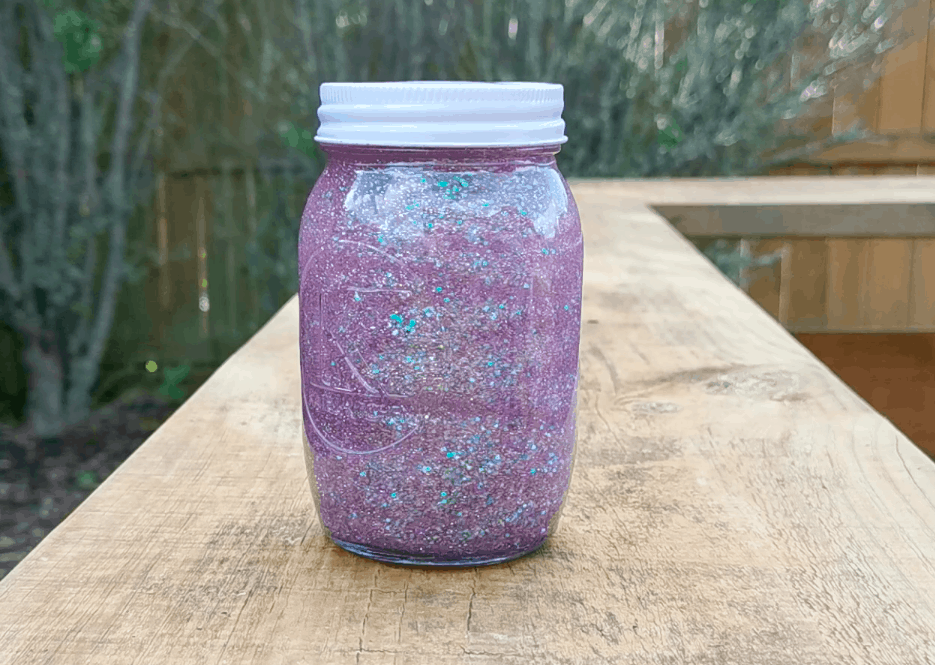
- DIY Sensory Bottles: “Ocean Magic” (an easy hand wash recipe)
Preparing a DIY Sensory Bottle can be a fun “arts & crafts” family activity and a great calming down tool. Try this really easy recipe! - Finger Tracing Calm-Down Cards & Posters
- Progressive Muscle Relaxation for Kids (Free PDF included)
Breathing Exercises for Kids Using Shapes (Download)


thankful for all you have to offer.