Impulse Control Activities for Kids: In this article, you will learn what impulsivity looks like in kids. You will also read about 21 fun activities, games, and resources that will help your kids practice self-control. At the end of the post, you can download some fun impulse control worksheets for kids.
Almost everyone can think of situations when they’ve had trouble controlling their impulses.
Sometimes we want to spend a few extra dollars on something fun online, or maybe eat just another piece of chocolate.
These habits may seem harmless, but to kids who lack impulse control, it can be a real problem in their everyday lives.
And the same holds true for all those around them.
By the time we are adults, most people have the necessary impulse control skills for everyday situations.
Children are naturally curious individuals with an appetite to explore their environment using their senses. Kids will often act on their impulses to fulfill their needs and indulge in their sensory seeking behaviors.
(Disclosure: We are a participant in the Amazon Services LLC Associates Program, an affiliate advertising program designed to provide a means for us to earn fees by linking to Amazon.com and affiliated sites. As an Amazon Associate, I earn from qualifying purchases. There may also be other affiliate links in this post. You can also read our Disclosure & Disclaimer policy here)
What is Impulsivity?
Definition of Impulse Control:
Impulse Control is the ability to resist an impulse, desire, or temptation and to regulate its translation into action.
Source: APA Dictionary of Psychology
So, impulsivity is a tendency to act hurriedly and without adequate reflection on the possible consequences.
Why is my Kid so Impulsive?
Impulsivity in kids may be a natural stage of growth and development.
There are lots of reasons why your child may act impulsively, like:
- Excitement
- Frustration
- Fatigue
- Lack of skills / Immaturity
In some cases, though, there are other underlying problems.
One of the common causes of impulsive behavior is ADHD (Attention-Deficit / Hyperactivity Disorder). Other developmental disorders and mental health issues may also lead to impulsive behaviors.
When a child lacks impulse control it affects their daily life, and the whole family too.
Related Reading:
What are the Signs of Impulsiveness in Kids?
There are several forms of impulsiveness that can be identified in childhood:
- Impatience and inability to wait their turn, interruption in classroom and discussions
- Having a short-fused temper, crying, and screaming for long periods
- Taking risks that are potentially harmful and dangerous
- Quitting games, activities and play due to uncontrollable frustration
- Hitting and biting children, adults, and pets
- Lying, stealing, and running away
Why is it Important to Teach Impulse Control to our Kids and How?
We need to teach our kids to think before they act.
Proper impulse control is mostly taught to kids by their parents and other adult figures.
Kids also learn self-control from their siblings and friends and by living their own everyday lives.
Witnessing our child act out in destructive manners is painful. As parents, we yearn to help them understand the importance of weighing up the risks versus the rewards.
A child’s brain, much like a sponge, will use their ever-changing environment to make decisions.
The trait of proper impulse control will boost their potential to construct better decisions as they develop as teenagers and grow through adulthood.
When teaching our kids about impulsivity, they not only will have a greater awareness of how their actions will affect those around them, but will also recognize that, like them, other kids may also lack self-control.
Empathy is a powerful tool when teaching our kids valuable life skills, such as pausing to think before they act.
Kids with ADHD commonly struggle with impulsivity as a daily occurrence at home, at school, and in social interactions.
When a child doesn’t stop to think before they act, it can lead them to trouble and potentially dangerous situations. The act of stopping to think about our actions is a learned trait that needs practice in order to turn into a regular habit.

21 Fun Impulse Control Activities to Test Your Child’s Self-Control
Now that we’ve covered the importance of self-control as a trait, here are some fun and rewarding impulse control activities for kids to practice with your family.
1. “Don’t Eat the Marshmallow”
Otherwise known as “The Marshmallow Test”, this tried-and-true game was initially developed in the late 1960’s as an experiment to study gratification deferral in children. It also works as a fun and rewarding impulse control activity for children as young as 3.
In a room with little to no distractions (such as a TV, radio, books, etc.), sit your child at a table and give them a clean plate with a single marshmallow (or other small treats).
Tell your child that you’ll be leaving the room to finish a quick household chore while they wait for you to finish. They have two choices; they can eat the marshmallow now, or they can wait to eat it. If they wait, you will give them another marshmallow to eat when you come back.
Once you leave the room to finish your chore, your child will have the time to contemplate the choices you gave them. This will test their ability to think over the pros and cons of acting on their initial desire.
After all, good things (and more marshmallows) will come to those who wait.
This is what this activity looks like ( Warning: unbearably cute video!)
2. “Red Light, Yellow Light, Green Light”
This game is well-known as a classic in gym class or recess but can also be taught to your child for everyday decision-making.
Just a little reminder in case it was not part of your childhood games: When your child hears the words “Green light” they can move forward, but when they hear “Red light” they must freeze.
You can play this game and once your kid is familiar with it, you can turn it into a useful impulse control activity or self-control tool.
You can tell your child to envision a traffic light over their head, and check the light before they act on an impulse. This traffic light is their light, and theirs only.
Explain to your child that they can make better decisions by paying close attention to their imaginary traffic light.
Role-play situations. What is your traffic light telling you?
If the light turns red, this means that their brain is telling them to STOP, and for a good reason; to avoid them getting hurt or in trouble.
If their light turns yellow, it means to slow down and think carefully about their next choice, and maybe ask a parent or teacher for help.
If the light turns green, they have determined that their decision is a positive one, and they can proceed while feeling good about their choice.
3. “Extra Pocket Money”
This is an impulse control activity for older kids.
If your child is given a daily budget for a hot lunch or snack at school, consider giving them extra pocket change one day before sending them off.
With that cash, they can decide to either purchase a dessert or snack at the school cafeteria or wait until they are home from school to spend it on a special concession snack at the movies.
Much like the Marshmallow game, this activity presents your child different choices with various outcomes. However, the time to make their final decision is lengthier and there are more distractions ahead that may affect your child’s final choice.
In the long run, the decision is entirely theirs and it is up to them to determine how to use their extra pocket money. As a parent, you can modify this activity’s model to your choosing, depending on your child’s interests and personality.
4. “The No Talking Game”
Who knew that this game would be a favorite for both kids and parents?
All jokes aside, this activity is great to practice in groups of multiple kids, such as in classrooms and with siblings.
The goal of this game is to not only have kids practice withholding their impulse to break the silence with their voices, but to focus on their awareness of their overall environment.
This game is best to start when the family is in an upbeat mood. Start by telling your kid(s) that the “No Talking Game” is starting and they have a few goals to achieve during the game, including:
- To go as long as possible without talking or moving out of their seat
- To listen to their environment and use a pencil and paper to take notes (or draw pictures, if they prefer) of all the sounds, sights, smells, textures, and emotions they feel during quiet time.
- If the person has the urge to say something, they should write it down or draw it instead of blurting it out loud, with the promise that it will be discussed after the game is over
- When someone else is talking, everyone else should carefully listen and not talk until it is their turn to talk.
Providing them a pencil, paper, and a long moment of silence, start the game. You can continue to work on your household projects or join your kids to make it even more fun!
When someone caves into their impulse to start talking, pause the game.
Ask the person who started to speak what they needed to say.
Was it important enough to say before the game ended? Could it have waited until the game was over? Why do they feel it was important enough to say out loud before the end of the game?
If what was said is found not to be urgent, gently remind them that they could write it down to talk about after the game, and you will talk about their writings/drawings once the game is over.
When the quiet time is officially done, each person takes turns to talk about what they wrote or drew on their paper.
This will teach your kids that if they are patient and wait their turn, they can comfortably talk, knowing all eyes and ears are on them with little to no communication issues.
5. “The Dance Party Freeze Game”
Of all the self-control activities for kids, this quick and easy game will help your kids dance their way to practicing better impulse control skills. Based on the bouncy song written by the “Kiboomers”, this fun song instructs kids to dance, hop, skip and twirl until the leader says, “Freeze”!
See the official video on YouTube 👇:
If you have an Amazon Echo, this song can be played by asking Alexa, “Play the ‘Freeze Dance’ by the Kiboomers.”
6. Impulse Control Traffic Light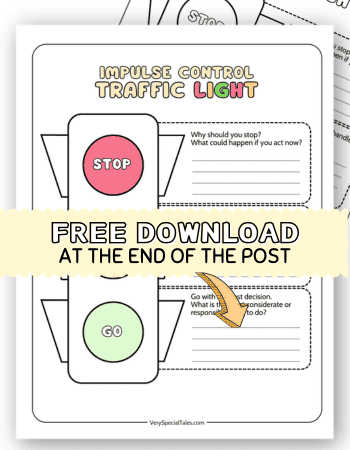
The Impulse Control Traffic Light activity is a fun and effective way to teach kids the importance of thinking before acting. This activity uses the familiar concept of traffic lights to help children develop self-control and make thoughtful decisions in various situations.
It works nicely because kids fully understand how traffic lights work:
- Red – Stop
- Yellow – Slow down
- Green – Go.
You can explain how they are like car drivers cruising through their daily journey and, sometimes, before they respond to certain situations, they need to proceed through the traffic light sequence.
Related resources: Stop Think Do Activities for Kids
7. Personal Space Activity
Impulsive kids may also invade personal space, not realizing how it may affect others. Lack of response inhibition, self-awareness, or self-control may lead to behaviors that make others uncomfortable
Personal Space Circle Activity
Draw with chalk on the floor or use a hula hoop or rope to create a personal space circle. This visual aid helps children understand and respect personal boundaries by physically demonstrating the appropriate distance to maintain from others.
Take turns to role-play conversations where kids speak to each other without trespassing in the personal space target. Then, role-play situations where they go inside the personal space circle. Ask the person in the circle to explain how it makes them feel.
8. Impulse Control Journaling
Impulse control journaling involves kids writing about moments when they felt impulsive, reflecting on their actions, and considering better choices for next time. This activity is particularly effective for children aged 8 and up who are comfortable expressing themselves through writing, helping them develop self-awareness and improve decision-making skills.
9. Impulse Control Workbook
This Self-Control Workbook is packed with fun and engaging worksheets and activities to help kids explore self-control, learn to wait patiently, and manage impulses.
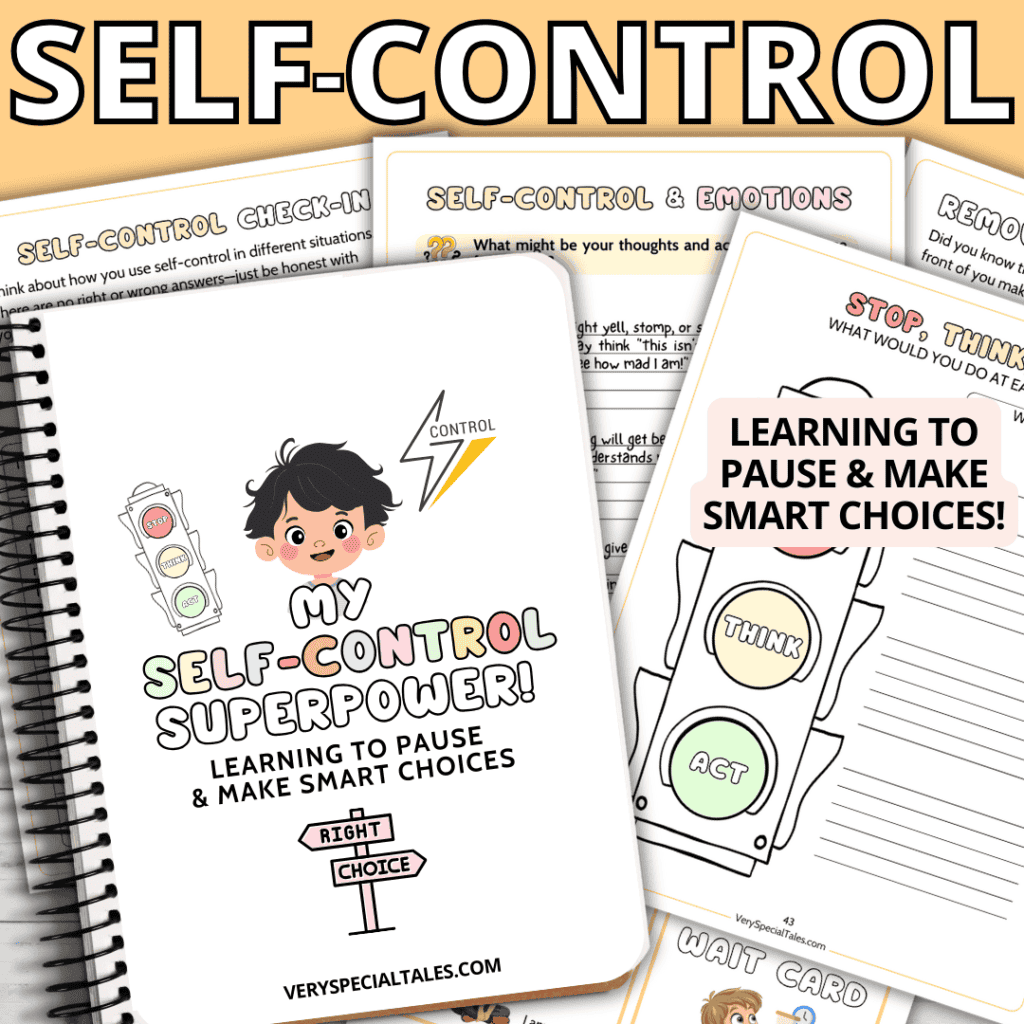
This helpful workbook is organized into two sections:
- Educator/Caregiver Section: A comprehensive guide with tips and advice to help you support your child or student on their self-control journey.
- Kids Self-Control Worksheets and Activities: Fun and engaging worksheets covering:
- What is self-control, with examples and the consequences of using (or not using!) our self-control
- Self-control and emotions, with helpful tools and strategies to stay in control when overwhelmed.
- Learning to wait, with practical tips and strategies to help your kid/student improve their waiting skills/patience.
- Impulse control, featuring helpful techniques to master thinking before acting.
- Self-control in social situations.
- 22 Self-control strategy cards to reinforce the tools and techniques explored in the worksheets.
10. Impulse Control Worksheet
These fun impulse control worksheets include several activities that will challenge your child’s urge to say something immediately and instead follow the instructions provided.
They are super fun, and I’ve added the option of timing the activities. This will add an extra layer of challenge, motivating them to attempt the activity several times to try to beat their own record.


I searched for books on Amazon but it’s unavailable and the game won’t be shipped to my country india but your article is really helpful would really appreciate if send the pdf. Of doz books on my email
Thanks for your message, Amrin. I’m sorry to read that some of the recommended items are not available in your country. I can’t provide you with PDFs, as books needs to be purchased from retailers.
If you are interested in reading very helpful strategies to help kids with impulse control, I suggest you also check our other article on the topic:
https://veryspecialtales.com/impulse-control-strategies-kids/
It explores 30 effective strategies for kids who struggle with impulsivity.
Hello, good time. I enjoy your content very much and I am very happy to meet you. Good luck always.
Thank you for the input on healthy and unhealthy relationships. I am currently working with preteens, teens, and young adolescents. They experience different Peer pressure and concerns about how to fit in. Always looking for a positive outlook on what to do next and with whom. Trying new techniques for building on friendships to relationships.
Looking forward to using with my students.
Looking Forward to trying it. Thank you
thank you, great content!
Thank you!
Thank you for the impulse control worksheets.