

Fun Deep Breathing Exercises that Kids Will LOVE to Practice
Post Summary: 14 Fun breathing exercises for kids that will help when they are anxious, frustrated, angry, or overexcited + Free PDF Breathing Exercises for Kids (Worksheets and printable breathing exercise cards – download link at the end of the post) + Benefits of deep breathing for children of all ages.
Deep breathing is often one of the first relaxation techniques that adults turn to when we need to get our tension or stress under control.
We know that when we slow down our breathing rate and take deep slow breaths we immediately start feeling the benefits of this easy and useful technique.
But, we often fail to teach our kids the power of deep breathing.
If you tried in the past and felt it didn’t work, chances are you missed either one of these steps:
- Find calm moments to practice their breath work.
Practicing breathing techniques while your child is calm and happy so that your kids can use them when they feel unsettled, angry, worried, or face a stressful situation. - Making breathing so much fun that it becomes an enjoyable activity on its own.
I will try to tackle the second issue in this post and show you my favorite ways to make deep breathing fun and interesting for kids.
We will try to understand first some basics about breathing and its benefits. And we will subsequently learn a collection of breathing exercises for kids that will make this soothing tool a lot easier to put into practice.
Table of Contents:
- What is Breathing?
- Cycle of Breathing
- Deep Breathing Benefits
- Why Breathing Techniques Work
- Fun Breathing Exercises for Kids at Home or School
- 6 Easy Breathing Techniques
- Shapes Breathing (Lazy 8 Breathing, Square Breathing, Star Breathing, Rainbow Breathing & others)
- Yoga Breathing Exercises (Lion Breath, Bumblebee Breathing, Crocodile Breathing)
- Belly Breathing for Kids
- Mindful Breathing
- Other Deep Breathing Exercises
What is Breathing?
Breathing is a vital automatic process that supplies oxygen to our cells and disposes of carbon dioxide.
The rate and depth of breathing are automatically (and unconsciously) controlled by homeostatic mechanisms. The rate and depth of breathing are influenced by our physiological needs and even by our moods and emotional state.
For example, when we are exercising carbon dioxide production increases. Our body responds by increasing the rate and depth of breathing to facilitate greater oxygen absorption.
Examples of changes in breathing patterns linked to emotional states and moods could be our increased breathing rates in anger or anxiety situations.
The automatic breathing pattern that we have described can change to facilitate different activities like:
- Swimming
- Talking
- Singing
Slow breathing techniques seem to promote a predominance of the parasympathetic nervous system, The main job of this network of nerves is to relax your body or reduce its activity (for example, it lowers your heart rate, tightens airway muscles, or helps with food digestion)
Cycle of Breathing
Breathing has the following cycle:
- Inhalation: air enters our lungs and reaches the alveoli where it diffuses into the bloodstream
- Internal Retention: after inhalation, there is a brief retention pause with a larger volume of the chest cavity that facilitates the gas exchange (oxygen enters and carbon dioxide exits)
- Exhalation: Carbon dioxide reaches the alveoli and it is subsequently flushed out of our body
- External Retention: Exhalation is followed by a pause where the lungs remain at rest.
Deep Breathing Benefits
Deep breathing has multiple benefits such as:
- helping to reduce anxiety and stress
- helping to reduce pain sensation
- improving concentration
Why Do Breathing Techniques Work?
Anger or anxiety are big emotions that result in excessive physiological arousal. Therefore, it makes perfect sense to use physiological deactivation techniques such as breathing exercises.
In psychological practice, training in deep breathing is often used either as a standalone technique to control excessive physiological arousal or as part of a relaxation package.
Some examples of exercises that help children learn deep breathing are:
- making soap bubbles
- breathing in, pretending to smell a flower
- breathing out, pretending to blow out a candle
- slowly inflating a balloon.
FUN Deep Breathing Exercises for Kids for Home or the Classroom
Breathing exercises help relieve anxiety, anger, and frustration.
A very effective way of introducing kids to deep breathing techniques is by making them fun and interesting.
Easy Breathing Exercises for Younger Children
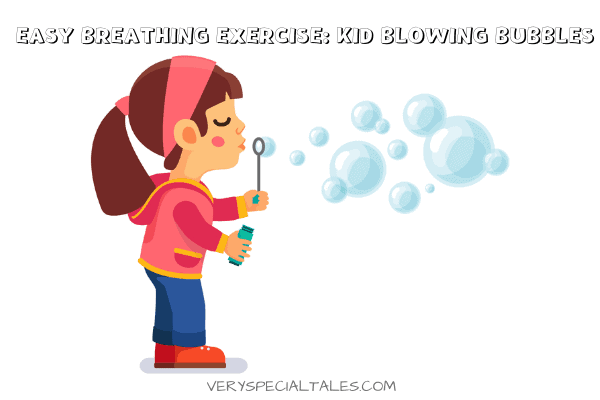
These are some of the easiest breathing exercises to help young children learn deep breathing.
- Bubble Breathing: blow soap bubbles
- Pinwheel breathing exercise: have fun blowing air into a pinwheel
- The Cotton Race!: place cotton balls on a flat surface and blow on them to move them along.
- Cande Blowing: pretend you have a birthday cake in front of you and blow out the birthday candles!
- Scented Flower: ask your child to pretend to smell a flower
- Deep breathing while Mum/Dad/teacher counts to 10.
These easy breathing exercises are also used by OTs and speech therapists when working on strengthening oral motor muscles.
Shapes Breathing (Examples: Rainbow Breathing, Lazy 8 Breathing, Square Breathing, Star Breathing, Five-Finger Breathing)
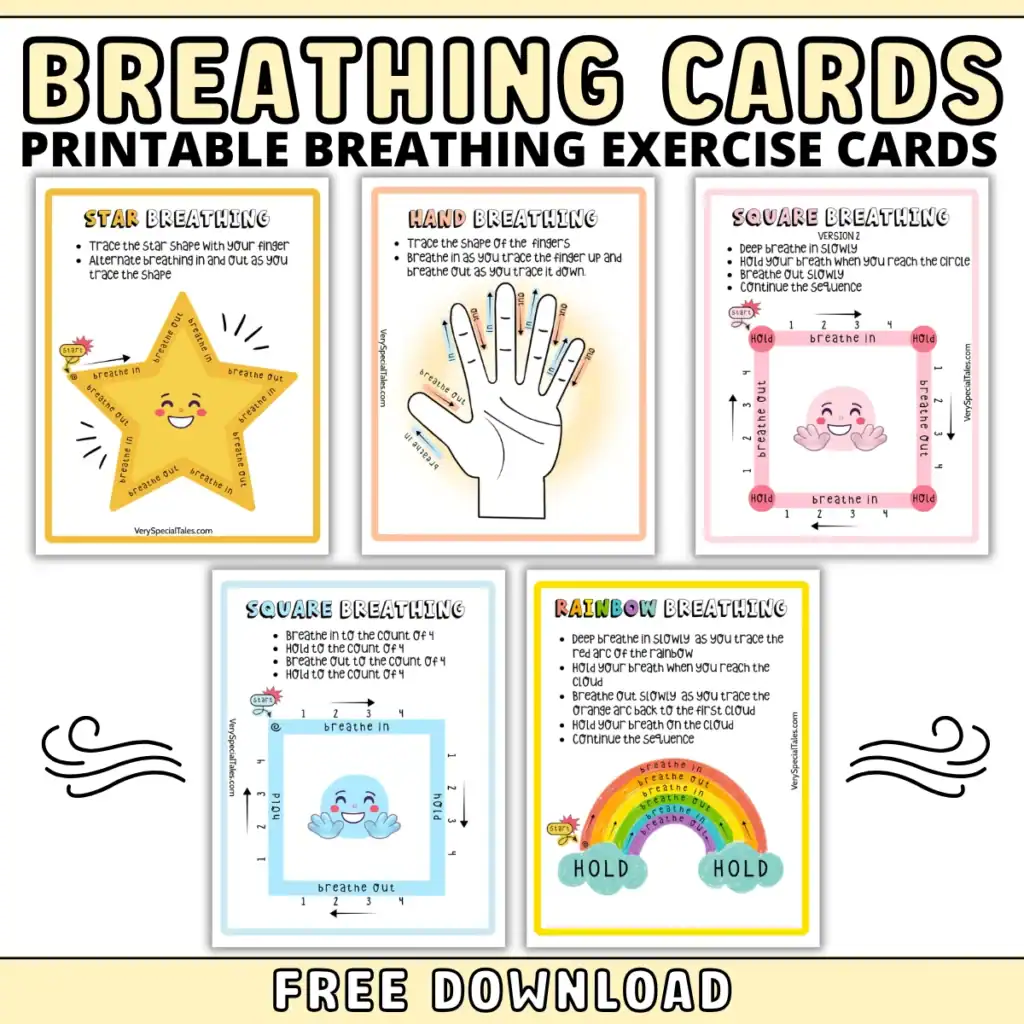
Shape breathing techniques have become extremely popular.
This great technique uses simple shapes (squares, triangles, stars, etc.) that the child will trace with their finger while practicing deep breathing.
I believe this type of breathing technique works really well with kids because:
- it removes the focus from the anger or anxiety outburst
- it moves the attention towards a totally different activity (the finger tracing)
- it supports the breathing exercise by giving cues on when to breathe in and out
- this new activity requires concentration and precision. Tracing the shape requires visual-motor coordination (the ability to coordinate vision with the movements of the body or parts of the body), the kid needs to coordinate their vision with the movement of their hand/finger tracing the shape.
Using shapes /props to learn breathing techniques:
I often come across new shapes and themes that are used as support for this breathing technique. They are all adaptations of the same type of exercise.
The shape you use is not the most essential part of the activity. The important aspect if this simple breathing exercise is that the child traces the drawing outline while they follow the cycle of breathing (breathe in-hold-breathe out-hold)
Some examples of this technique include:
- Square breathing
- Triangle breathing
- Star Breathing
- Hexagon Breathing
- Rainbow Breathing
- Hand Breathing ( 5 Finger Breathing)
- Eight Breathing
I will share a couple of examples, and link to a few posts that expand on this concept:
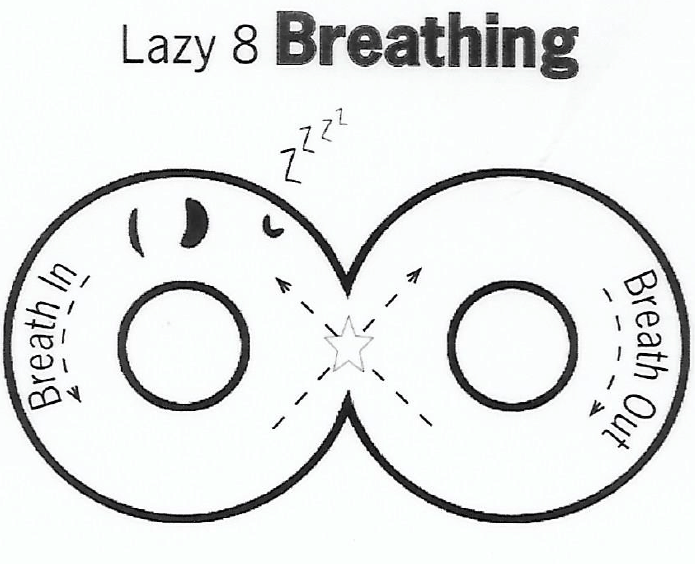
- Lazy 8 Breathing exercise.
This was my favorite breathing exercise for a long time (it was the first shape breathing activity we learned)
This breathing technique is very simple and consists of tracing the 8 shape with your finger taking a deep breath in as you go through the first half, and breathing out as you cross to the second half.
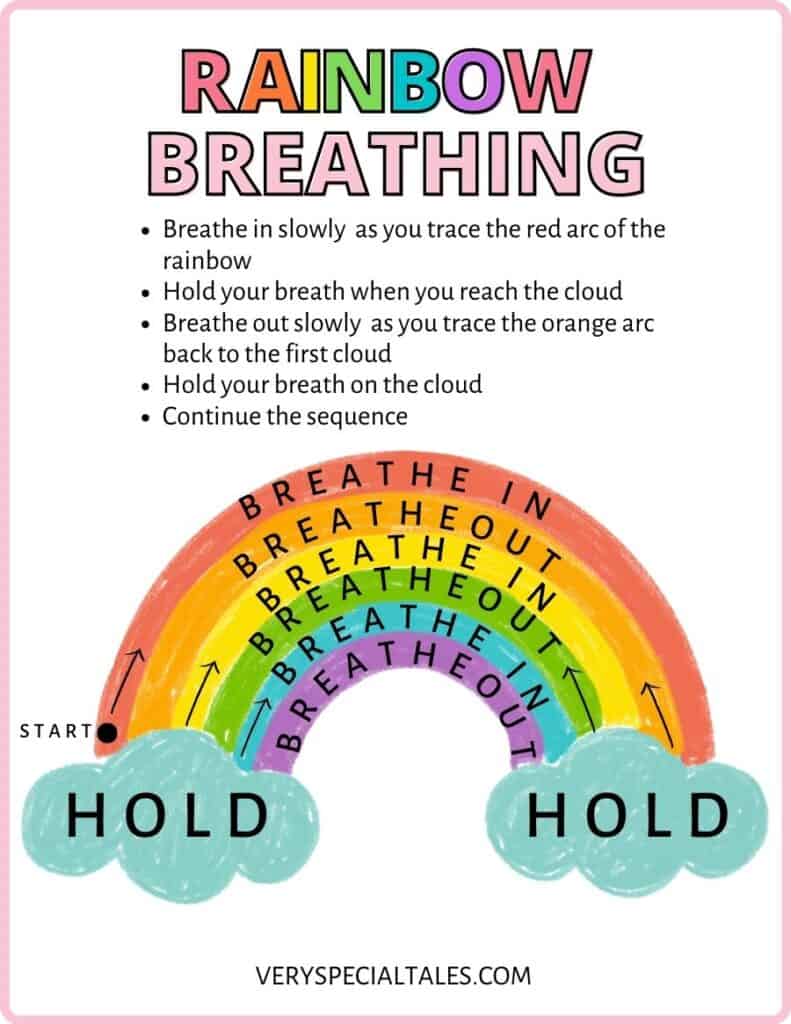
- Rainbow Breathing Exercise (included in your free download)
Ask your child to trace the arc of the rainbow. Breathe in. Hold when you reach the cloud. Then breathe out, returning to the initial cloud.
➡️ Read more about:
- Lazy 8 breathing and the use of shapes to teach deep breathing
- Square Breathing

If you wish to watch videos of deep breathing techniques, this is an example of a square breathing video. I prepared this one myself because I find it easier and less distracting to follow the numbers (and I prefer to focus on breathing without a background voice).
Yoga breathing techniques (Animal Breathing: Lion’s Breath, Bumble Bee Breathing, and more!)
Yoga breathing techniques are also known as “Pranayama”.
These techniques have made it to this list not just because they are helpful but also because pretending to be animals while we learn to breathe is a fun way to start kids on this powerful tool.
Let’s check a few examples, and I will also link below to a post on animal breathing techniques for kids.
- Lion’s Breath
- Go to the floor on all fours as if you were a lion
- Take a deep breath through your nose
- Open your mouth as big as you can
- Stick your tongue out
- Eyes wide opened
- And, ROAR!
- Bumble Bee Breathing
- Breathe in
- Breathe out with your mouth closed, while you hum like a bee
- Repeat this breathing sequence for a few minutes
- Crocodile Breathing
- Lie on your tummy
- Fold your arms above your shoulders and rest your head on them (it helps you start deep breathing)
➡️ Read MORE yoga breathing techniques for kids and get your free poster

Belly Breathing Technique
- Belly Breathing (Diaphragmatic breathing).
In diaphragmatic breathing, breathing is done by contracting the diaphragm. The air enters the lungs, the chest does not rise, but the belly pushes outwards.
Deep belly breathing is a very simple exercise that kids will be able to learn easily.
But we can make this simple technique even more fun by using two different techniques:- Using our child’s imagination. In the “Balloon Breathing Technique,” your child will use an imaginary balloon to learn how to practice belly deep breathing.
- Using props, like a soft toy or a stuffed animal. In this technique, your child will lie down and place a soft toy on their belly. This is a great way for younger kids to track their breathing practice, as they will see their soft toy move up and down as their belly moves while breathing.
Read in more detail ➡️ belly breathing for kids.

This is a cute video to learn about abdominal breathing with Rosita from Sesame Street:
Mindful Breathing Exercise (Feather Breathing)
- Feather Breathing
This is another great breathing exercise. 
The focus of this exercise is breathing out.
When we first learned this exercise, we used our imagination. We imagined we had a feather in front of our mouth, and we slowly released our breath into the feather.
Now, we have turned this into a fun mindfulness breathing activity to make it more fun and interesting for the senses.
We use a feather with bright colors (from our crafts supplies), and we follow this script:
“Look at this feather. What colors do you see? Are they nice and bright?
What do you think it will feel like when you touch it? Would you like to touch it now? How does it feel?
Do you think it will tickle your face if we brush it through your face? Would you like to try it?
Does it have any smell?
How do you think it will move when we blow into it? Take a deep breath and release the air through your mouth slowly.
Let’s repeat it a few times”
Other deep breathing exercises
- Alternate nostril breathing
Place your thumb on your right nostril and your middle and index on your left nostril. Hold your right nostril closed with your thumb and breathe in slowly through the left one. Breathe out through the right nostril while closing the left one. Hold your breath a couple of seconds and breathe in through your right nostril, keeping the left one closed. Continue alternating sides.
More Breathing Resources
Our Cool Kid Journal (Anger Management Activities for Kids) explores many effective calming strategies for kids. It includes a section on deep breathing and breathing cards.
What do you think about breathing exercises for kids now?
Yes! They can also be a fun activity for home or the classroom.
If you found this post useful, please, share it with others and pin it for later.😊
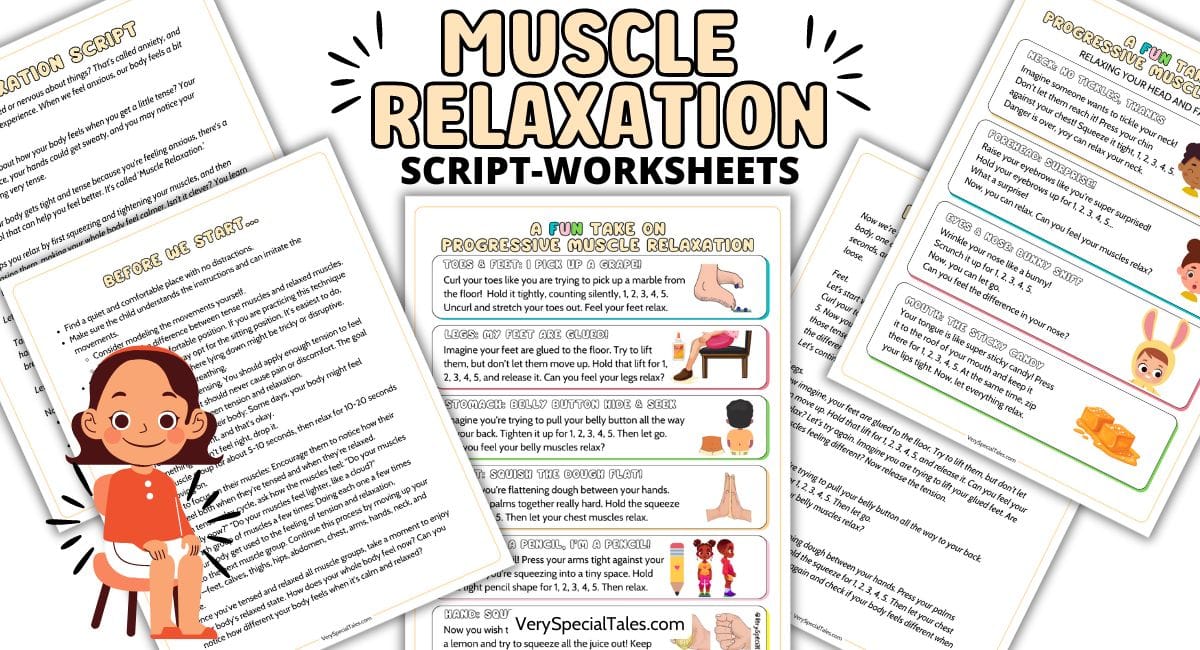
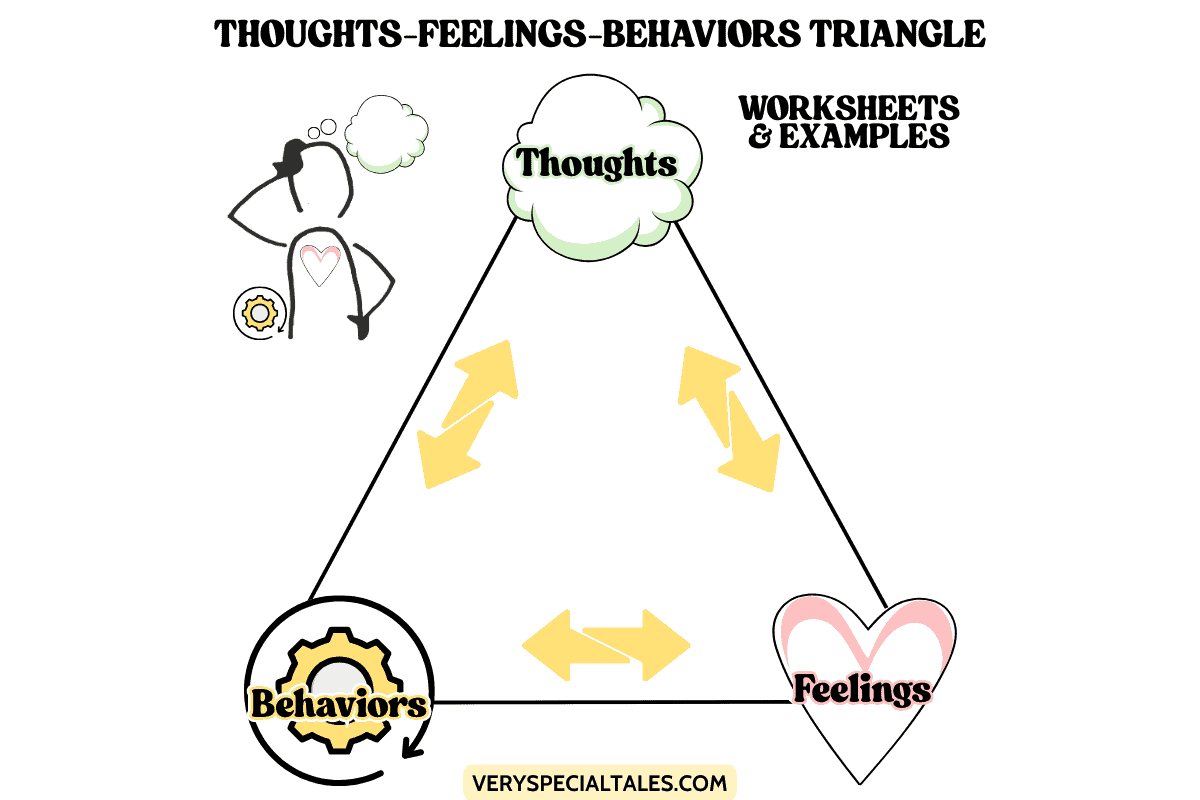
And, don’t forget to download your free breathing exercises for kids (worksheets) by filling in your details below (you can use them as printable posters too!):
14 Fun Breathing Exercises for Kids



Thank you for such wonderful resources!
You’re welcome. I hope you find them useful 👍
Hi Clara,
Thank you for such a wonder resource, I have been looking for a full set of breathing exercises and these are just perfect!
Thank you! I love these!!
THANK you!!!
Looks amazing
Thanks, Michelle. Let me know how they work for you. 👍
Hiya, thank you for all the information. I would like to request the resources please
Hi Shadia,
Thanks for your message!
There is a download form at the end of the post 👍
Thank you for sharing your helpful resources!
You’re welcome, Kat! I hope you find them useful.
Thanks so much
Much appreciated for my K-3 students, they love this! 🙂
Thanks, Kim! I’m glad your student love these resources. I use breathing techniques with my kids very often, and they are an essential tool to help them calm down.
Thank you so much 💜💜💜
Love these!
These are fabulous and just what I was looking for:))
Thank you so much.
I am a school counselor and would like to download the breathing worksheets.
Thank you,
Eric
Hi there,
How can I get in contact with you to ask questions about distribution.
Thanks so much!
Danielle
You’ve just done it! I have replied to you via email.
These resources look great – i would love a copy
Thanks, KR! Request your copy at the end of the post 👍
These are wonderful exercises for children , Thank You
These are great. Can I please have a copy of them? Thanks
Hi Jennifer, you can download a copy by filling in the info in the download form at the end of the post👍
I think this is very useful information.
Thanks for the helpful resources.
This is great material you have put together. Thank you so much.
Hello,
I am interested in these posters. What is the best way to download.
Thank you and have a great day.
Hi Jenny,
thanks for your comment. There is a download field at the end of the post. You only need to fill in the details, and you will receive an email with the download link.
This is very beneficial to help students regulate their emotions.
I would love to have copies of the shape breathing exercises. Thanks, this will be good for returning to school and helping the students reacclamate.
thanks
Thank you. My students who have ASD will really benefit from learning these strategies. I’m going to have them teach the other students in their classes.
Thank you!
Thank you for your comment, dear Collin. I appreciate your kind words and look forward to sharing more valuable resources with you in the future. Best regards and thank you again for your support!
Hello. I am an SEL facilitator. I would like to download the breathing sheets for calm spots. Thank you!
I would like to download a copy of the breathing exercises for kids please.
Thank you!!
I am an LCSW and would like to download the coping skills worksheets since I see kids.
Hi Monica, thanks for reaching out. I appreciate your kind words and enthusiasm for utilizing my coping skills worksheets. You can download the worksheets by filling in your details in the download form at the end of the post. Additionally, I encourage you to explore my page: https://veryspecialtales.com/category/coping-skills/, where you can find more helpful resources on coping skills. Best regards and thank you again for your support!
These look awesome, thank you!
My students are going to love these. Thank you!
I’d love a copy please!
Thank you!
I am looking forward to working with my daughter with these amazing cards. Thank you 🙏
I am a SENCo and would like a copy of the resource please.
Hi, thanks for reaching out. You can download your printable by filling in the details in the download form at the end of the post. I hope you find this resource helpful.
Thank you! I’ve used many of your exercises and tools with my students. They have been very helpful!
Great ideas to implement with littles. Can I get the printable worksheets please.
thanks
Love these ideas, would love to be able to download them 🙂
Thank you!
I loved the aricle and look forward to sharing it with the families I work with.
How do I download these resources they are brilliant
Thanks, Alexandra. There is a download form at the end of the post. If it doesn’t show, try reloading the page 👍
These will be super useful for my students!
thank you
I would love a free copy of the cards. Thank you
Thank you!
Would like to download some of your resources please.
I think they are wonderful.
Thank-you.
Kind regards,
Stacey
Wonderful! Thank you!
I would like to get print off some of your printables for my students. Thank you.
These look great would love to use them in my classroom.
Hi! I would love to try these with my kiddos. Could I please have a PDF?
Thank you for these helpful resources!
Thank you for these helpful resources!
Thank you!
can I get the printable worksheets? these are great, thanks!
Very helpful printable. Thank you!
Hello, these looks amazing – thanks.
Just a note, I entered details but I havent receievd confirmation email.
Thank you so much for your kind words! I believe you’ve received the worksheets now, and I really hope you find them helpful.
I love the examples of breathing!
I would love a copy of these please
These are awesome!
Looking forward to using these with my students!!
Thank you!
Would love a copy of these – thank you!
Thank you for all the resources thay are very helpful
Thanks, they look great
Great resources for kids of all ages and capabilities