
Positive Self-Talk Activities for Kids and Teens: Discover ways to guide children in turning negative self-chatter into motivating inner dialogue. This post offers strategies for fostering positive thinking, examples of adaptive inner conversations, and a variety of enjoyable activities suitable for children across different age groups. At the end of the article, you can download a free Positive Self-Talk printable to help students put these strategies into practice.
Table of Contents
- What is Self-Talk
- Identifying Negative Emotions
- 17 Tips to Promote Self-Talk in Kids
- 25 Positive Self-Talk Activities for Kids & Youth
- Activities for Kids (all ages)
- Activities for Teens
- Positive Self-Talk Printable (Free Download)
What is Self-Talk
Self-talk, also known as our internal dialogue, comprises the sentences and messages we tell ourselves, often functioning as an inner voice that guides our thoughts and actions.
Self-talk can be both negative and positive.
Our negative self-talk reinforces negative beliefs and attitudes and it may lead to feelings of worthlessness.
An example of negative thinking: “I’m useless, I’ll never be able to do that”
These negative thoughts can sometimes pop up spontaneously as automatic thoughts in the form of negative ideas about ourselves, the world, and the future.
On the other hand, the benefits of positive self-talk are powerful and include reassuring ourselves, motivating us, replacing negative inner talk, focusing our attention on the positives within us, and even enhancing performance.
Kids have to face difficult situations in their everyday lives that can trigger negative self-talk.
Encouraging positive self-talk may be a very useful strategy in such situations.
Why is Self-Talk Important?
This internal dialogue often reflects our subconscious beliefs and attitudes, and it can shape the way we interpret and respond to situations:
- Influences Perception: Our self-talk can color our perceptions of events and experiences. Positive self-talk can lead to a more optimistic outlook, while negative messages can contribute to a pessimistic view.
- Impacts Emotional Response: The nature of our internal dialogue can affect our emotional state. For instance, encouraging self-talk can boost confidence and reduce stress.
- Shapes Behavior: Self-talk can influence our behavior. Positive self-talk can motivate us to take action and face challenges.
- Affects Decision-Making: How we talk to ourselves can impact our problem-solving and decision-making skills.
- Self-Fulfilling Prophecy: Sometimes, what we repeatedly tell ourselves can become a self-fulfilling prophecy. If we constantly tell ourselves we are capable, we may become more proactive and successful in our endeavors. Conversely, if we often tell ourselves that we are bound to fail, we might sabotage our own efforts.
To put it simply, self-talk is an important part of how we think that really affects how we feel and how we deal with everything around us.

Identifying Negative Emotions
Being able to identify their negative emotions in the first step kids can take to be able to deal with them appropriately and understanding situations that may benefit from positive self-talk.
Some kids are still learning about emotions. There are different tools and activities that you can use to help your child identify different types of emotion:
- story-telling
- role-playing
- describing situations in their lives that may trigger certain emotions.
These are some examples that children may relate to, and may help them understand more complex emotions:
- Fear: Not doing an assignment or breaking a rule and then worrying about the consequences.
- Sorrow: Losing a friend or a pet.
- Embarrassment: When someone makes fun of their appearance, their work, or anything they said.
- Guilt: When they lie about something or cheat on a test and know it’s wrong
- Anger: When something they own is taken away against their will or when they are being scolded when not at fault.
- Loneliness: When their friends do not come to school or when they feel like they do not fit in the circle that they are in.
- Jealousy: A classmate scoring more in a class test or some other kid gets the latest gadget.
- Worthlessness: When they think they are not good enough after failing at a task or when a task seems too hard.
Tips to Promote Positive Self-Talk in your Kids
- Always validate your child’s feelings and tell them it is “normal” and even adults have troubling thoughts.
- Teach your child the role our thoughts play in how we feel.
This is an example of how our own thoughts may trigger our anxiety or, on the contrary help us cope:
Situation: the teacher is going to ask me a question
a) anxiety triggering thought: I’m going to forget everything I studied.
b) coping statement: I’m going to breathe in and think about the answer. If I need a few seconds to think about it, I will just say so.
Related reading: 12 Unhelpful Thinking Styles (and why you should challenge them) - Spend enough time with your children to have a better understanding of their personalities and their thought process, so that you can respond accordingly.
- Model positive self-talk. Show them how you phrase more adaptative self-talk when you are facing a difficult situation.
- Identify situations or experiences that trigger negative thoughts, and prepare positive statements that can compensate thought associated with it that we can retrieve.
- Help them reflect on the positive qualities and talents that they have.
- Teach your child that his/her mind is a “motel” or a “guest house” that will be visited by a number of emotions during the day and none of them is coming to stay forever. So whatever it is, it will be over soon. This will help your child get some perspective and minimize the problem.
- Keep reminding them that there is no problem that cannot be dealt with.
- Teach them calming phrases that they can repeat to themselves when in stressful situations. “Everything will be fine” “I can do this” “It will be over soon”
- Frequently engage them in activities that help them practice converting common negative thoughts into positive ones.
- “I am so dumb, I always make mistakes.” into:
- “I am learning from my mistakes and I will keep getting better.”
- Teach them to find a positive aspect in every situation. For example, when feeling alone they could tell themselves “I can now enjoy the peace of my own company, read a book, focus on studies, etc”
- Write down every day a list of positive, happy thoughts.
- Teach them about gratitude More 👉 Gratitude Activities for Kids
Examples and tips of self-instructions that can help kids deal with certain emotions:
- Embarrassment: ask them to reflect on past achievements and strong traits.
- Fear: Competence-related self instructions work better than threat-related verbal cues (Kanfer, F.H., Karoly, P & Newman A., 1975). “I’m a brave kid. I can handle darkness” would be better than “It’s ok, darkness is a fun place”
- Anxiety: Prepare positive self-talk statements to cope with different stages of the anxiety-triggering situation (Meichembaun & Goodman, 1971):
- preparation statements: “I need to remember to breathe in and out”
- coping statements: “I can do this, I’m doing great”
- acknowledge accomplishments: “I was a little anxious at the beginning, but I’ve done a great job answering the teacher’s questions”
- Anger: Self-talk can be used to cope with challenging situations in an adaptative way (following a similar approach to the anxiety example shown above)
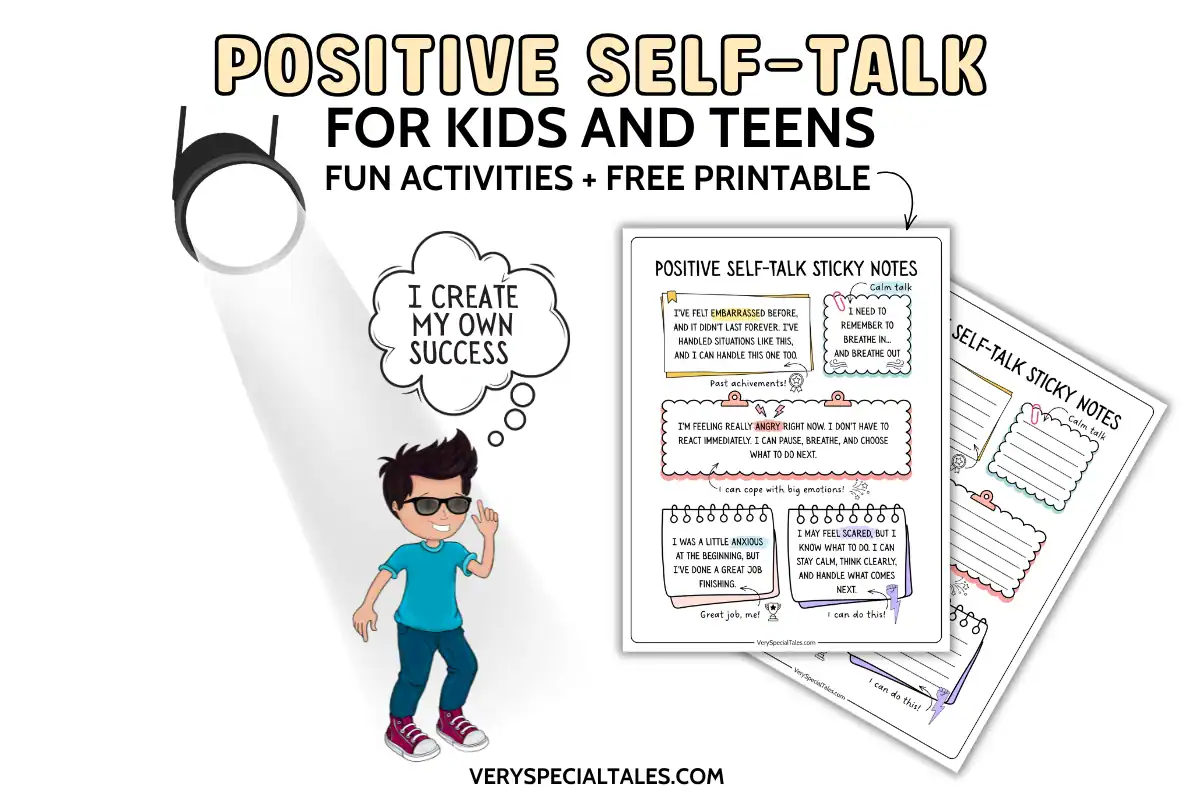
The Positive Self-Talk Sticky Notes printable helps students put these emotion-driven self-talk strategies into action, with a free download available at the end of the post. It includes ready-to-use examples and a blank version so students can write their own personalized reminders.

25 Positive Self-Talk Activities for Kids
Positive self-talk activities for kids are fun exercises and games that help children think and speak about themselves and their abilities in a positive, encouraging way. These activities will also contribute to building self-esteem and confidence.
The positive self-talk activities below are not just about teaching kids to talk to themselves nicely. They also involve learning to speak positively in general, which could also encourage them to be kinder to themselves and build their own confidence:
- Storytelling with a Positive Twist
Encourage kids to create stories where the characters overcome challenges using positive thoughts and actions. - Positive Thought Jars
Kids can write or draw positive thoughts and place them in a jar. Whenever they feel down, they can pick one to read. - Compliment Circles
In a group, each child gives a compliment to the person on their right, focusing on positive traits or actions. - Positive Talk Role-Playing Scenarios
Create scenarios where kids must find a positive solution or outlook in a challenging situation.
For example, if a friend doesn’t share a toy, instead of getting angry, a child learns to think, “Maybe my friend needs a moment, and then we can play together.”
Or if they struggle with homework, they might encourage themselves by thinking, “I can ask for help and learn from this.” These role-plays help kids learn to handle real-life challenges with a positive mindset, which strengthens their positive self-talk skills. - Things I Like About Myself Worksheets
Use worksheets to help them reflect on the positive qualities and talents that they have (these “Things I like about myself” worksheets can help you with this activity)

- Practice Positive Affirmations
Positive affirmations are positive statements that we tell ourselves for self-motivation or to challenge negative thoughts.
So, start the day with positive affirmations with your kid!
Use a positive affirmation card to help our kids focus on the positive message. Or encourage your kids to prepare their own positive affirmations.
These positive affirmations worksheets are great for younger kids or children with fine motor skills issues. - Growth Mindset Activities
Mindset is a state of mind that shapes our beliefs. Consequently, it influences what we think, feel or do and plays an important role in our success or failure.
Encourage a positive mindset with fun activities that will support the belief that their abilities can grow through effort, helpful strategies, and other people’s support.
Examples of growth mindset activities include:- Rephrasing Sentences: Teaching kids to change statements from a fixed mindset (like “I can’t do this”) to a growth mindset (such as “I can’t do this yet, but I can learn with practice”) helps them understand that abilities can be developed.
- Watching Inspirational Movies: Films that showcase characters overcoming adversity can inspire children to believe in their own capacity to face challenges and persist through difficulties.
- Writing Uplifting Statements: Encouraging children to write positive, empowering statements can reinforce their belief in their own potential and ability to improve.
- Growth Mindset Journal: Keeping a journal where children can reflect on their daily experiences, celebrate small wins, and plan how to approach challenges differently in the future can foster a continuous growth mindset.
Related Reading: 15 Fun Growth Mindset Activities for Kids
- Positive Reflection Journaling
Ask kids to write about a time they felt good about themselves or a challenge they overcame. - Writing a Gratitude Journal

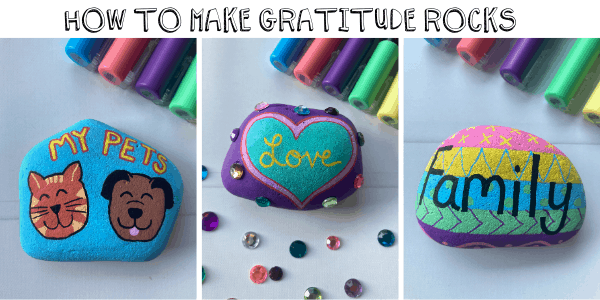
- Prepare Gratitude Rocks.
While you prepare your gratitude rocks, you all have an opportunity to reflect on some of the good things and people in your lives.
- Self-Portrait with Positive Traits
Kids draw self-portraits and surround them with words or pictures of their strengths and positive qualities. - Kindness Challenge
Set a daily or weekly challenge for kids to perform acts of kindness, focusing on the positive impact they can have. - Positive Memory Book
Children can create a scrapbook filled with memories and moments that made them feel happy and proud. - ‘I Can’ Jar
Kids write down things they can do well, emphasizing their abilities and strengths, and place them in a jar. - Emotion Charades
Play charades focusing on positive emotions, helping kids recognize and understand these feelings. - Creating a Positive Vision Board
Kids can make a collage of images and words that represent their hopes, dreams, and positive aspects of their life. - Future Self Letters
Have kids write a letter to their future selves, highlighting their hopes, dreams, and positive qualities they admire about themselves. Encourage them to think positively about their future and recognize their own potential. - Hero’s Journey Story Creation
Invite kids to create a story or comic where they are the hero. The narrative should include overcoming obstacles using positive traits and thinking. This not only boosts creativity but also helps them identify and appreciate their inner strengths. - Building Positive Mantras with Art
Instead of traditional affirmations, kids can create artwork that represents a positive mantra or saying. For example, painting a sun to represent brightness and happiness in their life. The creative process allows them to express and internalize positivity in a unique way. - Self-Esteem Activities for Kids
Self-esteem activities and games focus on helping children recognize and appreciate their own abilities, qualities, and potential.
For a comprehensive list of activities:
Positive Self-Talk Activities for Youth
Many of the activities mentioned above can be adapted for kids of various ages. However, the following ones are particularly stimulating for older kids as positive self-talk is integrated with skills like critical thinking, creativity, leadership, and social responsibility:
- Personal Growth Podcast Project
Encourage them to create a podcast or a series of audio recordings where they discuss topics related to personal growth, resilience, or positive thinking. This could include interviews with peers or family members, discussing how positive self-talk has helped them. - Vision Board Workshop
Older kids can create more sophisticated vision boards that focus on their future aspirations, including career goals, personal development, and hobbies. This activity encourages them to think positively about their future and the steps needed to achieve their goals. - Debate Club with a Positive Spin
Organize debates on topics that encourage positive thinking and solutions. For example, debating how to promote mental wellness in schools. This helps older kids to think critically about positive changes in society and their role in it. - Leadership and Positivity Workshop
Organize a workshop or a series of sessions where older kids learn about leadership skills intertwined with positive self-talk and mental resilience. They can learn how to lead by example, including how to encourage positive thinking in others. - Positive Self-Talk Sticky Notes
Earlier in this post, we shared practical tips on how to approach different emotions using self-talk, for example, recalling past achievements for embarrassment or using coping statements during anxiety and anger. Download the free Positive Self-Talk Sticky Notes printable to turn those strategies into visible reminders. Students can use the blank template to create their own self-talk, and the example notes can be displayed as inspiration or used as a poster.
Fostering a positive attitude in our children is a great way to help them navigate through the negative things life may throw their way. Help their inner critic by practicing turning every negative statement into positive words, building confidence and emotional resilience.
Other Useful Positive Self-Talk Resources in this Blog
- Learn how to use positive affirmation cards to promote positive thinking and self-love.
Free Positive Self-Talk Printable for Kids and Teens
Download the free Positive Self-Talk Sticky Notes printable to help students practice emotion-focused self-talk. Includes ready-to-use examples and a blank template to create personalized reminders.