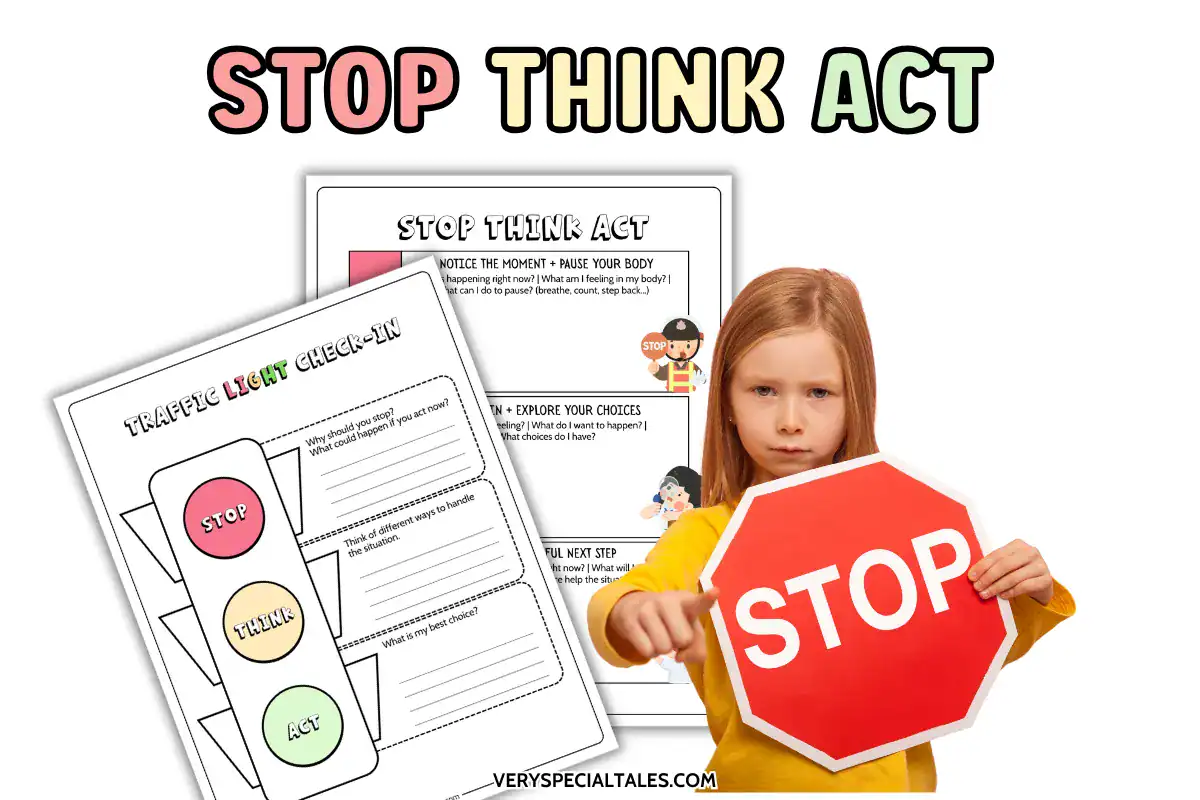

Stop-Think-Act is a simple decision-making strategy used by people of all ages to slow down, regulate emotions, and respond more intentionally. It breaks the “react first, think later” cycle by introducing a brief pause, a moment of reflection, and a more thoughtful action.
To make this strategy even easier to use with your child or students, I’ve included two free printables: a Kids Stop-Think-Act Worksheet and a Traffic Light Check-In Sheet. Both are designed to help children walk through the steps in a simple, visual way.
The steps are straightforward:
- STOP to pause before reacting.
- THINK about what’s happening and what your options are.
- ACT by choosing the response that will help the most.
You may also have seen this strategy written as Stop-Think-Do. It’s simply another name for the same three-step process. Different programs use different wording, but the steps and the purpose are identical.
Stop–Think–Act is an especially powerful tool for children.
The three steps are easy to remember, and the model lends itself beautifully to visual supports: traffic lights, posters, simple worksheets, and step-by-step prompts that guide kids through each part of the process.
How Stop-Think-Do Can Help Your Child
Stop-Think-Act creates a pause between a feeling and an action. It helps kids slow down, think clearly, and choose a response that actually works for them.
This approach can make a real difference in areas such as managing emotions and social interactions, problem-solving, and executive-functioning support:
- Managing big emotions such as anger and frustration.
The pause created by Stop-Think-Act gives children space to recognise strong feelings, interrupt automatic reactions, and choose a calmer, more helpful response. - Navigating social situations.
In moments of conflict or disagreement, stopping and thinking helps kids communicate better, listen to others, and choose actions that resolve, rather than escalate, the situation. - Improving problem-solving skills.
The Think step encourages children to consider different options, outcomes, and the kind of result they want, which strengthens their decision-making. - Building self-control.
Stop-Think-Act teaches kids that they don’t have to follow their first impulse. That tiny pause is what helps them make safer, kinder, or more appropriate choices. - Staying focused on tasks.
Stop-Think-Act can also support executive-functioning skills, helping kids slow down before rushing through work or acting without planning.
The Three Steps of Stop-Think-Act
Stop-Think-Act works because each step guides children through a simple self-regulation process.
STOP.
A quick pause that helps children interrupt an automatic reaction.
Even one deep breath or counting to three is enough to create space.
THINK.
The child checks in with themselves and considers their options.
They name the feeling, look at what’s happening, and decide what choice will help.
ACT.
They follow through on the option they chose.
The goal is to pick an action that improves the situation, not makes it bigger.
How to Teach Stop-Think-Act to Kids
Start by explaining the three steps and showing them how you use the strategy in everyday situations.
The more children practise Stop-Think-Act during easy moments, the more naturally they’ll use it when emotions are running high.

10 Stop-Think-Act Activities for Kids
The following activities allow children to practice different parts of the Stop-Think-Act strategy. Some activities work through all three steps, while others focus more deeply on one element, such as pausing before reacting or thinking through choices.
1. Traffic Light Check-In
The traffic light is one of the most popular ways to practise Stop–Think–Act, and there are many variations you can use.
Kids can:
- Use a worksheet with a red–yellow–green light ( 🎁 included in your free download)
- Imagine the traffic light in their head when they need to pause
- Hold up a small traffic-light card
- Play Red Light, Green Light as an impulse-control game to practise stopping and starting their bodies with control
For Stop–Think–Act:
- Green = ACT
- Red = STOP
- Yellow = THINK
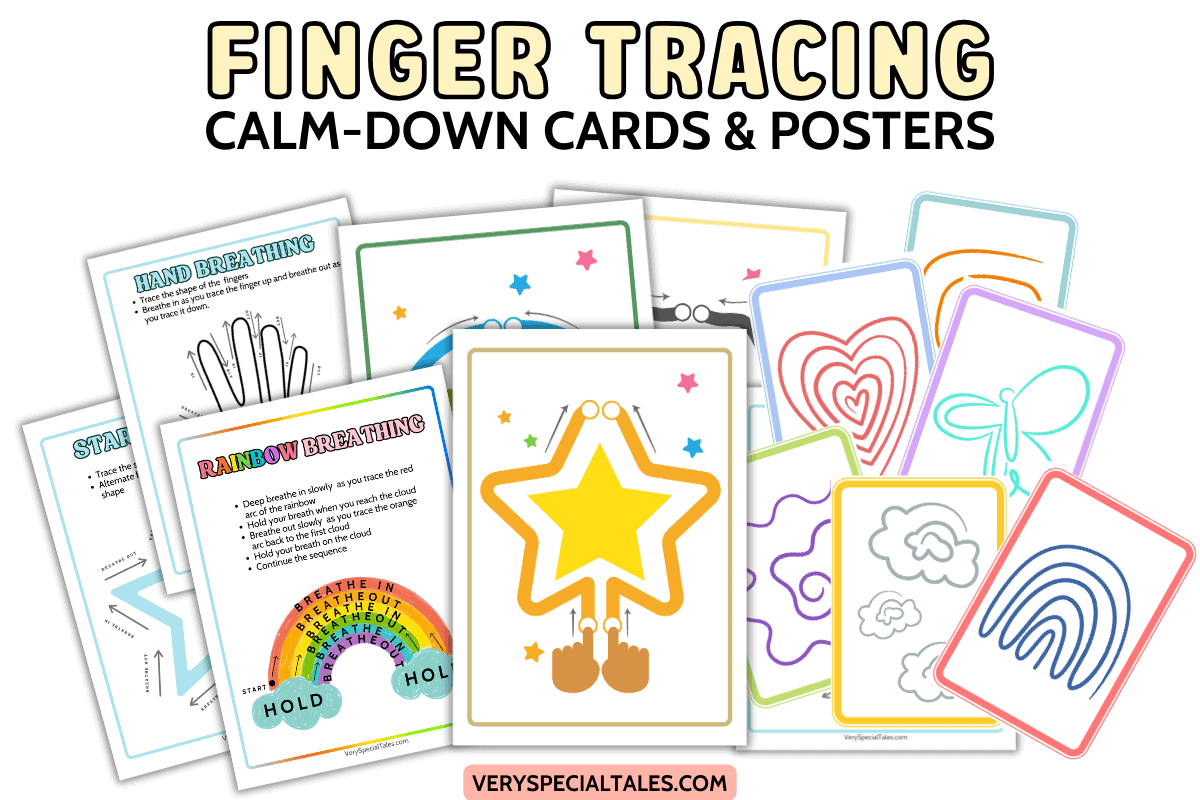
2. Stop Sign Breathing
This activity focuses on the STOP step.
Children trace the shape of a stop sign with their finger, taking a slow breath on each side.
The movement slows down their body and reminds them that the first part of Stop–Think–Act is simply to pause.
Linking the STOP step with breathing helps kids calm themselves before they start thinking about choices.
3. Choice Map
A Choice Map guides children through the THINK and ACT steps. After a small challenge, they map out:
- What happened
- How they felt
- What choices they had
- What action they ended up taking
This helps children understand that there is more than one possible response and that thinking before acting leads to better outcomes.
4. If–Then Planner
This activity helps children prepare the ACT step ahead of time.
We often make impulsive decisions when we feel stressed, rushed, or under pressure.
If–Then planning works because the decision is made in advance, when the child is calm and thinking clearly, rather than in the middle of a difficult moment.
Children complete sentences like, “If I feel frustrated, then I can take a short break,” or “If someone takes my turn, then I can ask for it back kindly.”
Related resource: To go deeper into this strategy, explore free if-then worksheets and examples, and help kids and teens create their own plans.
5. Stop Think Act Worksheet (included in the free download)
A basic Stop Think Act worksheet helps children walk through the three steps in a structured way. They identify what is happening, what they are feeling, what choices they have, and which action they will take.
6. Three-Step Comic Strip
A simple comic strip turns Stop–Think–Act into a visual story. Children draw three small panels:
- A moment when they needed to stop,
- What they thought about,
- The action they chose.
This activity helps kids break down the steps in a concrete way and see how each part leads to a better outcome.
7. Scenario Cards
Use short, everyday situations such as “Someone grabs your pencil” or “The game gets too loud.” For each scenario, ask the child:
- What would you do to STOP?
- What could you THINK about?
- What ACTION would help?
Practising with pretend situations helps children learn the steps before they’re overwhelmed by real emotions.
8. Better Ending Choices
Give a short story where a character faces a challenge but the ending is missing. Children create an ending using the Stop-Think-Act steps. This encourages them to think through the strategy from the character’s perspective and see how it changes the outcome.
9. Problem-Solver Prompts
These quick questions strengthen the THINK step. Ask the child:
- What do you want to happen?
- What are your choices?
- What might happen if you choose each one?
Prompts like these help kids slow down and consider the consequences before acting.
10. Stop-Think-Act Bookmark
A simple bookmark can be a great reminder of the three steps. Children colour and decorate the bookmark, then talk through what each step means and how they might use it during the day. Once finished, they place the bookmark somewhere helpful (inside a notebook, taped to a desk, or tucked into a pencil case) so they can see the steps whenever they need a quick reminder.
Other Impulse Control Resources
Workbooks:


Blog Posts:
Free Stop-Think-Act Worksheets for Kids
To make it easier to teach this strategy at home or in the classroom, you can download two free printables: a Kids Stop-Think-Act Worksheet and a Traffic Light Check-In Sheet. Both give children a simple, visual way to practise the three steps.

Please send the stop. think and act work sheet. Thanks.
work with children in community, your website is amazing. thanks
Thank you