Frustration tolerance activities for kids: Explore fun games and activities that help kids build resilience and manage frustration. At the end of this post, download three helpful frustration tolerance worksheets. Whether you’re working with your kids at home or creating lesson plans for middle or high school, these engaging activities provide valuable support for any frustrated kid.
Want a ready-to-use frustration tolerance activity pack? Get the Frustration Tolerance Workbook for Kids, a comprehensive printable resource including 100 pages of worksheets, coping strategies, role-play cards, and problem-solving activities. No prep needed, just print and go!
Table of Contents
- What is frustration tolerance
- Benefits of developing frustration tolerance skills
- Signs of low frustration tolerance in kids
- Tips to teach your kids or students how to manage frustration
- 32 Frustration tolerance games & activities
What is Frustration Tolerance
Frustration tolerance is the ability to stay calm and manage feelings of frustration when things don’t go your way or when facing challenges. It means not giving up or losing your temper when you encounter difficulties, and instead, finding ways to cope with the situation and keep trying.
Frustration intolerance beliefs can be categorized into four different dimensions:
- Emotional intolerance or difficulty dealing with emotional distress.
- Entitlement, described as intolerance to delayed gratification or unfairness.
- Discomfort intolerance, involving difficulty in tolerating challenges and everyday hassles.
- Achievement, involving difficulty tolerating frustration when goals are not met.
Benefits of Developing Frustration Tolerance Skills
Frustration is a normal emotion everyone sometimes feels, but learning how to handle it is an important skill that helps kids stay calm, keep trying, and solve problems when things don’t go as planned.
Teaching kids’ frustration tolerance skills:
- Improves Emotional Regulation: Helps kids manage emotions like anger or disappointment and stay calm under stress. Research exploring frustration tolerance found that students with higher frustration tolerance also exhibited self-reported and teacher-rated self-control.
- Encourages Problem-Solving: Builds persistence, allowing kids to tackle challenges and think critically for solutions.
- Builds Patience and Persistence: Teaches kids to stick with tasks despite difficulties or delays, which is crucial for long-term success.
- Enhances Academic Performance: Research suggests that frustration tolerance skills predict academic achievement, and it is still linked to it two years later.
- Strengthens Social Skills: Helps kids handle conflict and work with others without becoming upset.
- Correlates with Growth Mindset & Grit: Students with high frustration tolerance also demonstrate grit and a growth mindset.
- Positively Influences Mental Health & Wellbeing: Research has linked low frustration tolerance beliefs to stress, anxiety, and depression in young adolescents.
- Prepares for Real-Life Challenges: Equips kids to handle setbacks, delays, and criticism with resilience.
Signs of Low Frustration Tolerance in Kids
Recognizing signs of low frustration tolerance can help identify when kids struggle to manage challenges. Below are some examples of behaviors that may indicate difficulty coping with frustration.
- Frequent emotional outbursts when faced with challenges.
- Giving up easily on tasks that require effort or persistence.
- Difficulty waiting for their turn or handling delays.
- Expressing frustration verbally, such as saying, “I can’t do this” or “This is too hard.”
- Impatience or irritability when things don’t go their way immediately.
- Avoidance of difficult tasks or situations they perceive as challenging.
- Becoming overly upset or angry over minor inconveniences.
Tips to Help your Child/Student Improve their Frustration Tolerance
Before we dive into our fun tolerance activities, let’s review a few tips that can help your child or student improve their ability to handle frustration:
- Model calm behavior when you feel frustrated.
The best way to teach a new skill is by leading through example. Whenever you feel frustrated, share your feelings in a calm way; “Well, this feels quite annoying. I’m going to count to 10 and take another go.” - Let them know it is normal to feel frustrated- everybody does sometimes!
The key is to learn to handle it in a healthy way. - Understand your child’s frustration triggers.
If you understand what triggers your child’s frustration (e.g., academic challenges, waiting, loss of control, transitions, change, or unpredictability), you can anticipate challenging moments and guide your child in developing strategies to manage those situations more effectively. - Teach them healthy coping skills.
Teach your child effective ways to cope with frustration, such as breathing techniques, relaxation techniques, problem-solving, or dealing with conflict. - Allow them to feel frustrated.
It may be tempting to help them out of this negative emotion by doing the things that trigger their frustration. But they need to learn to cope with it, with guidance and support, developing the skills to manage their feelings and find solutions to challenges while gradually becoming more independent. - Teach them goal-setting skills.
Teach them to set SMART goals, break tasks into manageable chunks, plan and review their goals. - Praise their efforts, not just the results, to encourage perseverance.
- Teach them how to challenge their negative thoughts.
Help them turn those “I can’t…” into more helpful thoughts (“I can handle this,” “I can learn if I practice,” “I can get better at this,” - Teach them delay gratification.
Create situations where they need to wait for rewards or outcomes. This will strengthen their patience and ability to manage frustration when things don’t happen right away.

Frustration Tolerance Games and Activities for Kids
Engaging games and activities can help develop frustration management skills, strengthening a child’s ability to cope with and overcome challenges in various situations. I’ve organized the activities below as follows, hoping to cover different aspects of frustration tolerance:
- Emotional awareness and regulation activities.
- Mindset activities.
- Problem-solving activities.
- Patience-building activities.
- Physical activities.
Emotional Awareness & Self-Regulation
The activities in this section focus on building an understanding of emotions and self-regulation, key coping skills for managing a child’s frustration and helping them navigate big emotions more effectively.
- Deep Breathing Exercises.
Taking slow, deep breaths helps kids calm their bodies and minds, reducing the physical symptoms of frustration like tension and quickened heart rate. This practice teaches them to pause before reacting emotionally. - Drawing or Journaling Feelings.
Expressing emotions through art or writing helps kids process their feelings in a safe and constructive way. It can also give them insight into what triggers their frustration and how they might handle it better next time. - Practicing Counting to 10 Before Reacting.
This simple technique creates a short pause between feeling frustrated and reacting. It allows time for kids to calm down and think about how they want to respond, rather than acting impulsively. - Naming Emotions Out Loud When Feeling Overwhelmed.
Verbalizing emotions helps kids acknowledge and identify their feelings, which is the first step toward managing them. By naming emotions, they can start to take control of their responses rather than being controlled by their emotions.
Related resource: Emotions Flashcards (a great tool to expand emotional vocabulary). - Creating a “Calm Down” Corner with Favorite Calming Tools.
Set up a quiet space with calming tools like stress balls, fidget toys, or soft pillows. When feeling frustrated, kids can retreat to this space to relax and regroup before rejoining activities.
Related resource: Calm-Down Boxes & Corner Easy Guide - Using a Feelings Chart to Identify Emotions in Tough Situations.
A feelings chart with different facial expressions or color-coded emotions helps kids identify what they are feeling when they’re upset. It’s a visual tool to help them connect their emotions to appropriate actions.
Related resource: Mood Charts for Kids - Role-Playing How to Handle Frustration with a Friend or Parent.
In role-play, kids can practice managing frustration in different scenarios, like losing a game or waiting their turn. This helps them rehearse coping strategies in a safe environment, preparing them for real-life situations.
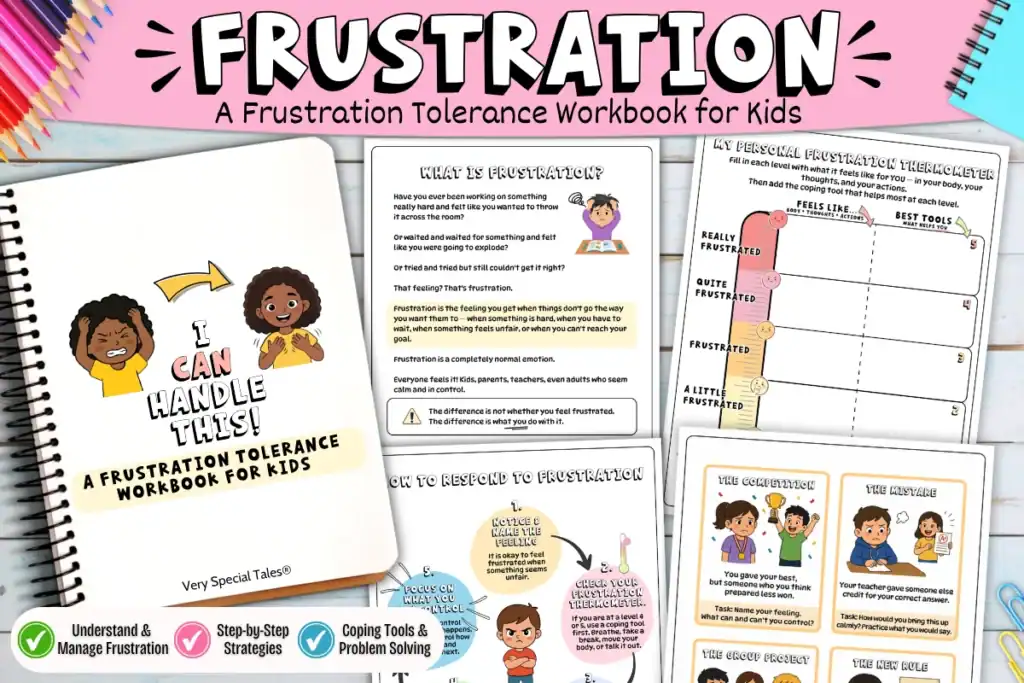
💭 The Frustration Tolerance Workbook for Kids includes real-life role-play cards with ready-made scenarios for practicing coping strategies in a safe, structured way.

- Frustration Thermometer Worksheet.
This tool can work as a frustration tolerance visual. Kids use a thermometer graphic to rate their frustration levels during different activities or scenarios. They can also identify coping strategies to cool down their emotions at each level. As an added challenge, you can encourage them to push themselves to handle higher levels of frustration gradually.
Related reading:
Growth Mindset & Tolerance Belief Activities
The following activities are designed to foster a growth mindset and challenge limiting beliefs, helping kids develop resilience and build tolerance for frustration in the face of setbacks.
- Keeping a growth mindset journal.
Keeping a journal where they write things that didn’t go right and how to improve next time. Encourages kids to reflect on setbacks and focus on lessons learned, fostering a mindset of continuous improvement rather than dwelling on failure. - Exploring the meaning of growth mindset through growth mindset statement cards.
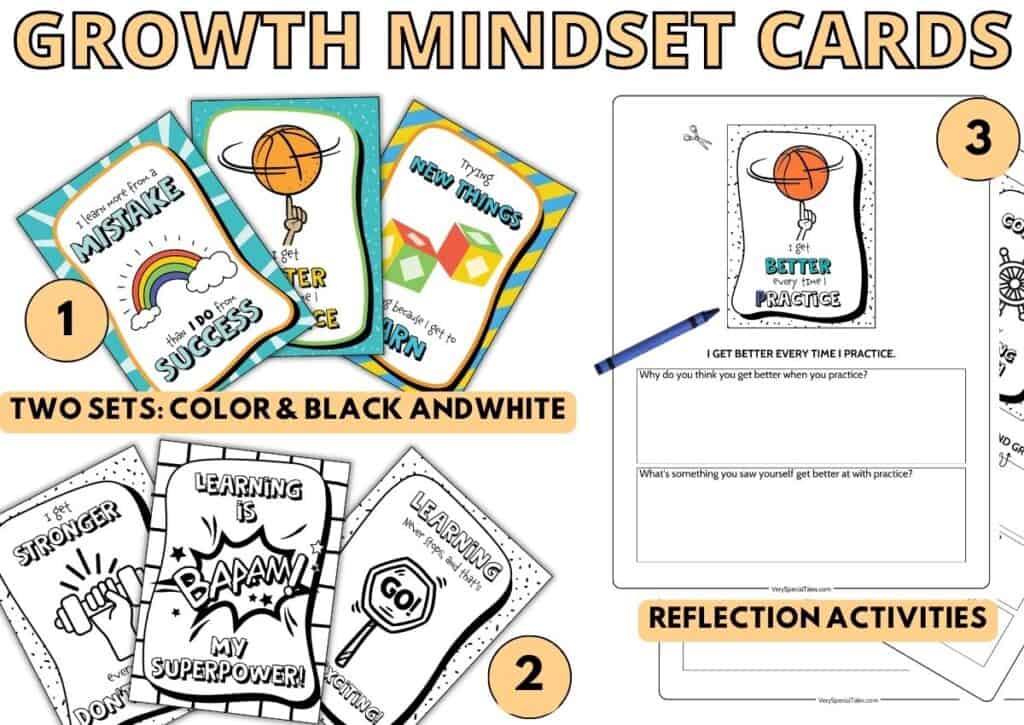
In this growth mindset activity set, each growth mindset card comes with a reflection worksheet where they can explore and get a deeper understanding of why that type of positive talk may help them. Positive self-talk helps kids replace negative, limiting thoughts with encouraging ones, reinforcing their belief in their ability to overcome challenges.
- Challenge “I Can’t”.
Help kids identify low tolerance beliefs and reframe them into more positive, empowering thoughts.- Identify the Belief: Ask the child to write down situations where they often say, “I can’t handle this” or “This is too hard.” For example, “I can’t handle waiting for my turn in a game.”
- Challenge the Belief: Next, have them answer questions like: Is this really true? Have I handled something like this before? What could I say to myself instead?
- Reframe the Belief: Help them rewrite the belief into something more manageable, like “Waiting can be hard, but I can distract myself or take deep breaths while I wait.”
Related reading: 15 Fun Growth Mindset Activities for Kids
Teaching Problem-Solving Skills to Improve Frustration Tolerance
The problem-solving activities in this section focus on guiding kids through the process of finding solutions in challenging situations, helping them break down problems and manage their frustration as they work toward a resolution.
- Brainstorming Multiple Solutions to a Tricky Problem.
Encourages creative thinking and flexibility by showing kids that there’s often more than one way to solve a problem, promoting adaptability and persistence.
For example, present kids with a math problem they initially struggle to solve. Ask them to brainstorm different strategies, like drawing it out, breaking it into smaller parts, or asking a peer for input. This encourages persistence and flexibility when faced with failure.

- “Frustration Triggers and Solutions” Worksheet.
In these worksheets, kids identify common situations that make them feel frustrated (e.g., losing a game, waiting in line) and brainstorm two or three possible strategies to handle each one.
The objective is to help them recognize their triggers and think ahead about how to manage their big feelings and reactions.
You can download this Frustration Triggers worksheet at the end of the post. - Completing a Puzzle That Requires Patience and Focus.
A puzzle is a great game for helping kids develop concentration and resilience. As they work through challenges step by step, they learn that perseverance leads to success. - Building a Challenging LEGO Set Without Rushing.
Teaches kids to approach tasks methodically, demonstrating the value of careful planning and patience in reaching complex goals. - Playing a Strategy Game like Chess or Checkers to Practice Thinking Ahead.
Improves critical thinking and foresight by encouraging kids to plan multiple steps ahead and adapt their strategies based on their opponent’s moves. - Designing and Testing Different Ways to Solve a STEM Challenge.
Promotes experimentation and resilience, showing kids that trial and error is a natural part of solving complex problems and that failure is an opportunity to learn.
For example, give kids materials like straws, tape, and paper, and challenge them to build a bridge or a tall tower that can hold a small object. After testing their first design, encourage them to redesign and improve based on what didn’t work, promoting resilience and learning through trial and error. - Group Negotiation Challenge.
Divide kids into two groups with the task of organizing a shared event, like a game or project, but each group wants to do something different. Have them brainstorm multiple possible solutions or compromises that everyone can agree on.
This activity teaches them to manage frustration through negotiation and focusing on solutions instead of getting stuck on disagreements. A group project also requires collaboration and compromise, and - Playing a Cooperative Board Game Where Players Must Work Together to Win.
In cooperative games, frustration can arise when strategies don’t work, or others have different ideas. This builds tolerance by teaching kids to collaborate, communicate, and handle challenges as a team. - “Step-by-Step Problem Solving” Worksheets
Whenever a kid is facing a situation that frustrates them, you can help them navigate the problem using a problem-solving worksheet to support their thought process (included in your download at the end of the post)

Related Reading:
Patience-Building Games & Activities
The patience-building games and activities in this section focus on helping kids develop the ability to wait and stay engaged during a frustrating situation, building their capacity to handle delays and challenges with greater tolerance.
- Waiting for a Timed Reward, Like a Treat After a 10-Minute Break.
Helps kids practice delayed gratification and cope with the frustration of waiting, building patience and tolerance in situations where they don’t get immediate results. - Completing a Long Maze or Dot-to-Dot Activity That Requires Focus.
Encourages persistence and focus as kids work through a challenging task. The potential frustration of making mistakes or taking time teaches them to keep going without giving up. - Participating in a Slow, Step-by-Step Art Project Like Painting by Numbers.
This activity requires careful attention and patience, helping kids deal with the frustration of working slowly to complete a detailed project over time. - Writing a Story Where the Character Overcomes an Obstacle with Patience.
Engages imagination while reinforcing the message that challenges can be overcome with persistence, patience, and thoughtful decision-making. - Create a social story about frustration tolerance.
A social story is an extremely valuable tool to help kids understand and manage challenging situations by offering them clear examples of appropriate behaviors and coping strategies, making it easier for them to navigate emotions like frustration and anxiety.
Create social stories to help your kids or students navigate specific challenging situations.- For example, if you are working with young children having a difficult time with sharing toys, you can write a story where the character learns to wait patiently and take turns, and how that experience is rewarded with positive outcomes like making friends or having more fun together.
- Visual Timers.
Time is an abstract concept, and many young kids may grow frustrated when they need to wait. Introduce a visual timer in your routines and activities. It will transform the abstract concept of time into something tangible that your child can take control of.
There are plenty of options out there: stopwatches, timers, liquid timers.
Some kids may enjoy watching the numbers move down on a digital stopwatch. Some others may find that too boring and may prefer the visual effect of fine sand flowing down an hourglass, or the colorful oil in a liquid motion timer.
Related Reading: 15 Ideas to Teach Kids How to Wait Patiently
Physical Activities to Build Frustration Tolerance
The physical activities in this section aim to help a frustrated child by engaging in movement and mindfulness.
- Practicing Yoga to Manage Frustration.
Yoga encourages focus and relaxation, helping kids manage frustration by teaching them to calm their bodies and minds when they encounter difficult or stressful situations. - Going on a Nature Walk to Develop Patience.
Observing nature encourages kids to slow down and focus on the present moment. The experience of waiting quietly to spot wildlife or notice small details helps them practice staying calm and patient when things take time. - Engaging in Mindful Movement, Like Tai Chi.
Mindful movement helps kids stay in the present moment, teaching them to accept slow progress and tolerate the frustration of working steadily without rushing. - Doing a “Balance Challenge” to Build Concentration.
Balancing requires focus and control, and frustration can arise when it’s difficult to maintain balance. Kids learn to tolerate that frustration while keeping calm and focused. - Jumping Rope to Release and Manage Frustration.
Jumping rope can help kids manage physical energy and frustration, especially when they must focus on counting jumps and maintaining rhythm after mistakes. - Completing an Obstacle Course That Requires Precision and Patience.
An obstacle course demands both patience and attention to detail. Kids experience frustration if they don’t complete it perfectly the first time and learn to keep trying and stay composed.
Related Reading: 20 Mindfulness Activities for Kids
Incorporating frustration tolerance activities into daily routines helps kids develop healthy ways to cope with both everyday frustrations and difficult situations.
I hope the activities above, along with the downloadable worksheets in the next section, will support your child’s or learner’s frustration tolerance journey.
One last tip: Remember that ensuring your child gets enough sleep is essential, as fatigue can make frustration harder to handle. A well-rested child is better equipped to manage new challenges and build resilience.
Frustration Tolerance Workbook for Kids (Printable Resource)
Want to go deeper? Check out the Frustration Tolerance Workbook for Kids in our shop. This 100-page printable workbook is designed for ages 5–11 and covers everything from understanding frustration and body warning signs to real-life coping strategies and problem-solving, going much further than the free worksheets below.
No prep, no planning stress. Just print and go.
Other Resources to Teach Kids About Anger & Calming Down
- Anger Workbook for Kids
- Anger Management Activities for Kids
- Anger Games for Kids
- Anger Triggers in Kids
- Anger Signs in Kids
- 100 Calming Strategies for Kids
- Anger Volcano Worksheets
- Anger Iceberg Worksheets for Kids
- Anger Iceberg Worksheets for Teens
Frustration Tolerance Worksheets (Digital Download)
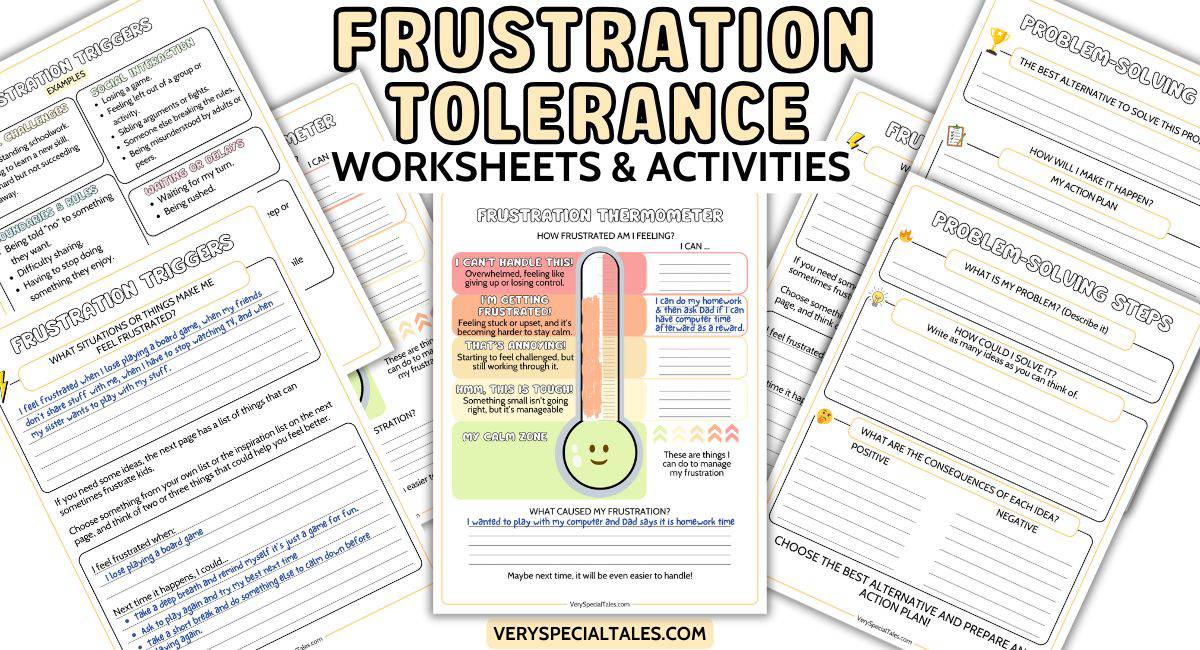
Your free Frustration Tolerance Printable PDF includes the following activities:
- Frustration Thermometer Worksheet
- Frustration Triggers Worksheet
- Problem-Solving Worksheet



thanks
Thank you
Free worksheets and great products
Thanks for freebies always looking for ideas thankyou
Thank you so much!!
Thanks