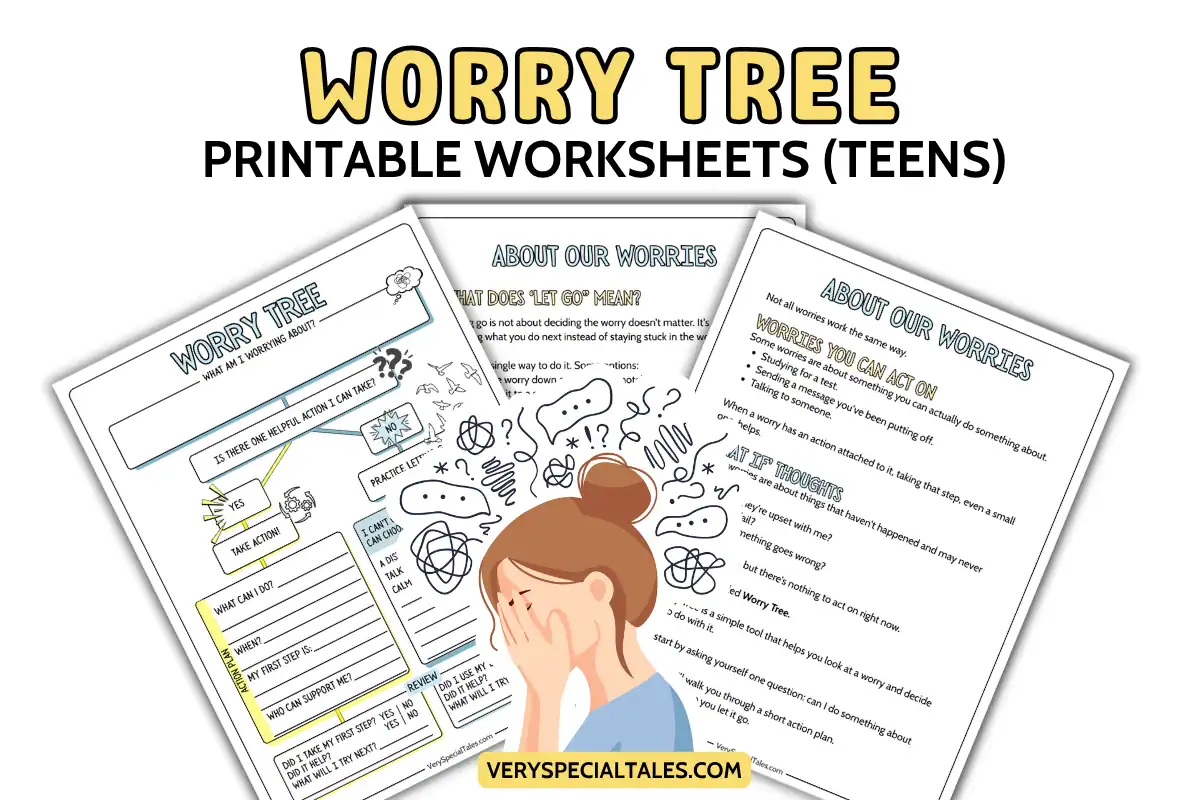
Explore how the Worry Tree helps teens manage anxiety by learning to sort their worries into what they can act on and what they need to let go. This post includes a free Worry Tree Worksheet for Teens to use at home, in school, or in a counseling session.
Teens worry. A lot.
About exams, friendships, what someone meant by that comment, what people think of them, what the future holds. Some of that is completely normal. But a lot of it is the kind of worry that just spins, never goes anywhere, and leaves them feeling stuck and exhausted.
Most teens don’t have a way to tell the difference between a worry worth their energy and one that isn’t. And without that skill, everything feels equally urgent.
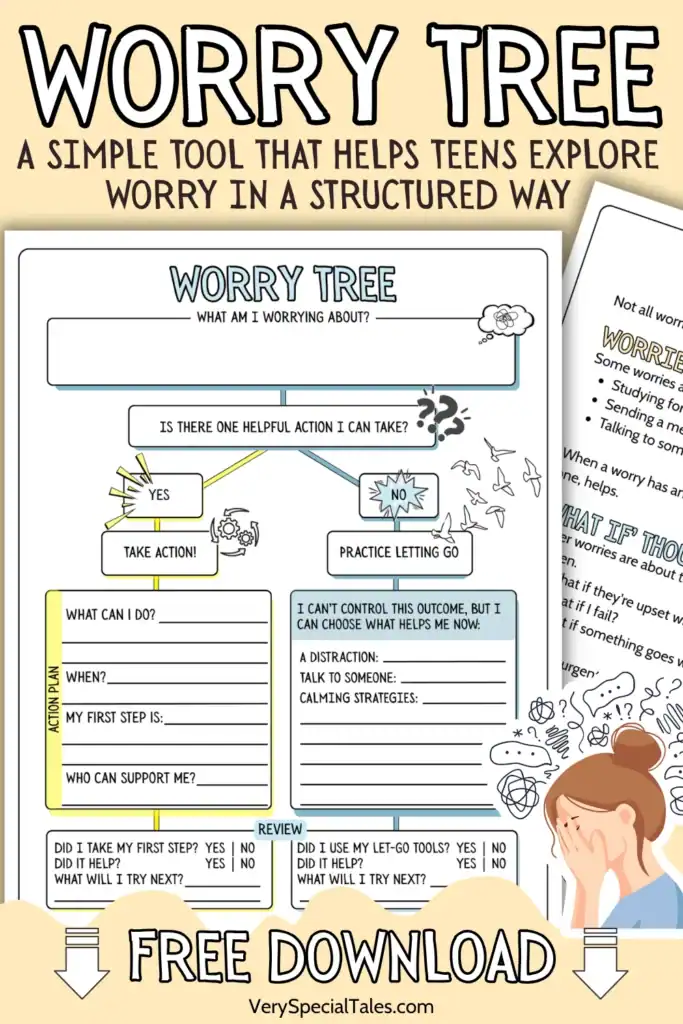
The Worry Tree is a simple, research-based technique that helps teens do exactly that. It doesn’t promise to stop worry. It gives teens a structured way to look at a worry, ask one key question, and then either take action or let it go.
At the end of this post, you’ll find a free Worry Tree Worksheet for Teens you can use at home, in school, or in a counseling session.
Working with younger children? Head over to the Worry Tree for Kids for a kid-friendly version of this activity, plus a free printable worksheet and completed example.
What Is a Worry Tree?
The Worry Tree is a decision-making tool developed by psychologists Gillian Butler and Tony Hope, first introduced in their book Managing Your Mind (Oxford University Press). It is grounded in Cognitive Behavioral Therapy (CBT), one of the most well-researched approaches to treating anxiety in young people.
The core idea is that not all worries are the same. Some are about current problems that we can actually do something about. Others are “what if?” thoughts about situations that haven’t happened and may never happen.
Knowing which type you are dealing with completely changes how you respond to it.
Why Identifying “What If” Thoughts Matters
91.4% of our worry predictions do not come true.
And the most common percentage of untrue worries per person is 100%.
(2020 Penn State University Study tracking worries for 30 days)
This is something worth sharing with your young person.
For a teenager who is absolutely convinced that the worst-case scenario is about to happen, that number can be genuinely eye-opening.
Note: the 91.4% figure comes from a study of adults with diagnosed generalized anxiety disorder, so it may not apply in exactly the same way to all teens. But the general principle, that our worry predictions are far less accurate than they feel, is well supported.
How the Worry Tree Works
The process follows a simple path.
Step 1: Notice the worry.
Name it. What exactly am I worrying about? Getting it out of your head and into words is already a useful step.
Step 2: Ask the key question.
Is this a current problem I can do something about right now? Or is it a hypothetical situation, a “what if” that hasn’t happened yet?
That’s the whole framework. The power isn’t in the steps themselves. It’s in building the habit of pausing before the spiral takes over.
Why The Worry Tree Works Well for Teens
Adolescence brings a particular kind of worry. Teens have developed the cognitive ability to think about the future, imagine consequences, and consider how others see them. But the emotional regulation skills to manage all of that often aren’t fully in place yet.
Research shows that “the comprehension that thoughts are uncontrollable crystallizes in adolescence” and that this developmental shift coincides with increased vulnerability to anxiety. In other words, the ability to worry in sophisticated ways arrives before the ability to manage it.
Tools like the Worry Tree help bridge that gap in a way that feels respectful rather than dismissive. It doesn’t tell teens their worries aren’t real. It takes the worry seriously, then helps them figure out what to actually do with it.
How to Introduce the Worry Tree to a Teen
A few things that make a real difference:
Keep the pressure low. Present it as something to try, not a skill they need to get right. The first time through, work through it together using a real worry rather than a made-up example.
Use something current. Ask what’s been on their mind and walk through the steps together. Teens may share different things depending on who they’re with, and that’s fine. The goal here isn’t the specific worry but learning how to use the tool so they can eventually do it independently.
Let them lead. Once they’ve identified the type of worry, let them decide what comes next. What do they think would help? What step feels manageable?
Follow up later. One of the most powerful things you can do is come back to it. Did the thing they were worried about happen? This kind of quiet tracking builds awareness over time in a way that a single conversation can’t.
Other Worry and Anxiety Resources for Teens
If your teen is working on managing worry and anxiety, these printable resources go a step further. The No Worries Journal offers a deeper dive into understanding and coping with anxiety, and Thinking Traps explores the unhelpful thought patterns that often sit behind “what if” thinking.


Other Articles You Might Find Helpful
- 43 Anxiety Activities for Kids
- Things I Can Control (Worksheets)
- Unhelpful Thinking Styles
- Thoughts-Feelings–Behaviors Worksheet
- Social Battery Worksheet for Teens
- 50 Best Stress-Relief Games and Activities for Students
- Coping with Test Anxiety (Strategies + Worksheets)
Download the Worry Tree Worksheet for Teens
The free Worry Tree Worksheet for Teens is a three-page tool that teens can use independently or with adult support.
The first two pages cover two key concepts: the difference between worries you can act on and “what if” thoughts, and what it actually means to let a worry go. It gives teens the language they need before they start.
The last page is the Worry Tree itself. Teens start by naming their worry, then ask one question: is there a helpful action I can take? From there, the worksheet guides them through either a short action plan or a set of letting-go strategies, and ends with a review section to reflect on what helped.
It can be used at home, in a school counseling session, or as part of a broader anxiety toolkit.