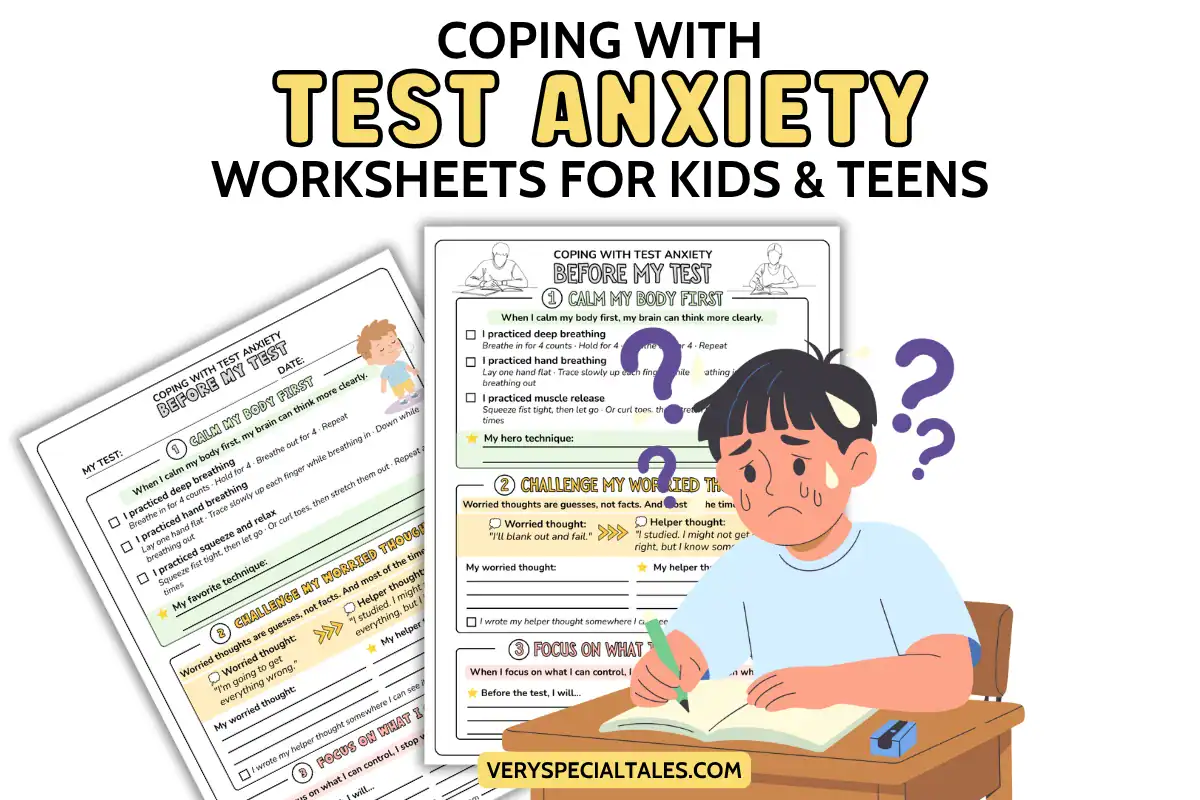
Test anxiety is one of the most common anxiety triggers at school, and it affects kids and teens across all ages and ability levels. This post covers three evidence-based coping strategies your child can use before and during a test, plus a free “Before My Test” Worksheet to help them put those strategies into practice when it counts.
Looking for more ways to help your child or teen manage anxiety? The No Worries Journal for Kids (ages 5 to 11) and the No Worries Journal for Teens go deeper on everything in this post, with guided worksheets and strategies for building lasting coping skills. No prep needed, just print and go!
Your child studied. They knew the material the night before. But the moment the test is placed in front of them, their mind goes blank. Their heart races. Their hands are clammy.
That’s not a sign they didn’t prepare. That’s test anxiety.
What Is Test Anxiety?
Test anxiety is a type of performance anxiety that occurs before or during exams. It’s not simply nerves. It’s a stress response that interferes with how a child thinks and performs, regardless of how well they actually know the material.
A child can study hard, know the content, and still freeze during an exam because of anxiety, not because of a lack of knowledge or effort. That distinction matters, because the solution isn’t always “study more.”
Two out of three school-going children experience moderate to high levels of test anxiety
(Multicenter Study on Test Anxiety in Children and Adolescents, PubMed)
Research points to three main approaches for managing test anxiety:
- Calming the body.
- Changing unhelpful thinking patterns
- Building practical skills like study habits and test-taking
This post focuses on the first two. Preparation matters too. A child who feels ready going into a test will almost always feel less anxious. But we’ll cover effective study strategies in a separate post. For now, we’re focusing on the strategies that help when the anxiety is already there.
3 Coping Strategies for Test Anxiety
Research following teens during exam season found that these coping strategies produce large reductions in test anxiety and also lower general anxiety levels. (Source: Anxiety, Stress, & Coping)
The order below is intentional. Start with the body. Then work on the thinking.
1. Calm Your Body First
When anxiety kicks in, the body’s fight-or-flight response activates. Heart rate increases, breathing speeds up, and muscles tense. The thinking part of the brain becomes harder to access — which is exactly why cognitive strategies don’t land well when a child is already in panic mode.
Calming the body first isn’t just a comfort measure. Deep breathing directly activates the parasympathetic nervous system, which signals to the brain that the threat has passed and makes clear thinking possible again.
Deep breathing: Breathe in for 4 counts, hold for 4, breathe out for 4. Repeat until the heart rate slows. For younger kids, hand breathing works well — lay one hand flat, and use the other to trace slowly up each finger while breathing in, and down while breathing out.
Muscle release: Make a tight fist as if squeezing a lemon, hold for a few seconds, then let go. Or curl the toes as if picking up a marble from the floor, hold, then stretch them out. Both can be done discreetly at a desk during a test — no one around them needs to know.
The goal isn’t to feel completely calm. It’s to bring the body back to a level where the next two strategies are actually usable.

2. Challenge the Anxious Thought
Test anxiety almost always comes packaged with specific thoughts. And those thoughts are almost always predictions about the future, not facts: “I’m going to fail.” “I’ll blank out on everything.” “Everyone else is better prepared than me.” “If I don’t do well, everything is ruined.”
They feel true. They’re not evidence.
Cognitive restructuring works by putting those predictions to a simple evidence test. Most of the time, the evidence doesn’t support them. And once a thought is challenged and found to be inaccurate, it loses much of its grip on how the child feels.
Step 1: Catch the thought.
What is the brain actually saying? Name it specifically. “I’m going to blank out and fail this test.”
Step 2: Look at the evidence.
Is this definitely true? What’s the evidence for it? What’s against it? “I’ve studied. I’ve done okay on tests before. I know some of this material, even if I don’t know all of it.”
💡 The evidence step can feel discouraging if past tests haven’t gone well. In that case, skip it and go straight to Step 3: “I’m going to try my best with what I know” is honest and calming no matter what.
Step 3: Find a more accurate thought.
Not forced positivity but a more honest version. “I might not get everything right, but I prepared and I’ll do my best with what I know.”
Once your child has found that more balanced thought, it becomes their phrase to repeat before the test, during a hard question, or whenever anxiety spikes again. For younger kids, calling these “helper thoughts” versus “worried thoughts” makes the process more concrete and easier to engage with.
💭 Both the No Worries Journal for Kids and the No Worries Journal for Teens include guided worksheets for practicing this skill, with templates to help children and teens catch and reframe anxious thoughts on their own.
3. Focus on What You Can Control
A lot of what makes test anxiety so draining is that kids and teens spend mental energy on things they have no influence over: what questions the teacher will ask, what grade they’ll get, what classmates will score. Anxiety feeds on uncertainty and on feeling powerless.
When attention shifts to what is actually controllable, the brain moves out of threat-appraisal mode and into problem-solving mode. That shift matters because problem-solving leads somewhere. Worry doesn’t.
Before the test: Study in steady sessions in the days before (not cramming the night before). Sleep. Eat breakfast. Pack the bag the night before. Arrive without rushing. These are all controllable.
During the test: Start with questions they know. Skip hard questions and come back to them. Use breathing if anxiety spikes. Repeat the helper thought. These are controllable too.
Most kids and teens are surprised by how long that list actually gets once they start writing it down.
More Anxiety Resources for Kids and Teens
If your child needs more than one worksheet to work through their anxiety, the No Worries Journal goes deeper. Both the kids’ and teens’ editions cover the same strategies introduced here, plus more tools for understanding triggers, building a personal coping toolkit, and working through specific anxiety situations — including test anxiety.
👉 The No Worries Journal for Kids uses five engaging stories to introduce practical coping tools and worksheets for children ages 5 to 11.
👉 The No Worries Journal for Teens guides teenagers through understanding their anxiety, recognizing triggers, and building strategies they can actually use.


Other Articles You Might Find Helpful
- 43 Anxiety Activities for Kids
- Things I Can Control (Worksheets)
- Unhelpful Thinking Styles
- Thoughts-Feelings–Behaviors Worksheet
- Worry Tree for Teens (Worksheet)
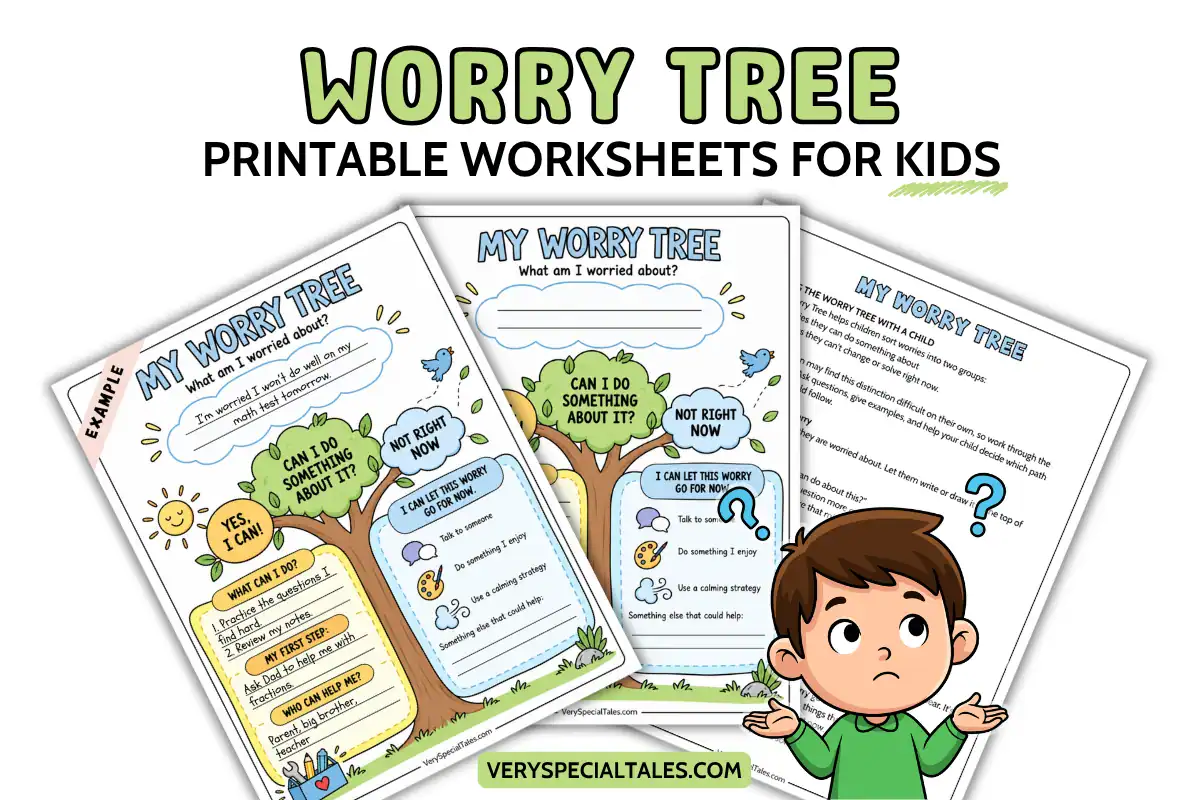
- Worry Tree for Kids (Worksheet)
- 50 Best Stress-Relief Games and Activities for Students
Download the Free “Before My Test” Worksheet
Do you have kids or students who struggle with test anxiety? This free one-page worksheet comes in two versions (one for kids, one for teens) and is the perfect support to learn and practice the three strategies in this post. A helpful checklist to work through before the actual exam, it walks them through calming their body, flipping their worried thought, and building a short plan for what they can control. Simple and practical enough to actually help.