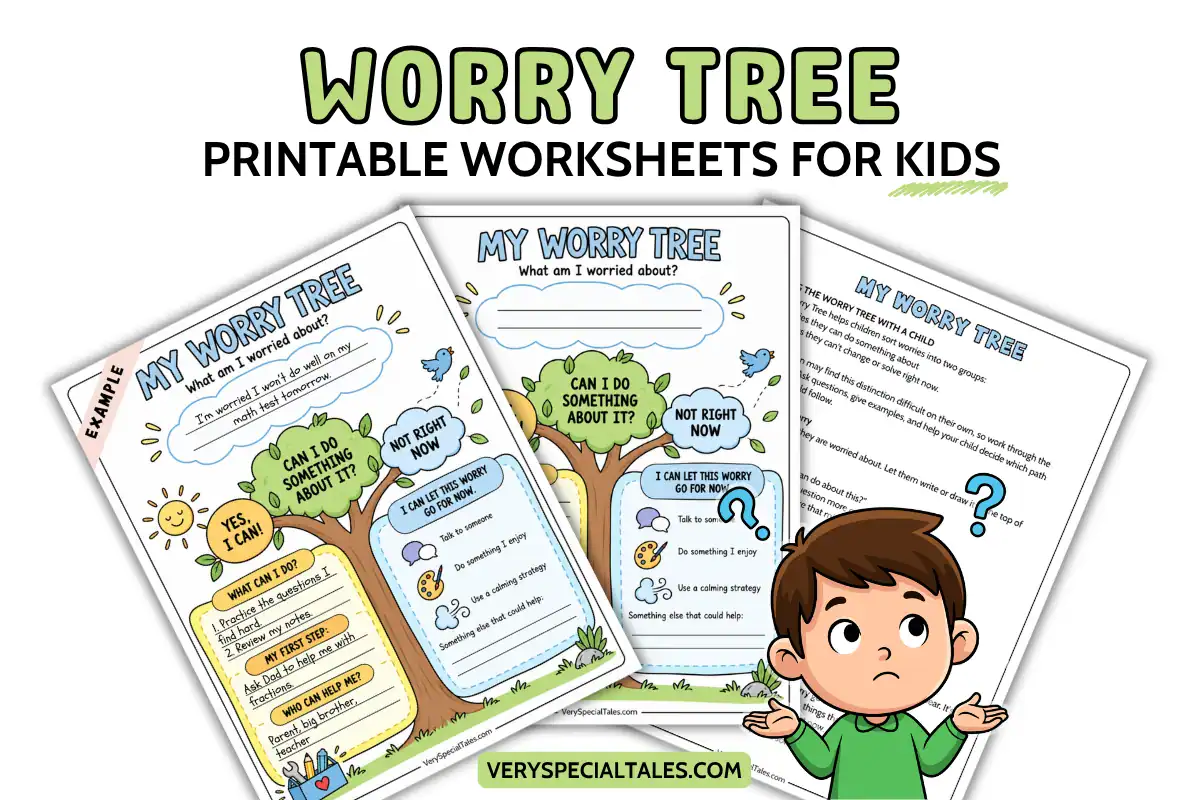
Explore how the Worry Tree helps kids work through worries by deciding what they can do about them and what can help when there isn’t a solution right now. This post includes a free Worry Tree Worksheet for Kids, plus a completed example, to use at home, in the classroom, or during a counseling session.
Kids worry too.
About the dark. About getting a question wrong in class. About whether their best friend is mad at them. About the dog, the storm outside, the first day back at school.
Often, young kids can’t yet tell the difference between a worry that needs a plan and a worry that just needs to be let go. To them, every worry feels equally big and equally now.
The Worry Tree gives kids a simple, visual way to sort a worry so they know what to do with it next.
At the end of this post, you’ll find a free Worry Tree Worksheet for Kids you can use at home, in the classroom, or during a counseling session.
Working with teens? Head over to the Worry Tree for Teens for an age-appropriate version of this activity and a free printable worksheet.
What Is a Worry Tree?
The Worry Tree is a decision-making tool grounded in Cognitive Behavioral Therapy (CBT). It was created by psychologists Gillian Butler and Tony Hope, and first introduced in their book Managing Your Mind (Oxford University Press).
At its core, the Worry Tree asks one simple question: Is there something I can do about this worry?
Sometimes the answer is yes. A child worried about a test can practice. A child worried about something that happened with a friend may be able to talk to them.
Other times, there is nothing useful to do right now. The child may be worrying about something they can’t control, or about something that might never happen. That’s when the focus shifts from solving the worry to finding something that helps them move on from it for now.
91.4% of worry predictions never come true.
The most common result? 100% of a person’s worries were unfounded that day.
(2020 Penn State University study.)
How to Use the Worry Tree with Kids
Here’s how to guide a child through the Worry Tree, step by step.
Step 1: Say the worry out loud.
Ask, “What are you worried about?” Help your child put the worry into words. They can write it at the top of the worksheet, or you can write it for them.
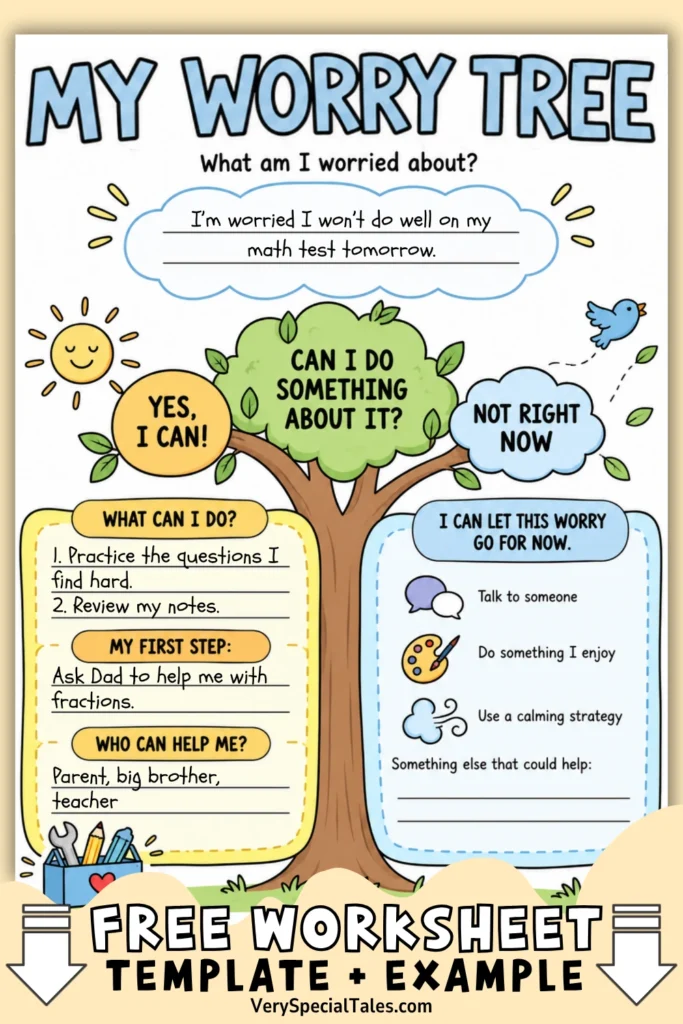
Step 2: Ask, “Can I do something about it?”
Help your child think about whether there is a helpful step they can take. A worry doesn’t have to be about something happening right now for the answer to be yes. A child worried about tomorrow’s test, for example, can still study or ask for help.
The question to focus on is simple: Is there something I can do that might help?
- If YES: Make a small plan:
Suppose your child says:
“I’m worried I won’t do well on my math test tomorrow.”
There is something they can do, so follow the YES, I CAN! side of the tree:- What can I do? Practice the questions I find hard.
- My first step: Review fractions after dinner.
- Who can help me? Parent, big brother, or teacher.
The first step doesn’t need to solve everything. It just needs to give the child something useful they can do next.
- If NOT RIGHT NOW: Choose what can help
Kids can’t simply decide to stop thinking about something. They need something to do instead: a breathing exercise, a hug, naming three things they can see in the room. The goal isn’t to argue the worry away. It’s to give their attention somewhere else to land.
Some helpful tips:
- Practice on something small first.
Don’t start with their biggest fear. Try it on something low-stakes, like being picked last for a game, so the process feels familiar before it’s needed for something that matters more. - What can I say instead of “Don’t worry”?
Be careful not to dismiss a worry just because it seems small to you.
Rather than: “Don’t worry about it. That’s not going to happen.”
try:
“We don’t know for sure. Let’s look at what we know right now.”
Or:
“Is there anything we can do about it? If there is, let’s figure out one small step.” - Keep track of worries, if helpful.
Save some completed Worry Trees and use them when you want to explore what happened to past “what if” worries. Looking back at their own experiences can help children see that worrying about something doesn’t mean it will happen. You don’t need to revisit every worry. A few clear examples can make this easier to understand.
Note for Parents and Educators
The Worry Tree asks children to think about a worry in two different ways: Is there something I can do to help with the problem? And if there isn’t, what can I do to help myself feel better? This kind of flexible thinking can be difficult for younger children.
According to psychologist Jean Piaget, children under about 11 think best about things they can see and experience directly. Hypothetical “what if” situations are much harder, especially for children under 7.
That’s why it’s best to use the Worry Tree together. Point to each branch, talk through real examples, and help your child decide whether there is a helpful step they can take. If there isn’t, help them choose what they can do to feel calmer and move on for now.
Other Worry and Anxiety Resources for Kids
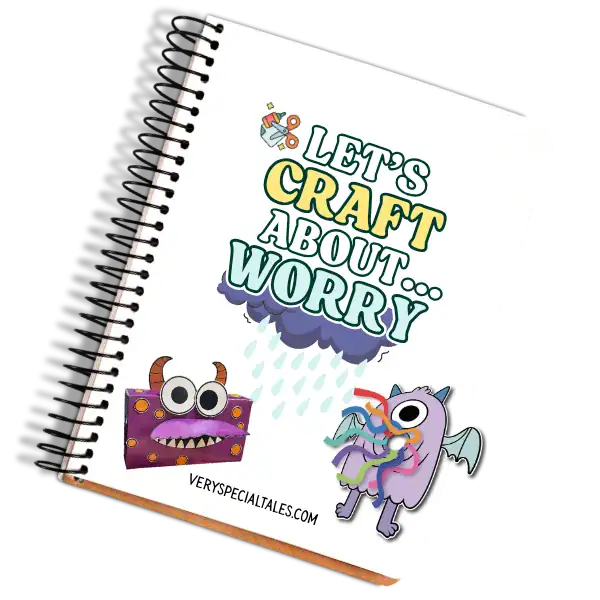
If your child is working on managing worry and anxiety, these printable resources build on what’s covered here. The No Worries Journal uses five relatable stories and built-in worksheets to teach kids a full set of tools for handling anxious moments; and Let’s Craft About Worry turns coping skills into hands-on paper crafts, perfect for kids who learn best by cutting, coloring, and building.

Other Articles You Might Find Helpful
- 43 Anxiety Activities for Kids
- Things I Can Control (Worksheets)
- Unhelpful Thinking Styles
- Thoughts-Feelings–Behaviors Worksheet
- 50 Best Stress-Relief Games and Activities for Students
- Coping with Test Anxiety (Strategies + Worksheets)
Download the Worry Tree Worksheet for Kids
Download the free printable Worry Tree for Kids and use it to help your child work through a worry: Can I do something about it? If not, what can I do to help myself feel better?
Use the worksheet together to talk through the worry, find a helpful next step, or choose a strategy to let the worry go for now.