

Friendship Activities for Kids: In this post, you will find 43 fun activities to use at home or in your friendship lesson plan. You can also download a free printable friendship activity PDF 🎁.
Friendship is one of life’s most valuable gifts. Having good friends and being one is one of the most rewarding parts of being human.
Friendship is also one of our most important needs.
Why Having Friends is Important
Friends are people who know and like each other. Friends spend time together, talk, play, and help each other. True friends make you feel good and trustworthy.
According to Maslow’s hierarchy of needs, aside from food, water, and shelter, having a group of people who love and support you is extremely important.
There are so many benefits that support the importance of friendship, it’s hard to list them all!
Friendship can:
- Increase your feeling of belonging. A tight circle of friends can become a person’s tribe or community, providing them with a place to belong.
- Boost happiness. Close friends have the ability to bring joy in any context.
- Reduce stress. Knowing you have a loyal friend can help calm you, and it also provides a non-judgmental sounding board to help brainstorm ideas.
- Provide support through challenges. Whether a person is going through a divorce, a family loss, or a global pandemic, friends can offer support to each other in various ways.
In early childhood, establishing friendships is a crucial developmental milestone.
“Children who enjoy close friendships are more likely to experience higher levels of happiness, life satisfaction, and self-esteem and less likely to be lonely, depressed or victimized” (Holder, Mark & Coleman, Ben. (2015))
(Disclosure: We are a participant in the Amazon Services LLC Associates Program, an affiliate advertising program designed to provide a means for us to earn fees by linking to Amazon.com and affiliated sites. As an Amazon Associate, I earn from qualifying purchases. There may also be other affiliate links in this post. You can also read our Disclosure & Disclaimer policy here)
What Makes a Good Friend?
What are the qualities of a good friend?
There are so many bits and pieces that create the magic of friendship, it’s hard to say exactly what makes someone a good friend. We often turn to different friends for different things—someone to laugh with, someone to talk to, someone who just gets us.
Still, there are a few qualities that most of us look for in a friend, such as:
There are many ways to help kids understand how to be and have amazing friends. Here are a few of my favorite friendship activities…
Fun Friendship Activities for Kids

Let’s explore a list of friendship activities that will help kids navigate social situations and have fun with friends (most of them make great team-building activities too).
1. Write a Story Together
Organize the kids into small groups or pairs and ask them to work together on writing a story.
2. Make a Video!
Organize the kids in small groups and ask each of them to explain what being friends means to them. Make a video and share it with the class.
3. Friendship Picture Books
I believe children’s books are one of the best ways to teach younger children about values and emotions.
These are some examples of books about friendship :
- Kindness is Cooler, Mrs. Ruler Book
Written for children aged 5-10, this book helps guide the conversation with elementary school-age kids on the importance of being kind.
With thousands of positive reviews, this book is an excellent tool for encouraging friendship. - Teach your dragon to make friends.
A book about the importance of friendship and how to make new friends (up to 8 years old)
4. Ball Toss
This is a warm-up activity to help students explore the qualities of healthy relationships. Have the students stand up behind their desks or in a circle at the front of the room.
Toss the ball to someone in the group and ask them to call out a word that represents qualities of a healthy relationship, such as trust, support, kindness, or fun.
Ask that person to then toss the ball to someone else. Each time a new student catches the ball, ask them to share a new quality… and so on.
If you feel that your students may get stuck or run out of ideas, there is also a thumball version that includes conversation prompts on the ball. (Wherever your thumb is placed on the ball, that’s the question you need to answer.)
These are a couple of examples: elementary icebreakers and group starter thumball
5. Friendship Want Ad
Ask kids to create a fun friendship ad that describes all the qualities they love in a best friend.

This is a great way to reflect on what makes a good friend!
6. Friendship Spotlight Game
Let’s put some common behaviors under the friendship spotlight.
In our (free) friendship spotlight worksheet, you will find 15 different scenarios. Ask your kids or students to label those situations as:
- Unhealthy/bad signs in a friendship (red light)
- Warning signs (yellow light)
- Healthy/good signs (green light)
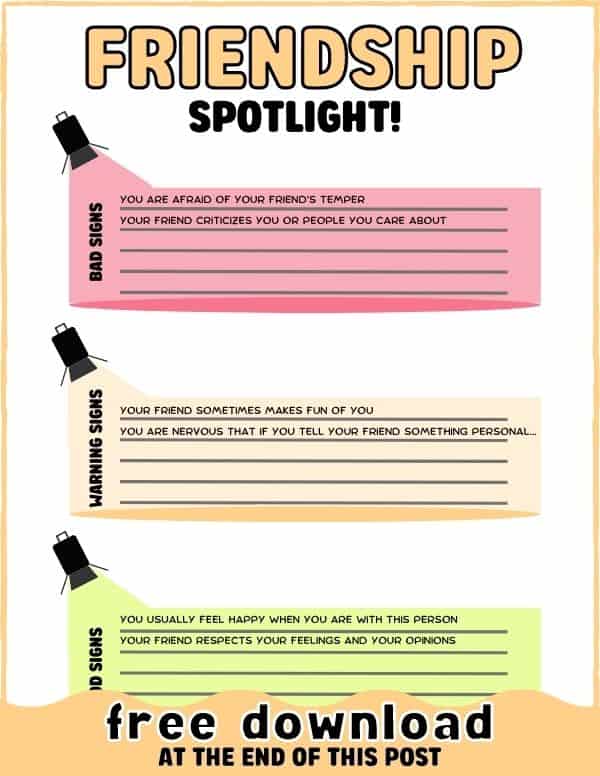
You can also create your own list of scenarios and use the blank page for the kids to have their say (red, yellow, or green)
Grab this free friendship worksheet at the end of the post 👍
7. Blindfold Obstacle Game
Create a safe obstacle course. Kids partner up so that one goes through the obstacle course blindfolded, and the other leads them by voice. This fun activity is not just a friendship game, but it also helps practice good listening skills.
8. Things We Have In Common
This friendship activity is great for breaking down barriers.
Kids are organized in small groups, ideally with a mix of kids that they aren’t already friends with. The group has to find a certain number of things that they all have in common.
Kids not only learn a lot about each other but also become aware of how many things they may have in common with kids from different social groups.
9. Face Time / Exploring Emotions
Have the kids cut out pictures from magazines and label what emotions the people are feeling.
Learning to identify other people’s emotions will help them become better friends.
10. Telephone Game
This is a classic game and a perfect activity for circle time.
One of the kids whispers a message to the next person sitting next to them. And the message continues circulating until it reaches the last kid in the circle. The final message often has nothing to do with the initial one.
How can we make the most of this game?
Let’s think about gossip. We have to be very careful with what we say because messages change as each person adds something new to them.
11. Create a Friendship Flower Garden
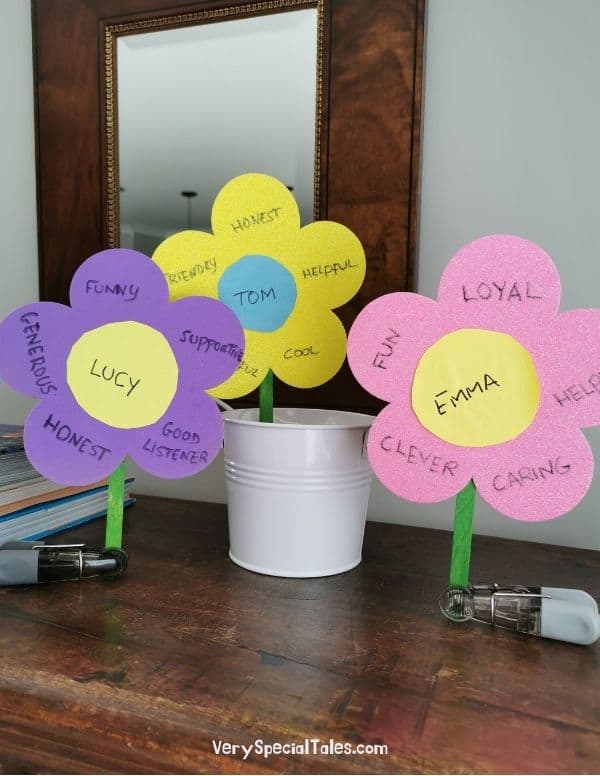
Ask your child or students to draw a flower with large petals (or use a coloring worksheet; there are many available online). Write a characteristic of a good friend onto each petal and color them.
After coloring in their flowers, the kids can hang them up to create a ‘friendship garden’. You can also glue them to a popsicle stick and “plant” a friendship garden.
Another option is to use flower foam shapes, as shown in the picture below. Write a child’s name in the middle of the flower, and then use the petals to write adjectives that describe why that person is a good friend.
12. A Recipe for Friendship
Another fun way to frame a conversation about social skills is to organize a “Recipe for Friendship” activity.
The characteristics of a good friend can form the ingredients. Then you may want to ask your students what a good friendship looks like and encourage them to use their descriptions in their recipe instructions.
13. Build a Tower
Teamwork activities are a great way for kids to develop their interpersonal and friendship skills.
In this case, we propose building a tower. There are several “build a tower” activity ideas that we could implement:
- the classic wooden blocks stack games
- suspend family game
- magnetic building tiles (I find this one works well with young children because the magnetic tiles help their tower’s stability)
- card tower-> with a twist: the tower of self-esteem
The first three options are great choices not just as a team activity, but they also help develop creative thinking, imagination, as well as fine motor skills and hand-eye coordination.
The last one (the tower of self-esteem) ticks the same boxes as the rest of the tower games, but it provides children with an opportunity to work on self-esteem, social skills, conversation skills, and emotional intelligence.
14. “Exploring Friendship” Workbook
Discover a set of engaging worksheets and activities designed to help kids:
- Explore the true meaning of friendship
- Identify the qualities we value in a friend and
- Learn how to resolve common friendship issues.
The kid version also includes three inspiring posters to reinforce these important lessons!
This Friendship Workbook for Kids is a great resource for anyone working with children to develop their social-emotional skills, whether at home, in the classroom, or in your professional practice. A teen version is also available to support older kids and teens as they navigate more complex friendships.


15. Friendship Bracelets
Friendship bracelets are usually handmade bracelets given to someone as a symbol of friendship.
There are plenty of friendship bracelet kits available on the market, like this one.
16. Friendship Word Search
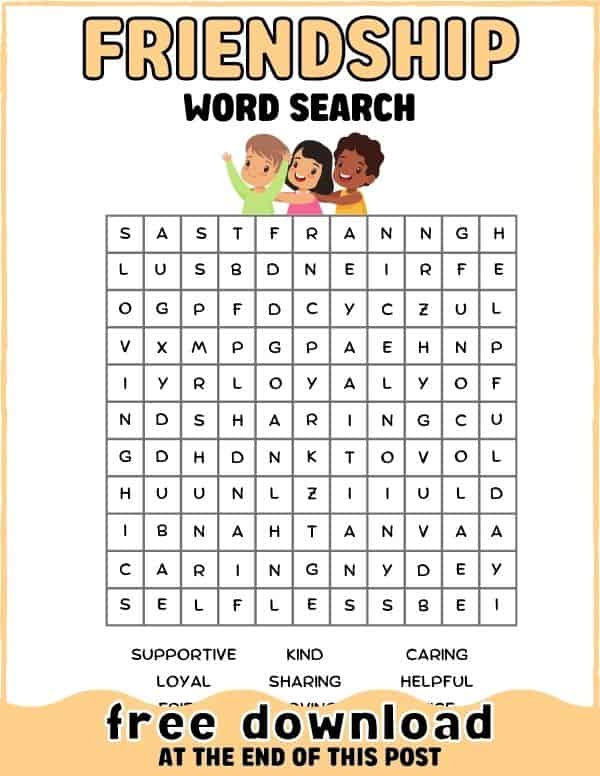
We love word games, so we had to include a friendship-themed word search in our activity list.
Take this opportunity to teach kids some common strategies:
- Go from right to left to see if you spot any word, and then continue with other directions (right-left, top-down, down-top, diagonal)
- Choose the first letter from a word and scan to see if you can find the word
Find all the hidden friendship words in this friendship word search. We have provided a list of the hidden words, but you can hide it for the older kids (free download at the end of this post – solution included)
17. Friendship Letter
Ask your kids or students to write a letter to a friend to say what they appreciate about them.
18. Act it out: Friendship Role Play
Acting out is a fun activity that will help kids reflect on appropriate interactions with others and how their actions affect others.
- Have two kids stand in front of the group or in the middle of the circle during circle time.
- Ask them to act out different scenarios that display good friendship or even bad friendship behaviors
- Take turns with different kids so that they all have a chance to practice their friendship skills
19. Friendship Yarn Circle
This friendship game is a great idea to help kids visualize how friendship interconnects us.
It’s a fun and simple activity for all ages and works well for large groups.
- Have everyone stand in a circle with the first person holding a ball of yarn.
- When a kid tosses the ball to someone else, they have to say something that they like about the catcher (every kid holds onto their yarn piece)
- It continues until all the kids have had a chance to toss the yarn and have been chosen.
In the end, you will have a beautiful visual display of how friendship connects everyone.
20. Play Friendship Board Games
Board games encourage turn-taking and cheering each other on.
Most board games will make great friendship activities, but if you are looking for a game that explores friendship skills specifically, this is a good option:
This game consists of six different boards, and one of them is about “What Makes a Good Friend”. This is a great game to encourage children’s conflict resolution, group work, and develop strong social skills.
21. Give them a Challenge
Sometimes, the best activity to help develop a friendship is to complete a challenge together.
Whether it’s building furniture from flatpacks, solving a riddle, or doing a puzzle together, there are plenty of ways to help kids develop friendships through problem-solving.
22. Kindness Challenge
This challenge is slightly different to the previous one.
Choose a month and set a Kindness Challenge so that kids are motivated to perform random acts of kindness.
In our post 101 Kindness Activities for Kids, you can explore fun activities for your kids or students and download a fun kindness challenge.
23. Friendship Rocks
Paint a gratitude rock and give it to someone special as a token of friendship.
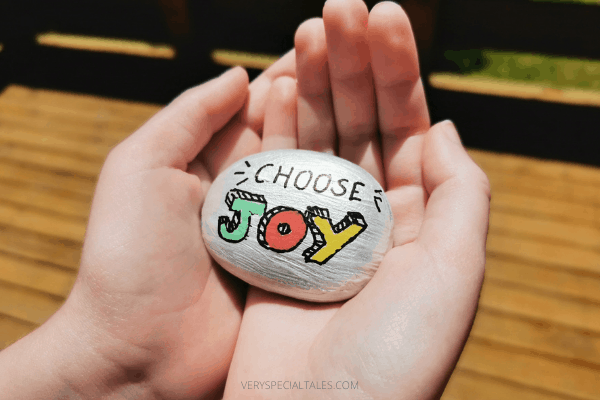
Related: How to prepare gratitude rocks (and 8 fun ideas on how to use them)
24. Friendship Scavenger Hunt
A scavenger hunt is another all-time favorite with kids (and adults!), so we just had to include it in our list.
Prepare a list of nice friendship qualities like:
- best smile
- awesome helper
- good listener
- great friend
- new friendship
Write down as many items as kids in your classroom. The rule is that names can’t be repeated in each item, so everybody gets a kind word.
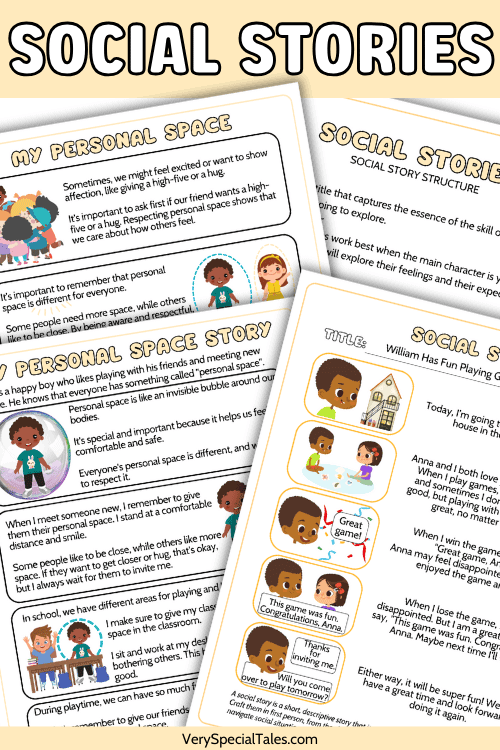
25. Create a Friendship Social Story
Social stories are short, simple stories that teach kids how to handle specific social situations. They’re especially helpful for children who need extra support with communication or social skills. Written from the child’s point of view, these stories explain what to expect, how to act, and how others might feel.
For example, our Social Skills Workbook includes two social stories:
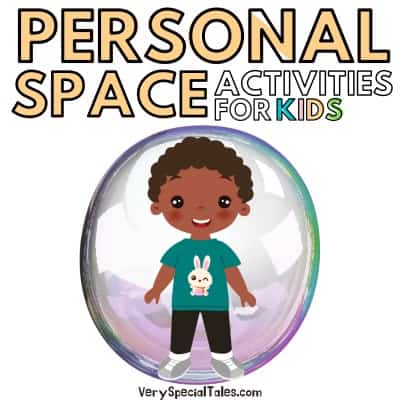
- Respecting personal space, an important skill when interacting with friends
- Having fun on a playdate, learning that spending time with a friend is what matters most, not whether you win or lose
26. Turn-Taking Activity
Taking turns is a key part of communication. It helps kids know when to speak, when to listen, and how to keep a conversation going, an essential skill for building friendships.
Talking Stick
The talking stick (or turn-taking stick) is simply a small stick, decorated in a fun way, that helps kids take turns during conversations.
Pair students and give them a topic to discuss. Only the student holding the stick is allowed to speak. Once they’ve shared their thoughts or feelings, they pass the stick to their partner.

27. Friendship Acrostic Poem
Have kids create an acrostic poem using the words “FRIENDSHIP” or “FRIEND”, where each letter starts a line describing what friendship means to them. This helps them think about different qualities of being a good friend in a fun way.
28. Interview with a Friend
Provide a list of fun questions. Kids partner up and interview each other, then introduce their partner to the group.
29. Friendship Compliment Circle
Sit in a circle. Each child says something they appreciate about the person to their right.
30. Friendship Pledge
As a group, create a Friendship Pledge (e.g., “We promise to be kind, listen, help each other…”) and hang it on the wall.
Our friendship workbook, Exploring Friendship, includes a “Friendship Acceptance Pledge” poster.

31. The New Friend Challenge
Challenge kids to connect with someone they don’t usually play or talk with. Give them a short checklist of friendly actions to try, like:
- Say hello and ask their name
- Invite them to play or join a group
- Ask a question to get to know them
- Share something about yourself
At the end of the day or week, reflect as a group: What did you try? How did it go? What did you learn about making new friends?
32. Wanted Poster: Great Friend Edition
Turn the classic Wild West “Wanted” poster into a celebration of friendship! Have kids create a poster for a classmate who has shown great friendship qualities.
They can include:
- The friend’s name
- A sketch or picture
- “Wanted for…” followed by positive traits (e.g., kindness, sharing, cheering up others)
- Fun reward ideas (e.g., “Reward: one high five and a big thank you!”)
This activity helps kids recognize and celebrate the positive qualities they see in each other.

33. Friendship Songs
Adding music to a message makes it more “sticky”. I often find myself humming songs when a word that is part of the lyrics comes to my mind.
So, let’s add a couple of friendship song examples to our list.
For young children, you may try:
- You’ve got a friend in me (Toy Story)
- That’s what friends are for (The Vulture Song- From “The Jungle Book”/Sing-Along)
Older kids may prefer these ones:
- Count on Me (Bruno Mars)
- True Friends (Hannah Montana)
34. Friendship Coloring Activity
Kids love to color, so why not use it as a chance to reflect on friendship? After coloring the “Friends are treasures” page included in your free download, they can think about what the quote means to them.

Alternatively, they can create their own drawing that represents friendship and explain how it shows what being a good friend looks like.
35. Friendship Quotes Activity
Choose a friendship quote and show what it means to you through writing or drawing.
Younger kids can pick from a list of quotes provided by the teacher.
Older students can find their own favorite quote to reflect on and share with the class.
Examples of famous friendship quotes:
- “A friend is someone who knows all about you and still loves you.” – Elbert Hubbard
- “There is nothing on this earth more to be prized than true friendship.” – Thomas Aquinas
- “Friends are the family we choose for ourselves.” – (Anonymous)
36. Friendship Videos
There are great resources online to teach kids about friendship.
These are some of my favorites:
- For younger children, Elmo and Rosita teach friendship values (sharing, doing funny things together, and the fact that we can be friends and we don’t need to like the same things):
- For older children, I love the Scooby-Doo video on how to be a good friend.
This video highlights some friendship values and how to spot good friends. Friends…
- Do things together
- Care about each other
- Have fun doing silly things
- Share
- Make you feel good
- Stand up for each other
We used this video as part of a friendship activity at my son’s school, and we loved it.
Social-Emotional Learning (SEL) Activities to Build Stronger Friendships
By now, we’ve shared over 30 fun activities to explore friendship. But building strong relationships also means developing key social-emotional skills, such as empathy, effective communication, and conflict resolution. The activities below focus on these important areas.
For each of the selected skills, you’ll find one suggested activity, along with links to additional resources for further exploration.
37. Communication Skills Activity: Conversation Cubes
When kids can express their thoughts, feelings, and needs in a clear and respectful way, it’s easier to avoid mix-ups and solve problems.
Good communication helps friends get along, work out their differences, and feel closer to each other.
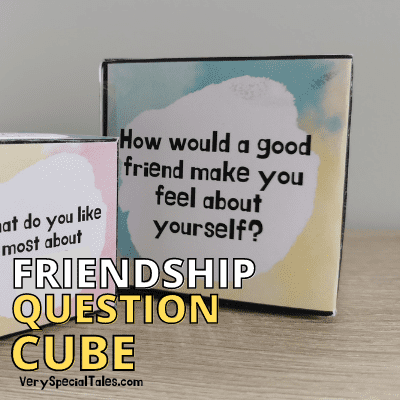
Friendship Conversation Cube
Roll a friendship question cube and take turns answering fun questions about being a good friend.
You can find the printable Friendship Conversation Dice in our Conversation Cubes post.
For more communication skills support, check out these resources:
38. Listening Activity: Whole Body Listening
Listening is one of the most important friendship skills. When kids truly listen to each other—without interrupting, rushing to respond, or getting distracted—they show that they care. Good listening builds trust, helps solve problems, and makes others feel valued. It’s how friendships grow stronger over time.
“Whole-Body Listening” is one of the most popular tools for teaching younger kids effective listening skills.
This listening skills activity teaches kids that listening goes beyond using their ears. Listening engages all our senses:
- Eyes on the speaker
- Mouth quiet
- Hands to ourselves
- Body facing the speaker
- Brain thinking about what the speaker is saying
Brainstorm with the kids what parts of our body we use to listen. Write their answers on the whiteboard, and work your way up to capture how we use all our senses to be good listeners.
For more listening activities for kids and a whole body listening worksheet, explore our post: 27 Listening Games and Activities for Kids.
39. Conflict Resolution Activity: Healthy vs. Unhealthy Conflict Resolution
Even best friends don’t always agree. And that’s okay! What matters is how we handle those tough moments.
Learning to talk things through, listen to each other’s point of view, and find a fair solution helps friendships last.
Conflict resolution teaches kids that strong friendships aren’t about avoiding problems, but about working through them with respect.
Friendship Builders vs. Friendship Breakers (Healthy vs. Unhealthy Conflict Resolution).
Have your kids write down ways to solve a conflict scenario.
They don’t need to be the best solutions; we’re just brainstorming anything that comes to mind.
Once they have come up with all these solutions, ask them to classify them as healthy vs. unhealthy.
For more conflict-resolution support, check out these resources:
Workbooks:


Blog Posts:
40. Friendship Apology Practice: Apology Letter
Saying “I’m sorry” can be tough, but it’s also one of the most important skills for keeping friendships strong. A real apology isn’t just about the words. It’s about taking responsibility, showing you understand how your friend feels, and wanting to make things right.
Activity: Write an Apology Letter
Sometimes it’s easier to say sorry in writing. An apology letter gives kids a chance to think about their words and express how they feel.
A good apology letter should include:
- What happened
- Why it was hurtful
- A sincere “I’m sorry”
- What they’ll do differently next time
For many more ideas and tips on how to apologize the right way, check our Apology Activities for Kids.
41. Friendship Empathy Activity
Empathy means understanding how someone else feels, even if you’re not in the same situation. When kids show empathy, they become more thoughtful, caring friends.
Empathy Role-Play
Give kids short scenarios and have them act out how someone might feel, then show an empathetic response.
Example:
- A friend is sad after losing a toy. What could you say or do to show you care?
- A classmate is sitting alone at lunch. What could you say or do to make them feel included?
For many more empathy activity ideas, check our Empathy Activities for Kids.
42. Emotional Intelligence Activities: Friendship Charades
Emotional intelligence helps kids understand their own feelings and those of others, which is an important part of building strong friendships.
Friendship Charades
Act out different friendship qualities, such as sharing, kindness, and helping, and have the group guess.
43. Anti-Bullying Activity: Bullying Skits
Being a good friend means looking out for others. Anti-bullying activities can help kids recognize bullying, understand how it affects others, and learn how to stand up for themselves and others.
Bullying Skits
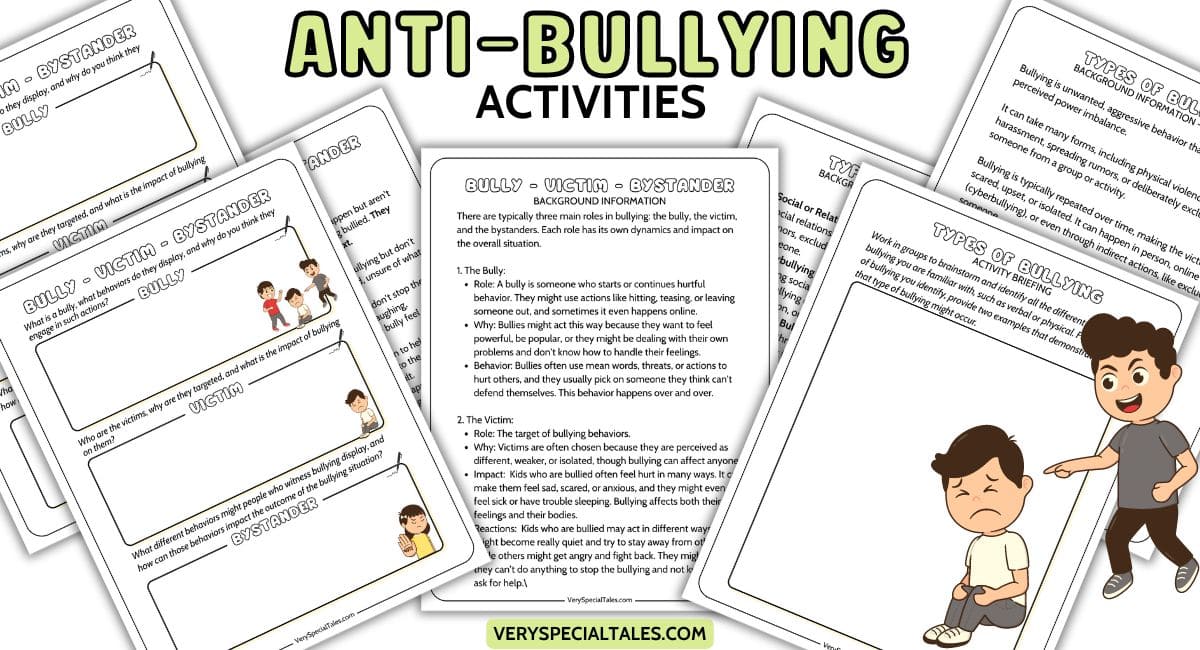
In groups, students create short skits that depict various bullying situations and demonstrate how to handle them effectively. The skits should include a clear conflict, such as verbal or physical bullying, and demonstrate positive ways to address the issue, whether by standing up to the bully, seeking help from an adult, or supporting the victim.
This activity allows each group of students to explore different roles, including the bully, the victim, and the bystanders, to better understand how their actions can influence bullying situations.
Other Social Skills Resources
- Friendship Activities for TEENS
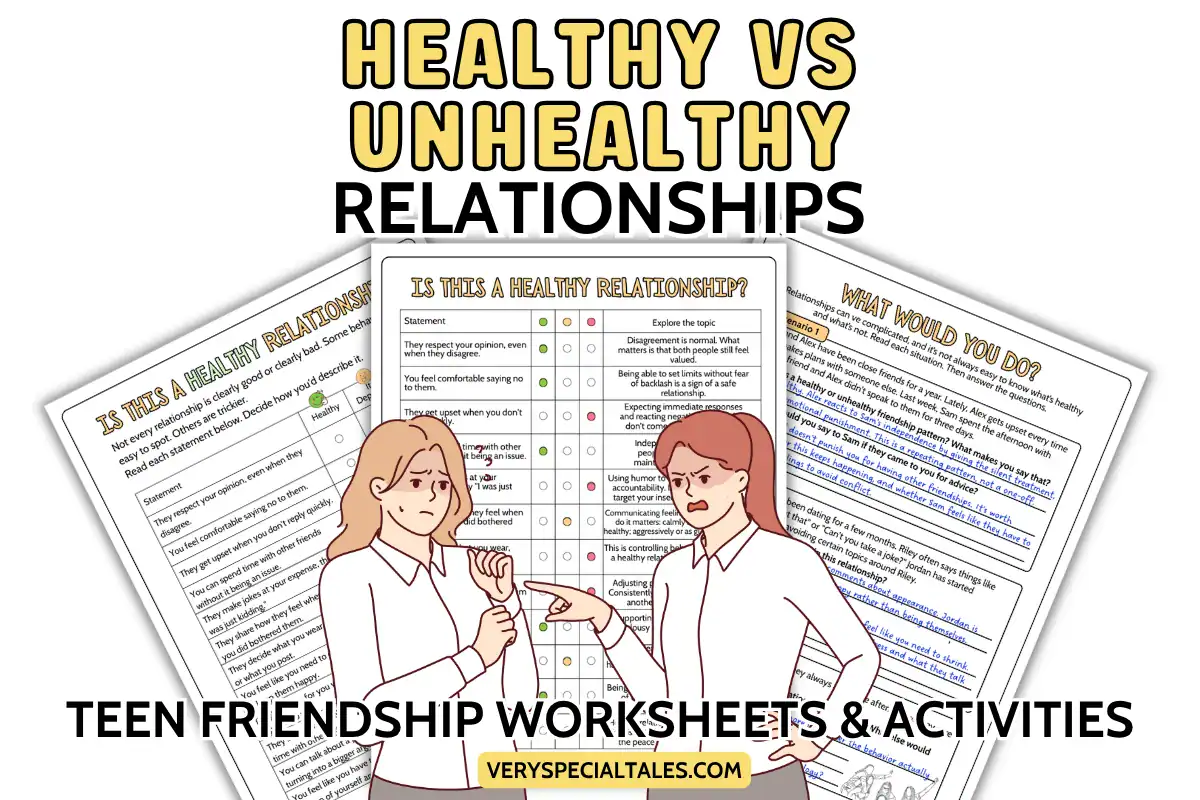
- Healthy vs. Unhealthy Relationships for Teens
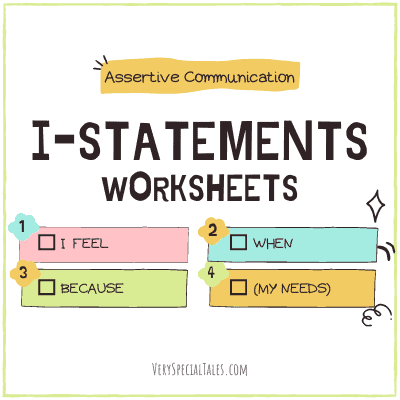
- I-Statement Worksheets
- Self-Introduction for Kids (Worksheets)
- Social Skills Activities for Kids
- 50 Communication Games & Activities for Kids
- Conversation Starters for Kids
- Listening Games and Activities
- Apology Worksheets and Activities
- Conflict Resolution Activities for Kids
- How to Teach Kids to Take Turns


Friendship Worksheets (Printable PDF Download)
Did you enjoy these friendship activities for kids?
Don’t forget to download your worksheets⇓
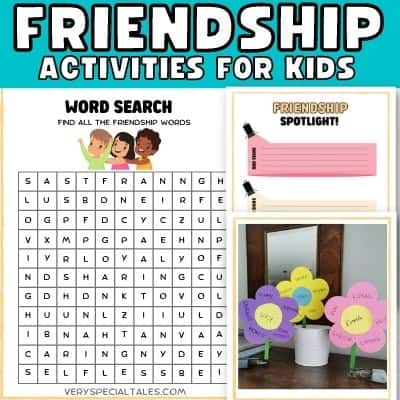
Your printable friendship worksheet includes the following friendship activities:
- Friendship spotlight
- Friendship search work
- Coloring activity with a friendship quote
I like this!
Love this!
So good thank you!!
I love these activities!
I’m glad to hear that you found my article helpful and appreciate your kind words, dear Anca-Maria.
I love this list of friendship activities! It’s such a fun way to encourage kids to bond and create lasting memories. The printable PDF is super helpful too—can’t wait to try some of these with my kids and their friends! Thank you for sharing!
I absolutely love this list of friendship activities! It’s such a fantastic way to encourage kids to bond and have fun together. The printable PDF is a great added bonus for easy access. Can’t wait to try some of these with my kids and their friends! Thank you for sharing!
So many good ideas! Thank you!