
How to Teach Empathy to Kids:
7 Tips + 25 Empathy Activities for Kids + Printable Empathy Bingos
Empathy is one of the most important social-emotional skills children can learn. It helps kids build strong friendships, handle conflicts, respond with kindness, and understand the feelings of others.
In this post, we’ll look at what empathy really is, how it develops, practical ways to teach it, and 25 fun empathy activities you can do at home or school. At the end of the post, you’ll also find two free printable Empathy Bingos to encourage real-life practice.
Recommended resource: If you’d like a ready-to-print option, you can also check our Empathy Workbook for Kids in the shop
What Is Empathy?
Empathy is the ability to understand and respond to the feelings and experiences of others. It involves two main components:
1. Emotional Empathy
This is the feeling side of empathy. It’s when a child senses or experiences another person’s emotions.
Example: A child sees a friend crying and immediately feels worried or sad too.
2. Cognitive Empathy
This is the thinking side of empathy. It’s when a child understands why someone feels a certain way, even if they wouldn’t feel the same in that situation.
Example: A child understands that a classmate is upset because they lost a favorite toy, even if losing their own toy wouldn’t bother them much.
Both types of empathy help children navigate friendships, resolve conflicts, and respond compassionately.
When Does Empathy Develop?
Even young children show early signs of empathy. Research suggests:
- Newborns may cry when they hear other babies cry (early emotional empathy).
- Toddlers often try to comfort others (hugging, offering toys, asking “Are you OK?”).
- Preschoolers and early school-age children begin to understand that people can feel differently from them (cognitive empathy).
- Older children (6+) start recognizing more complex feelings—embarrassment, frustration, loneliness—and can practice perspective-taking more intentionally.
Children develop empathy at different rates. Temperament, social experiences, models in their environment, and adult guidance all play a role.
Why Is Teaching Empathy Important?
Empathy supports many aspects of a child’s development:
Empathy is not simply “being nice”; it’s a foundation for healthy relationships.
How to Teach Empathy to Kids
Some aspects of empathy naturally unfold with development, but many can be supported intentionally. These strategies help build a strong foundation:
1. Model empathy every day
Children learn from what they see. Narrate moments when you notice someone’s emotions (“She looks frustrated; let’s hold the door for her”) to make empathy visible.
2. Teach kids about emotions
Kids cannot understand the feelings of others if they cannot identify their own.
Talk about emotions daily, not only when there is a problem.
3. Validate their feelings
When children feel understood, they learn to extend that understanding to others.
Avoid minimizing (“It’s not a big deal”).
Use supportive language (“I can see that was really disappointing for you”).
4. Talk about your own feelings
Sharing simple emotional experiences (“I felt nervous before the meeting”) models emotional openness.
5. Ask perspective-taking questions
“What do you think she might be feeling?”
“What would help him right now?”
“What might you need if this happened to you?”
6. Use real-life moments as teaching opportunities
Kids learn best from real interactions—playground conflicts, misunderstandings, sharing challenges, and moments of exclusion.
7. Encourage supportive actions
Empathy is not only feeling something, it’s acting on it.
Help children identify simple ways to support others.

Fun Empathy Games and Activities for Kids
Empathy grows when children learn to recognize emotions, understand other people’s perspectives, and take caring action. These games and activities help kids practise all three skills in fun, meaningful ways.
To make it easier to explore, we’ve grouped these 25 empathy activities into four categories:
- Activities that build emotional awareness
- Activities that strengthen perspective-taking
- Activities that encourage caring actions
- Activities that help kids apply empathy in real-life situations.
Activities That Build Emotional Awareness
(Children can’t understand others’ feelings if they can’t interpret emotions first.)
1. Feeling Faces Drawing Challenge
Ask your child or students to draw characters experiencing different emotions—worried, excited, frustrated, embarrassed, proud.
Then ask:
- “What makes you think they feel this way?”
- “What might have happened?”
- “What would help them?”
Related resource: Directed Emotions Drawing Activity
2. Playdough Emotions Modeling
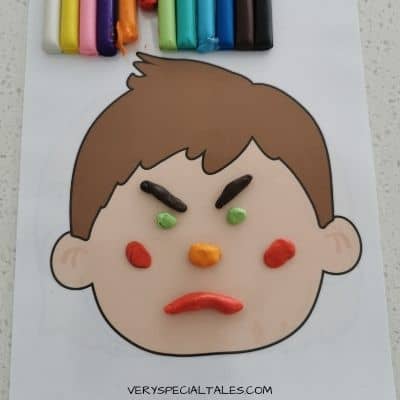
Children use playdough to create faces showing different feelings.
As they sculpt, talk through:
- What clues show the emotion (eyes, eyebrows, mouth)?
- What could have caused it?
A hands-on, calming activity that builds emotion recognition.
3. Emotion Charades
Kids act out emotions using only body language.
This helps them notice nonverbal cues—one of the biggest building blocks of empathy.
4. Story-Time Emotion Hunt
While reading picture books, pause and ask:
- “How do you think this character feels right now?”
- “What tells you that?”
- “What would you want if you were them?”
Books provide safe, rich practice opportunities for empathy.
5. Daily Feelings Check-In
Use a feelings chart or thermometer to help kids share how they feel each day.
Once they’ve shared, ask:
- “What could help you feel supported today?”
This models emotional communication they can later use with peers.
6. Feelings Journal
Kids write or draw about their own emotions and what helped them.
To build empathy, try adding a reflection like:
“Did you notice someone else’s feelings today? What made you think that?”

Helpful Resource for Teaching Emotions
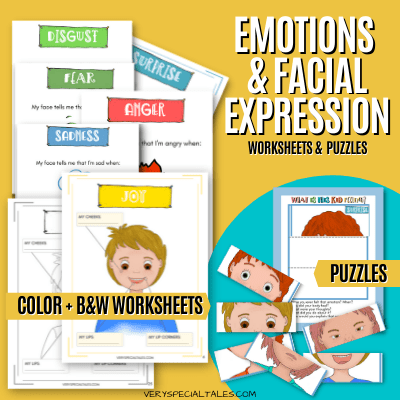
If you prefer something ready to print and use, you might find the Emotions & Facial Expressions Bundle useful.
It includes playdough mats, worksheets, puzzles, and flashcards that help kids practise identifying facial expressions and talking about feelings.
Activities That Teach Perspective-Taking
(These activities directly build the cognitive side of empathy—understanding someone else’s experience.)
7. “Walk in Their Shoes” Activity
Kids choose a character (e.g., the new kid, someone left out, someone nervous about speaking) and complete prompts such as:
- “This person is thinking…”
- “This person might be feeling…”
- “This person needs…”
This makes perspective-taking concrete and visual.
8. Empathy Scenario Cards
Present simple, relatable situations:
- A classmate wasn’t chosen for a team
- Someone is sitting alone
- A friend is embarrassed after making a mistake
Ask:
- “What might they be feeling?”
- “What would you want someone to do if this happened to you?”
- “What could you do to support them?”
9. Empathy Walk (Silent Observation Activity)
Take kids around the school or playground and observe:
- Who looks happy?
- Who might be struggling?
- What clues tell you that?
Follow up with a discussion about what support might help each person.
10. “What Happened Before/After?” Picture Inference Game
Show a picture of a child feeling an emotion.
Ask:
- “What might have happened before this?”
- “What might happen next?”
- “What could someone do to help?”
This empathy activity is a great way to help kids practise noticing clues and understanding what someone else might be feeling.
11. Empathy Thermometer
Create a simple scale that shows different levels of emotions (for example: calm, worried, upset, very upset).
Kids read or listen to short scenarios and place each one on the scale based on how big the feelings might be for the person involved.
Then talk together about what kinds of support might feel helpful at each level.
This helps children understand that different emotions may need different kinds of care.
12. Perspective Swap Role-Play
Kids play both sides of a scenario.
Example: “You didn’t get picked for a game.”
Round 1: one child is upset, the other responds.
Round 2: swap roles.
Role-playing both scenarios gives children a chance to explore what each person might be feeling in the same situation.
13. Empathy Maps
An empathy map is a simple visual tool that helps kids explore what someone else might be thinking, feeling, saying, and doing in a specific situation. You can use it with real-life moments, story characters, or common playground scenarios. As children fill in each part of the map, they practise slowing down, considering another person’s point of view, and understanding their feelings, thoughts, and actions.
Related reading: Fun Perspective Taking Activities for Kids
Activities That Teach Caring Actions (Empathy in Action)
(After kids understand feelings and perspectives, they can practise supportive responses.)

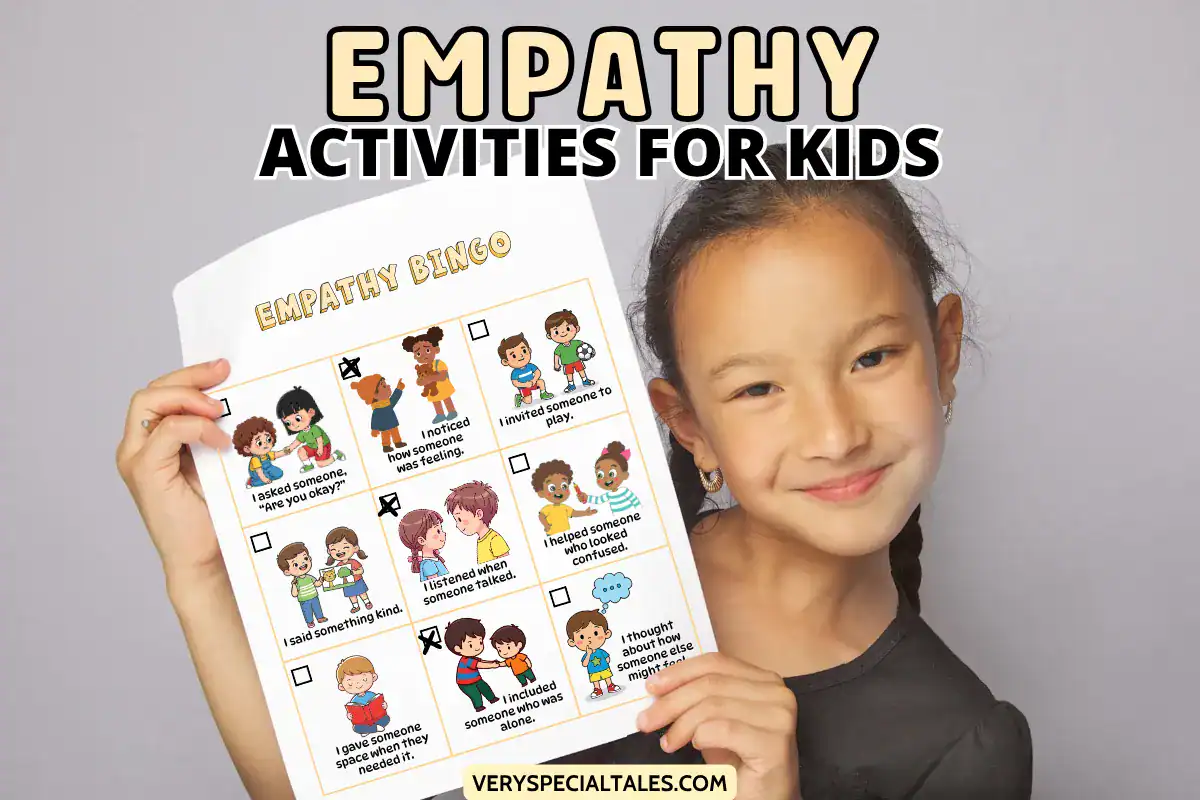
14. Empathy Bingo (Free Download!)
Create a bingo card or download our free Empathy Bingos. The freebie includes two versions: a kid-friendly board with simple prompts and illustrations, and a version for teens.
You can ask questions like:
- Asked someone, “Are you okay?”
- Included someone new
- Helped someone who looked confused
- Noticed a friend’s feelings
- Gave someone space when they needed it
Kids love marking off squares—and it makes empathy a habit.
15. Friendship Repair Scenarios
Present mini-conflict situations, such as:
- A joke hurt someone’s feelings
- Someone got left out
- A friend feels ignored
Kids brainstorm:
- What each person felt
- What each person needed
- What an empathetic repair might sound like
(e.g., “I didn’t mean to hurt you. Are you okay?”)
This activity is a helpful way for children to practise empathy while also strengthening their conflict-resolution skills.
16. Partner Empathy Interviews
Have children work in pairs and take turns interviewing each other with questions such as:
- “What makes you feel nervous?”
- “What makes you feel appreciated?”
- “What helps when you feel upset?”
Children learn about individual differences and practise listening.
17. “Draw the Moment” Empathy Art Activity
Kids draw a real or imagined moment where someone experienced a feeling (lonely, shy, proud, excited).
Then they draw a second picture showing a caring response.
18. Kindness Notes with Purpose
Kids write or color a note for someone, but with a twist—
each note must match an emotion, such as:
- “You looked nervous today. I believe in you.”
- “I saw you working really hard on your project.”
- “I noticed you were sad. I’m here if you want to talk.”
Not generic kindness—emotion-aware kindness.
19. The “Support Menu” Game
Create a simple list or “menu” of different ways kids can show support, such as asking a caring question, listening, offering comfort, giving space, or doing something kind.
Read a short scenario together, and ask children to choose which option from the list might feel helpful to the person in the scenario.
This activity teaches that empathy involves thinking about what the other person might need and choosing a response that fits their feelings.
Related reading: 101 Kindness Activities for Kids (Includes a printable Kindness Challenge for Kids)
Activities That Teach Empathy in the Real World
(Perfect for upper elementary and classroom use.)
20. Digital Empathy Mini-Lesson
Talk with kids about how empathy works online as well as in person.
Discuss:
- How tone can be misunderstood in text
- Why kind comments matter online
- How to support a friend through a message
- What not to do in chats or gaming
21. Emotion Detective Game
Kids look for clues in body language, tone, and behaviour.
You can say:
“Imagine you’re detectives. What clues tell you how someone is feeling?”
Playing “emotion detective” supports nonverbal awareness by helping kids pay attention to the expressions, gestures, and movements that reveal how someone might be feeling.
22. Real-Life Empathy Challenges (Mini Missions)
Give children simple tasks such as:
- Ask someone one caring question today
- Notice how a classmate feels during lunchtime
- Choose one person to include in a game
- Ask someone, “What do you need right now?”
These are light, practical, and deepen everyday empathy.
23. Group Problem-Solving Scenarios
Present a simple classroom or playground disagreement and guide children to explore it from each person’s point of view. Ask them to think about what each person might be feeling, what each person needs, and what a caring, fair solution could look like.
A group problem-solving activity like this helps children understand different perspectives and choose responses that consider everyone involved.
24. The Listening Challenge
Ask kids to pair up and practise taking turns truly listening to each other.
One speaks for 1 minute about something important to them.
The listener:
- maintains eye contact
- doesn’t interrupt
- summarizes what they heard
Listening is one of the strongest empathy skills because it teaches children to focus on another person, notice their emotions, and understand what they might need in that moment.
25. Empathy Workbook for Kids
A fun, printable empathy workbook with engaging worksheets and activities that help kids understand feelings, see things from others’ perspectives, and turn empathy into action.

Articles and Resources About Emotions/Feelings
- 50 Fun Feelings Activities for Kids
- Emotional Vocabulary List (100+ Feelings Words)
- Emotions Worksheets (Basic Emotions and 15 Emotions)
- Emotion Wheels for Kids (Printable)
- How to Use Emotions Flashcards
- Emotions Flashcards (Printable Resource)
- Printable Mood Tracker for Kids
Download Your Free Empathy Bingo Printables (Kids & Teens)
You’ll receive two printable Empathy Bingo boards:
- A kid-friendly version with simple prompts and illustrations
- A more mature version designed especially for teens.
They’re an easy, fun way to help young people practise noticing feelings, supporting others, and choosing caring actions.
Research on Empathy
- Mcdonald, Nicole & Messinger, Daniel. (2011). The Development of Empathy: How, When, and Why. Moral behavior and free will: A neurobiological and philosophical approach.
- Martin, G. B., & Clark, R. D. (1982). Distress crying in neonates: Species and peer specificity. Developmental Psychology, 18(1), 3–9
- Knafo-Noam, Ariel & Zahn-Waxler, Carolyn & Van Hulle, Carol & Robinson, JoAnn & Rhee, Soo. (2008). The Developmental Origins of a Disposition Toward Empathy: Genetic and Environmental Contributions. Emotion. 8. 737-752. 10.1037/a0014179.
- Aksan N, Kochanska G. Conscience in childhood: old questions, new answers. Dev Psychol. 2005 May;41(3):506-16.
- Garner, P. W. (2003). Child and Family Correlates of Toddlers’ Emotional and Behavioral Responses to a Mishap. Infant Mental Health Journal, 24(6), 580–596
Did you enjoy this post? ♥ Make sure you pin it for later!⇓
Amazing content!! love them!!
Love this!
I want to help my grandson and really appreciate some fun activities we can do together, thank you!!