
Respect Activities for Kids: Activities, games, and ideas to teach kids about respect at home and in the classroom. Interesting ideas for your social-emotional learning lessons, classroom discussion, or family conversations. And don’t miss the free Respect Charades activity at the end of this post: 15 common respectful behaviors already written out as situation slips, ready to print, cut, and play. No prep, just a fun, discussion-rich activity your kids or students will actually enjoy.
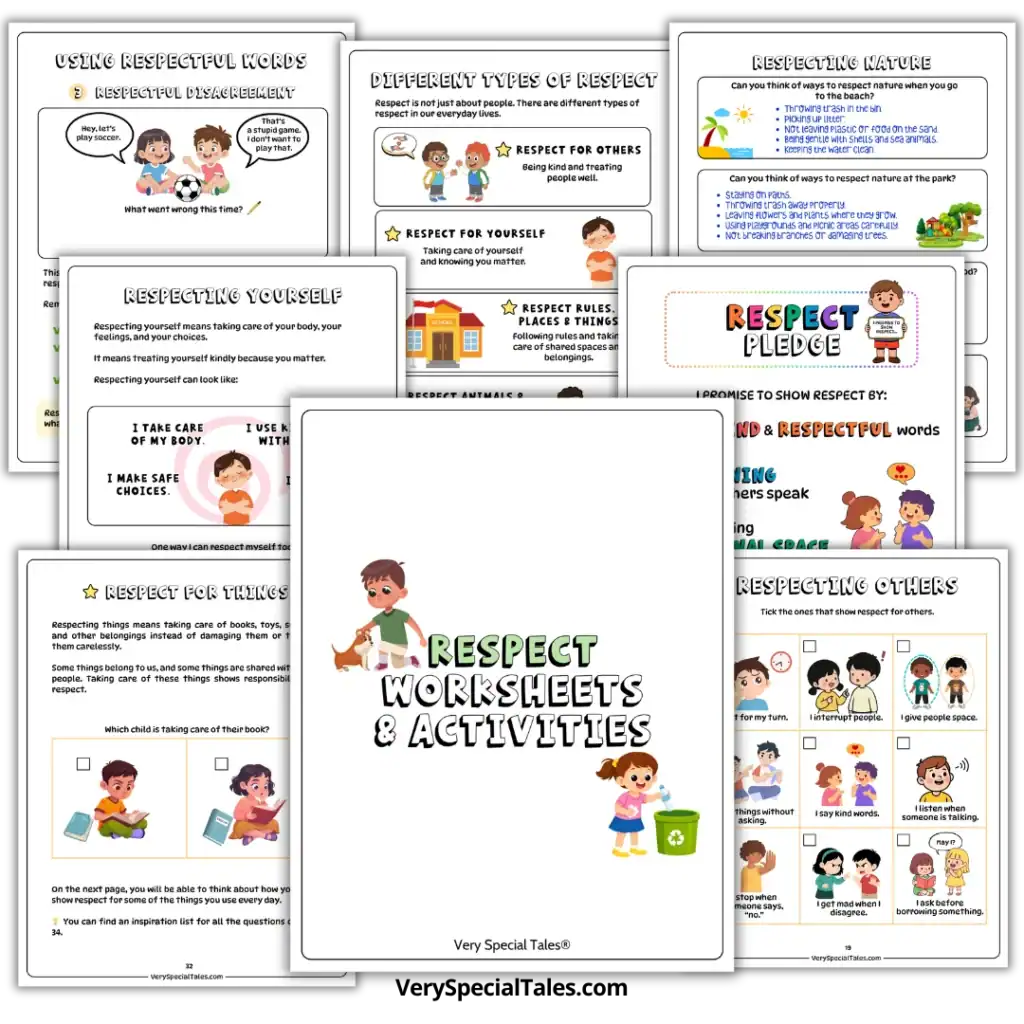
Want a complete respect unit, ready to teach? The Respect Worksheets & Activities pack includes worksheets, reflection activities, and discussion prompts covering every aspect of respect: self-respect, respect for others, respect for animals and nature, and respect for rules and property. Structured, thorough, and ready to use across multiple lessons. Perfect for the classroom or home.
What is Respect?
Respect is the ability to value and honor others, even if we don’t share the same views, values, or opinions, and regardless of their individual characteristics.
Respect means accepting others and treating them with dignity.
Respect permeates our acts and shows when we treat people and property with consideration. It also allows us to build trust and relationships.
Respect can also have a connotation of admiration toward something or someone, but our focus in this article will be on respect as a character trait or a value.
Different Types of Respect
We can identify different types of respect depending on the object of our respect. For example:
· Respect for other human beings
· Self-respect (appreciating yourself and valuing your own worth)
· Respect for laws, rules, decisions, institutions
· Respect for non-human beings (e.g., animals, nature)
How Do We Show Respect to Others?
Respect shows in our acts.
Respect is a lot more than being polite and showing good manners. These are just a few examples of respectful behavior:
We can show respect in our everyday live interactions when we:
- Give our full attention to the person who talks to us
- Accept different opinions without judging or trying to change them
- Have due regard for other people’s feelings
- Use kind words
- Show compassion and empathy
- Tell the truth and show honesty
- Apologize for acts that may have hurt others
- Listen to people’s opinions and try to understand them
- Communicate assertively (we respect ourselves and our opinions while we try to understand others)
- Deal with our frustration without unloading it on those around us
- Disagree politely
- Show gratitude
- Keep our commitments
Kids learn behaviors from the people around them, their family and friends, and their teachers. One of the best ways to teach respect to children is to act as respectful adults.
No matter what you are doing, show respect to those around you. You will be surprised how much easier teaching respect is when you are a strong role model.
(Disclosure: We are a participant in the Amazon Services LLC Associates Program, an affiliate advertising program designed to provide a means for us to earn fees by linking to Amazon.com and affiliated sites. You can also read our Disclosure & Disclaimer policy here)
Want a complete respect unit, ready to teach? The Respect Worksheets & Activities pack includes worksheets, reflection activities, and discussion prompts covering every aspect of respect: self-respect, respect for others, respect for animals and nature, and respect for rules and property.
Teaching Respect to Kids: 30 Fun Respect Activities and Ideas for the Classroom
Let’s explore some activities and ideas to teach kids about respect.
Defining Respect Activities
1. Definition of Respect
The word “respect” can feel overwhelming to kids, so a great way to help your students learn about respect is to go over the definition of respect and have them list out different character traits and behaviors that can go along with that (such as good manners).
2. Respect Show and Tell
Have students bring in an object that represents something they respect or admire and share why they chose it with the class.
3. Talk about the Golden Rule
This reciprocity concept of the Golden Rule is present in major religions and ethical traditions.
The Golden Rule asserts that we should treat others as we would like to be treated.
“Do unto others as you would have them do unto you.”
This rule is vital to teaching kids the value of respect.
4. Respects Synonyms & Antonyms
Ask your students to divide a paper into two columns. In the first column, they have to come up with words that have a connotation of respect. Examples of respect words can be:
- Honesty
- Acceptance
- Equity
- Appreciation
- Consideration
- Take into account
- Politeness
- Treating with dignity
- Honor
You can even include sentences like
- you have my full attention
- I disagree, but I respect your opinion.
In the second column, they must write words that denote a lack of respect (or disrespectful behavior). Examples of non-respect words and behaviors can be:
- Criticism
- Disrespect / Saying disrespectful things (even if said as a joke)
- Disregard
- Bad manners
- Teasing
- Rude behavior
- Name-calling
- Making fun of someone
- Not listening
- Excluding people
- Bullying
Self-Respect Activities for Kids
“Respect yourself, and others will respect you.” Confucius
5. A Letter to Your Future Self
Ask your students to write a letter to their future self explaining all the reasons why they are great kids.
6. My Inner Qualities Activity
This activity helps your kid reflect on those important inner qualities that you can’t see from the outside but make them special.
Examples of inner qualities could be being kind, thoughtful, optimistic, brave, patient, friendly.
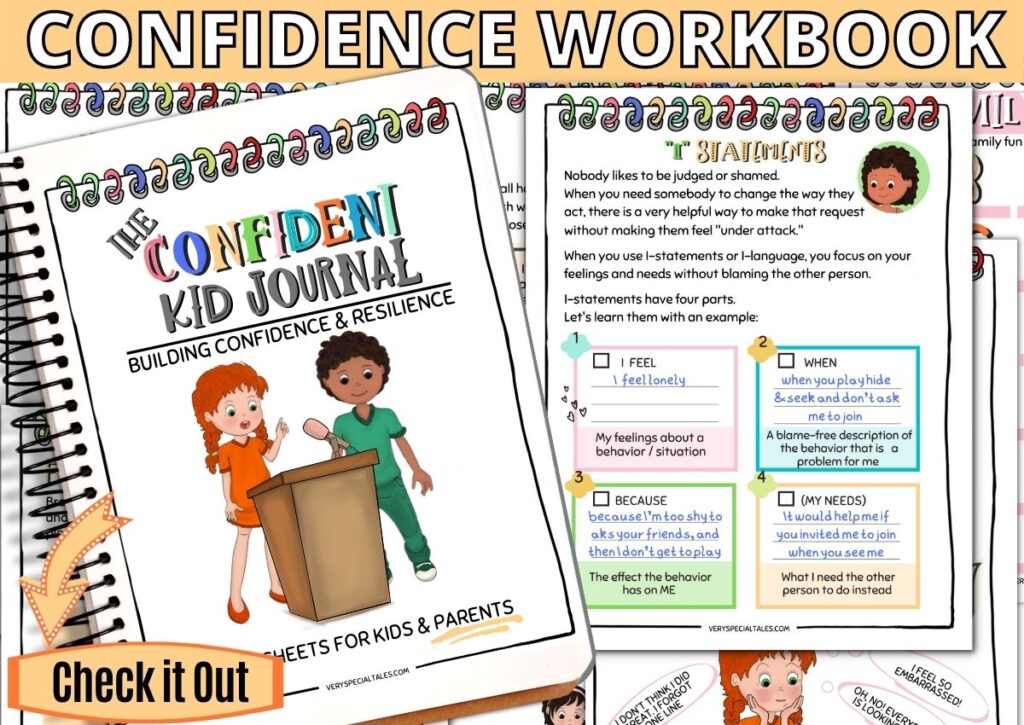
Related: Self-Confidence Workbook for Kids
Other Respect Activities for Kids
7. Respect Journal
Journaling is a great tool to help us reflect on personal experiences.
Ask your kid or student to devote a few minutes to think about the day and situations where they showed respect and consideration or other another day and situations where they should have acted differently.
8. What Would You Do If..?
What would be your student responses to different situations that occur in real life?
Everyday situations are the best way to talk about the importance of respect. They can see how they play an important role in society and how their social skills can influence everyone around them.
Before class, write out different situations that can occur to anyone and have your students journal how to respond with respect. Some situations that you could write are:
- Someone bumps into you in the hallway.
- You lend your pen to your classmate, and they forget to return it.
9. Respect Charades
Print and cut the free Respect Charades activity at the end of this post. It includes 15 common respectful behavior situations, already written out and ready to use. Put the slips in a bowl, and have students take turns drawing one and acting it out while the rest of the group guesses.

After each behavior is correctly guessed, pause for a quick discussion: why is this considered respectful? How does it affect the people around us? Those few minutes of reflection are where the real learning happens.
Download the free printable at the end of this post.
10. The Respect Circle
Have students stand in a circle and take turns saying something respectful about the person to their left. This game encourages positive communication and fosters a sense of community.
11. Personal Space Activity
This activity will help you teach how to respect personal space.
Draw a circle on a big sheet of paper. The inner circle will be the intimate space (1.5 feet radius), surrounded by personal space (4 feet radius), and the area outside is the social space.
Put that paper on the floor. Take turns to role-play conversations where kids speak to each other without trespassing in their personal spaces. (You may also use a string to create the circle or a hula hoop)
Related reading: 21 Personal Space Activities for Kids
12. Respect Relay
Divide students into teams and have them race to complete a series of respectful actions, such as shaking hands, using polite language, and showing gratitude.
13. Respect Bingo
Create bingo cards with respectful behaviors such as saying “please” and “thank you,” listening to others, and using polite language. As students observe these behaviors in their peers, they can mark off the corresponding square on their bingo card.
14. Respect Rocks
Have a jar in your classroom that is primarily for encouraging positive behavior and being respectful. Whenever one of your students is seen doing something positive, add a small rock to the jar. Once the jar is full, have your classroom receive a reward such as popsicles during recess.
15. Create a Class Mural About Respect
Using a bulletin board, have your students work together to create a beautiful piece of artwork for the entire school to enjoy. This exercise aims to explore the meaning of respect and create a feeling of community by working hard to build a mural together. Once a community is established, then showing respect is much easier in the classroom.
16. Establish Respect Rules
A group of people is more likely to be respectful to one another once a strong foundation is laid through an understanding of what is and what is not allowed.
Create a poster (this can be a class activity) where you lay out the respect rules in the classroom or at home. For example:
In this classroom, we use kind words; we look after our class property and others’ property; we help and support each other; we care for each other.
17. Gratitude Message
Have students write a positive note to a classmate, teacher, or family member, expressing gratitude or admiration. This activity fosters a sense of community and encourages positive communication.
18. Thank You Notes
Encourage your children to say “please” and “thank you” regularly and to express gratitude for the people and things in their lives.
For a more in-depth activity, have your students write a letter to express their appreciation or a card to say thank you.
Related: Gratitude Activities for Kids
19. How to Show Respect Poster
One of my favorite hands-on activities is on a poster board, have your students write down the names of their family members and teachers as well as different things that they could do on a daily basis. This can help them set clear expectations for how to show their appreciation for their family and school community.
20. Respect Scavenger Hunt
Create a scavenger hunt where students must search for objects or complete tasks that promote respectful behavior, such as picking up litter, holding the door open for someone, or complimenting a stranger.
21. Act it Out
Divide students into small groups and give each group a scenario to act out. The twist: some scenarios show respectful behavior, and some show disrespectful behavior. The rest of the class observes and discusses:
- What did they notice?
- How did the respectful version feel different from the disrespectful one?
Seeing both sides played out makes the contrast concrete for kids in a way that discussion alone doesn’t.
For the respectful behavior scenarios, you can use the situation slips from the Respect Charades activity (activity #9).
22. Voicing Disagreements
One of my favorite respect games to help children understand the topic of respect is to discuss the idea of respecting others while disagreeing with them.
Write down a situation on the board that your students may disagree on. Then, have them journal respectful ways to disagree with the person. Some things that they can write down are:
- use respectful words to explain why their viewpoint is the right thing
- show mutual respect
23. Respect Role-Playing
Use scenarios to demonstrate how to show respect in different situations.
For example, acting out how to greet someone politely, listening to someone when they’re talking, or asking for permission before touching someone else’s property.
24. Create a Respectful Pledge
Together with your children, create a pledge to respect others and treat them kindly. Display the pledge somewhere visible as a reminder like on your fridge or your classroom door.
25. Learn to Say I’m Sorry
I have a very detailed article with advice on how to teach kids to apologize (it includes activities and worksheets)
26. Assertive Communication Activities
Good communication skills also contribute to self-respect and respect from others.
Assertive communication is empowering, and it boosts our confidence. We are not afraid to defend our opinions and express how we feel.
It is likely to gain the respect of people around us because they see that we defend our rights but we respect others. It balances both our needs and desires with other people’s needs.
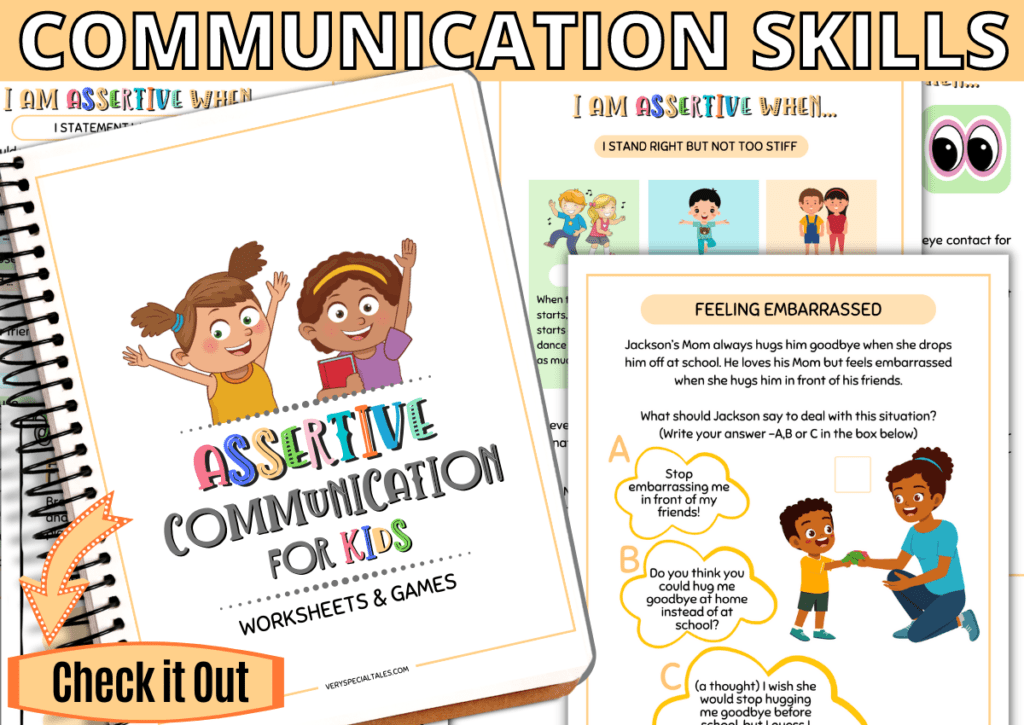
Check out these Assertive Communication Games and Activities
28. Turn-Taking Activities
These activities can help kids learn to take turns and not interrupt others
29. Listening Skills Activities
Giving our full attention is a sign of respect. These tips and listening activities will help you teach how to listen with our whole body.
30. Read Books About Respect
One of the simplest ways to begin teaching young children the concept of respect can be done by pointing out disrespectful behavior. Finding a book or tv show where the character is doing unkind things is one of the best ways to do this casually.
List of Picture Books About Respect (for inspiration):
- Teach Your Dragon Respect: A Story About Being Respectful (My Dragon Books – Reading age 2 -5)
I love the Dragon series books. Having a dragon pet is super cool, but what happens if your dragon is disrespectful? - Teach Your Dragon Manners: Train Your Dragon To Be Respectful. (Reading age 2-5)
And what happens if your dragon is rude? - A Little Respectful SPOT: A Story About Respecting People, Places, and Things (Reading age 5-7)
A cute little yellow SPOT shows different ways to be respectful to people, places, and things in everyday scenarios (being polite, respecting personal space and property) - Respect – The Best Me That I Can Be (Reading age 3-6)
In this book, a boy named Keigan walks us through real-life situations to teach us what respect means. - Respect and Take Care of Things (Reading age 2-7)
This book is about respecting property and nature. It teaches us to take care of our planet, encourages kids to pick up after themselves, and to ask permission to use things that don’t belong to them. - Let’s Talk About Body Boundaries, Consent, and Respect: Teach children about body ownership, respect, feelings, choices, and recognizing bullying behaviors (Reading age 4-7)
Respect Workbook for Kids (Printable Resource)
Want to Go Deeper? Check out the printable Respect Workbook in our shop.
This workbook helps children explore different dimensions of respect, including self-respect, respect for others, animals and nature, and respect for places, rules, and things. Each section combines worksheets and activities that help children connect respect to everyday situations and choices.
And then it brings it all to life with Respect in Action games: Bingo, Challenge, Charades, Pledge, Question Dice, and Discussion Cards. Everything you need to make respect stick, not just stick on a poster.
No prep, no planning stress. Just print and go.

Other Social-Emotional Learning Resources
- Fun Social Skills Activities for Kids
- Leadership Activities
- 30+ Anti-Bullying Activities for Kids
- Self-Awareness Activities
- Anger Management Activities for Kids
- 101 Kindness Activities for Kids



Really hoping this good info will help my ODD/ADHD/Autism spectrum son.
First of all, you’re right to say that children deserve respect as well. Some people say that you don’t even need to teach kids anything, you just need to show things with your own example. But I think that reading books about respect and immersing yourself into the world of fun and exciting character would be a perfect quality time spending for you and your kids.
This is exactly what I need as a couselor at an elementary school in teaching my kiddos about respect and responsibility
I loved your content. Thanks a lot
Loved your post. Thank you for these activities ❤️❤️