
Listening Games and Activities for Kids: Are you looking for fun activities and games to teach your kid how to be a better listener? Explore these 27 listening games and activities for kids! At the end of the post, you can also download a free set of Whole Body Listening worksheets, printable pages that help kids understand that good listening uses the whole body: eyes, ears, mouth, hands, and brain.
No prep needed, just print and go!
What is Listening?
Listening is the act of giving your full attention to sounds or spoken words in order to understand, process, and make sense of the information being conveyed. It involves not just hearing but actively focusing on and comprehending what is being said.
Listening is an important skill and one of the foundations of effective communication and meaningful connections with others.
E.C. Glenn analyzed 50 definitions of listening and found that most of them included the following components:
- Perception
- Attention
- Interpretation
- Remembering
- Response
These are three popular definitions of listening:
“Listening is the process of receiving, constructing meaning from, and responding to spoken and/or nonverbal messages”
(ILA –International Listening Association, 1995)
“Listening is the complete process by which oral language communicated by some source is received, critically and purposefully attended to, recognized, and interpreted (or comprehended) in terms of past experiences and future expectancies” (Petrie, 1964)
“Listening is hearing, understanding, remembering, interpreting, evaluating, and responding” (Brownell, 2002).
As L. Janusik suggests, we would probably need different definitions to capture different types of listening:
- Conversational listening, where the listener is expected to provide a response
- Linear Listening (like watching TV) where no response is necessary
The cognitive processes involved in different types of listening will be different too.
Why are Listening Skills Important for Kids
Good listening skills will provide a foundation to succeed in different areas:
- Social / Communication Skills
Most of our communication time is spent listening.
Listening skills are essential for effective social communication. - Academic
Listening comprehension is critical for academic success (McDevitt, Sheenan, and McMenamin, 1991)
If you think about it, you will realize that we spend most of our awake time listening.
Our kids utilize this important life skill in:
- Social interactions / when interacting with other kids or adults
- Learning environment / when listening to a teacher delivering educational content
- Instructional settings / following orders or instructions
- Leisure time/listening to music/ T.V.
Related reading: Social Skills for Kids
How to Teach Kids Listening Skills
There are many models and resources that can help our kids improve their listening skills.
I have selected two of those resources that I feel you may find interesting:
- Whole Body Listening
- HUEIRE Listening Model
Whole Body Listening
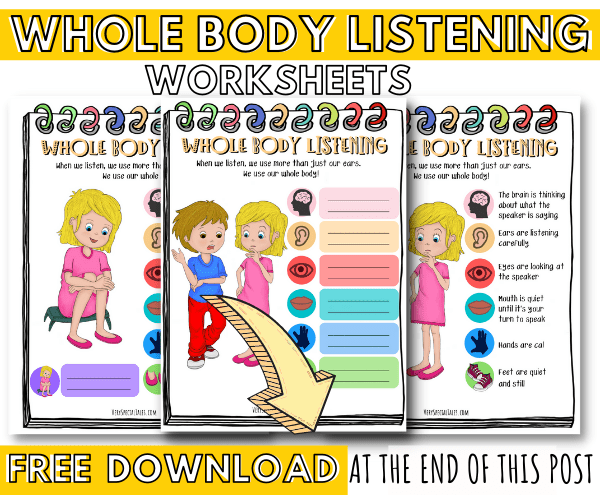
“Whole Body Listening” is one of the most popular tools to teach younger kids effective listening skills.
Whole Body Listening (WBL) was developed by Susanne Marie Poulette, a speech-language pathologist who worked in schools with children with communication difficulties.
WBL teaches kids that listening goes beyond using their ears.
Listening engages all your senses:
- Eyes on the speaker
- Mouth quiet
- Hands to yourself
- Body facing the speaker
- Brain thinking about what the speaker is saying
S.M. Poulette emphasizes that WBL is a tool, not a rule, for active listening.
She encourages us to be flexible and modify WBL as needed for students who have special needs, difficulty with self-regulation, or discomfort with eye contact.
HURIER Listening Model
One of the listening definitions that I listed in this post’s introduction was coined by J. Brownell.
Brownell, professor of organizational communication, developed the HURIER listening model that describes six stages of listening: hearing, understanding, remembering, interpreting, evaluating, and responding.
There are some things that we can do in each of these stages that will help us improve listening:
- H- Hearing -> Focus, eliminate distractions
- U- Understanding -> Ask questions, ensure understanding
- R- Remembering -> Stay focused, memory techniques
- I- Interpreting -> Interpret accurately, decode the emotional message and non-verbal cues
- E- Evaluating -> Listen to the whole message before responding
- R- Responding -> Respond appropriately, remember your responses influence others
Source: Brownell, J. (2002). Listening: Attitudes, principles, and skills
Fun Listening Games and Activities for Kids
There are many fun listening activities that can get our kids to practice their listening skills.
Most of these are classic games that we have all played in our childhood.
I have also included a Whole Body Listening worksheet for kids.
These are 27 fun listening games for kids to help them become good listeners:
1. Whole Body Listening Worksheets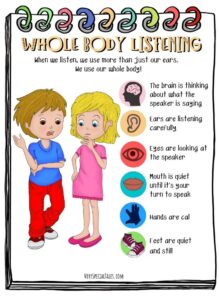
These are some fun printable worksheets to help you teach your kids or students that we use all our bodies to ensure we are listening effectively.
As I mentioned in the previous section, this listening skills activity teaches kids how to use different parts of their bodies to ensure effective listening.
You will find a download link at the end of this article.
💭 The Social Skills Workbook for Kids includes a full Listening section with structured worksheets and activities to keep building on these skills.
2. Broken Telephone
This is a classic listening game.
Sitting in a circle, ask the first child to whisper a message to the ear of the person sitting on either side. That child proceeds to pass on the message to the next person, and so on. When the round is finished, the first and last children compare their messages. Usually, the last message is completely unrecognizable from the one the first person started!
3. Simon Says
Simon Says is another classic game for young learners. Whoever takes the role of “Simon” issues a string of instructions (jump, touch your nose, hop on your left foot…) to be followed only if the sentence starts with “Simon says…”. If the instruction is executed but it doesn’t start with “Simon says” the player is eliminated.
4. Musical Statues / Freeze Dance
Musical Statues is a fun game for all the family. Dance to the sound of music and freeze when the music stops.
5. Musical Chairs
Musical Chairs is one of the most popular childhood games and also a listening game where players must listen to the music’s cues, ready to quickly find a chair when it stops.
6. Follow the Story
“Follow the Story is a great listening activity.” Start a story. Every few sentences, a new kid is chosen to continue where the previous one left it.
7. Take Turns with Nursery Rhymes
A great way for younger children to enjoy a similar activity would be “Follow the Song.” Start singing a well-known nursery rhyme. Each time you say a child’s name, they continue the song where the previous one left it.
8. Red Light, Green Light
This traffic light game is another classic activity: when your child hears the words “Green light,” they can move forward, but when they hear “Red light,” they must freeze.
9. Identify Sounds
Engage your child in a captivating activity that not only entertains but also nurtures their early listening skills.
Play different sounds and ask the child to identify them. It can be different animal sounds, instruments, or nature sounds.
We use Sound Touch, but I’m sure there are many others.
10. Drama
Turn your living room (or classroom) into a stage. Assign roles and let the show begin
11. Conversation Role Play
Encourage older children to practice communication skills in a fun way through role-play of real-life conversations.
💭 The Social Skills Workbook for Kids includes ready-to-use role-play scripts and prompts — great for making this kind of practice easy to run at home or in the classroom.
12. String of Words
Did you play this simple game in your childhood?
“I went to the supermarket and bought…” – As you go around, each kid adds a new item. They need to state the previous items plus a new one of their choice.
13. Find something on the map
Print copies of a map. Deliver spoken instructions to arrive at a certain place (or find something on the map)
14. Draw what I say
Deliver instructions for a drawing that all the kids will need to follow. For example: “There is a house in the middle of the page, a tree grows next to the house to the left, the sun is….”
There are different ways to use storytime to practice young kids’ listening skills:
15. Storytime: Listen to a story ( Or audiobooks for older kids)
16. Story Retelling
After hearing a short story, have kids take turns retelling it in their own words. This checks their listening and comprehension skills.
17. Guess what I’m describing
Get ready for a simple listening game that’s lots of fun! In “Guess what I’m describing,” players put their listening skills to the test in an entertaining and engaging challenge.
Choose something that you will describe, for example, a lion. Then, share clues, one at a time, till somebody guesses what you are describing
“It is an animal / It has four legs / It lives in the wild / etc.”
18. Mystery Bag
A variation of the previous game. Place objects in a bag and describe one without revealing it. Kids must guess the object based on the description.
19. Listening to Instructions
Give kids a set of instructions to follow, such as “clap your hands twice, then hop three times.” They must listen carefully and execute the actions correctly.
20. Rhyming Words
Call out a word, and kids take turns coming up with words that rhyme with it. This activity encourages attentive listening and creative thinking.
21. Nature Sounds Bingo
Create bingo cards with different natural sounds (birdsong, river, wind). When kids hear a sound, they mark it on their card.
22. Puppet Show
Put on a puppet show and ask kids to pay close attention to the dialogue and actions. Afterward, discuss what they saw and heard.
23. Remove words from a song
We used to sing a song when I was a child that repeated some words quite often.
We used first to sing all the (short) song, and then start removing words.
For example (this is a different song, our song was in Spanish)
“Five little monkeys jumping on the bed,
One fell down and bumped his head,
Mama called the doctor and the doctor said,
No more monkeys jumping on the bed!”
Now you remove the word “monkeys” and make a sound instead
Then you remove the word “bed,” so you don’t say either “monkey” or “bed.”
You remove as many words as you wish.
It’s quite fun, and they need to pay close attention to avoid saying one of the “forbidden words.”
24. Continue the song
Let’s continue singing. This time, only one person sings, but after a few verses, that person stops and chooses who continues the song.
25. Listen to Nature
Spending time outdoors is an excellent activity for your child’s senses. Encourage kids to listen to the sounds of nature, like birds, insects, and wind rustling through the trees.
26. Sound Scavenger Hunt
Scavenger Hunt is an old favorite. Turn it into a listening game, and instead of focusing on physical objects, look for different sounds. Prepare a list of specific sounds or categories, such as animal noises, musical instruments, or natural sounds.
27. “Locating the square”
Hand out a grid like the ones we use to play battleship.
Select a starting square (eg. D4) and give spoken instruction to reach your selected target square (5 to the right, 2 up, 1 to the left, 3 down….)
What other listening games do you play at home or school?
Whether it’s small groups or large gatherings, young kids or older students, there’s a great game here for everyone. So gather your classroom (or your family members) and dive into these engaging listening activities.
These activities are not only fun but also effective in improving kids’ active listening skills, making them better communicators and more attentive learners.
Check out our Teen Active Listening Activities: 12 Fun Ways to Build Communication Skills (+ Printables)
Other Social Skills Activities and Games
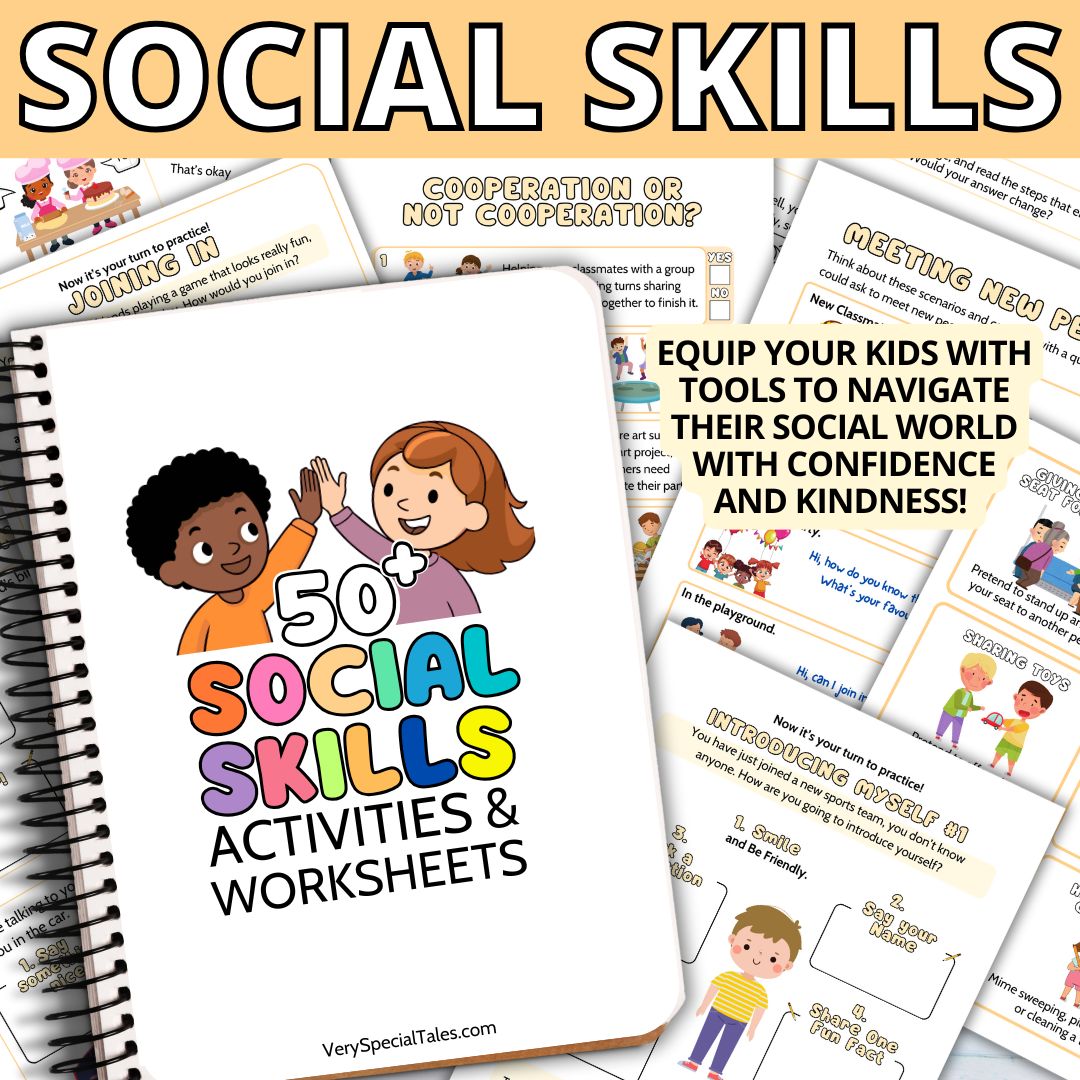
Social Skills Workbook for Kids (Printable Resource)
Want to go deeper? Check out the Social Skills Workbook for Kids in our shop. This 119-page printable workbook (ages 5-11) covers the full range of social skills children need to connect and communicate with confidence.
- Communicating: Expressing yourself clearly and confidently in different situations.
- Listening: Active listening skills and understanding others, including whole body listening concepts.
- Feelings & Emotions: Exploring how emotions shape our interactions with others.
- Participating: Joining group activities, taking turns, and engaging with peers.
- Caring, Friendship, and Speaking Up: Building friendships, showing kindness, and learning to advocate for yourself and others.
No prep, no planning stress. Just print and go.
Other Articles about Social Skills Activities and Games
- Social Skills Activities for Kids
- Social Skills Games
- Assertive Communication Worksheets for Kids
- 50 Communication Games & Activities for Kids
- Public Speaking Activities for Kids And Teens
- Turn-Taking Activities for Kids
- Personal Space Activities for Kids
Whole Body Listening Worksheets (Free PDF)
Download your free listening skills activity below 👇
I hope you enjoy it👆!




The children I serve love the interactive worksheets.
For helping my students
Helpful for children. Thanks for sharing it
Quite interesting.
Thank you for sharing these great ideas and tips. Much appreciated!
Give me good understanding… About communications… And how to deliver your children thank you🙏