Conflict looks different in the teen years. As adolescents grow more independent, peer relationships become more central to their lives. Disagreements are no longer just about sharing a toy or taking turns. They often involve trust, loyalty, social dynamics, boundaries, fairness, and even digital communication. Teens are also developing a stronger sense of identity. They care deeply about being heard, respected, and understood.
In today’s post, we will explore engaging activities that can help you work with your young person on developing conflict resolution skills. But, before moving into the activities, it is helpful to review three foundational elements of conflict resolution:
- Conflict Resolution Strategies
- Steps to Conflict Resolution
- Core Conflict Resolution Skills
Understanding these will help you add depth to the activities you choose to implement and make it easier to guide meaningful discussion and reflection.
Related resources: If you are supporting younger children, you may also find our Conflict Resolution Activities for Kids helpful.
Conflict Resolution Strategies
When people face conflict, they tend to rely on a small number of common approaches.
Understanding these basic conflict resolution strategies makes it easier to recognize what is the best fit for the different scenarios we may face.
Avoidance
Avoidance means stepping away from the conflict instead of addressing it directly.
This may involve:
- Ignoring the issue
- Changing the subject
- Delaying the conversation
- Physically removing yourself from the situation
Avoidance can be useful when emotions are high or when the issue is minor. However, if important concerns are never discussed, problems can grow over time.
Competition
Competition focuses on winning the disagreement.
The goal is to protect your own position, even if it comes at the expense of the relationship.
This strategy may include:
- Arguing forcefully
- Refusing to compromise
- Trying to persuade others to take your side
Competition can be appropriate when safety or core values are involved, but it often escalates everyday disagreements.
Compromise
Compromise means each side gives up something in order to reach a solution.
It is often used when:
- Time is limited
- Both parties want a quick resolution
- The issue is not deeply personal
Compromise allows both sides to move forward, even if neither gets exactly what they want.
Collaboration
Collaboration aims to find a solution that satisfies both sides fully.
This approach involves:
- Listening carefully
- Clarifying misunderstandings
- Exploring different options
- Working toward a win-win outcome
Collaboration usually requires more time and effort, but it can strengthen relationships.
Accommodate
Accommodating means prioritizing the other person’s needs or preferences over your own.
This may involve:
Choosing not to push your position
Agreeing to the other person’s solution
Letting go of your preference to maintain harmony
Accommodating can be appropriate when the issue is minor to you but more important to the other person, or when preserving the relationship matters more than the outcome. However, if used too often, it may lead to resentment or unmet needs.
Mediation
Mediation involves bringing in a neutral third party to help guide the conversation.
The mediator does not take sides but helps both parties communicate and explore solutions.
This strategy is useful when communication has broken down or when the conflict affects others.
Teen Conflict Example
Consider this situation:
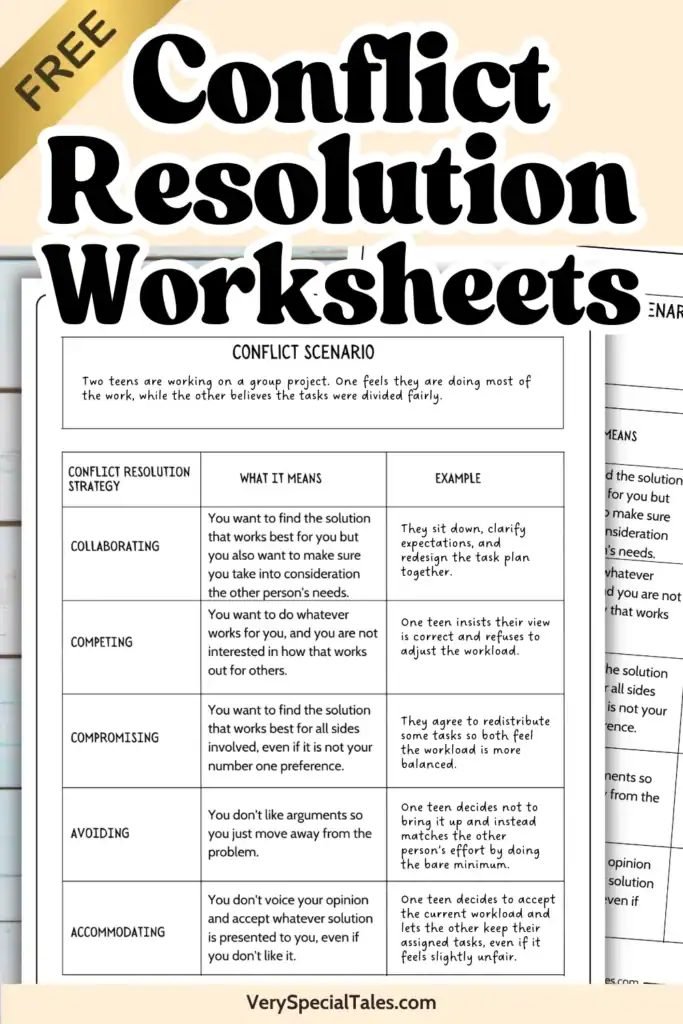
Two teens are working on a group project. One feels they are doing most of the work, while the other believes the tasks were divided fairly.
The same conflict can be handled in different ways depending on the strategy used.
Avoidance
One teen decides not to bring it up and instead matches the other person’s effort by doing the bare minimum. They reduce their contribution but avoid any discussion about the imbalance.
This approach may temporarily reduce tension because no confrontation takes place. However, it can negatively affect the quality of the work and may damage trust if the pattern continues.
Competition
One teen insists their view is correct and refuses to adjust the workload.
This approach may be necessary if there is a clear issue of fairness and previous attempts at discussion have failed. However, it can damage trust if used too quickly.
Compromise
They agree to redistribute some tasks so both feel the workload is more balanced.
Compromise works well when both sides are willing to adjust and the goal is to move forward efficiently.
Collaboration
They sit down, clarify expectations, and redesign the task plan together.
Collaboration is often the best fit when the relationship matters and both want a solution that feels fair long term.
Accommodate
One teen decides to accept the current workload and lets the other keep their assigned tasks, even if it feels slightly unfair.
This may be appropriate if the issue is minor to them or if preserving harmony feels more important than redistributing the work. However, if this becomes a pattern, it may lead to frustration or feeling undervalued.
Mediation
If the disagreement continues, they ask the teacher to clarify expectations for the group.
Mediation is useful when communication breaks down or when the conflict affects grades or others in the group.
There is no single “correct” strategy for every situation. The key is recognizing which approach fits the circumstances and the importance of the issue.
Steps to Conflict Resolution
While conflict situations may look different in the teen years, the core process for resolving disagreements remains largely the same. If you are working with teens to build their conflict resolution skills, these common steps can help structure and guide the process.
1. Calm Down
Before solving anything, emotions need to settle.
Without emotional regulation, problem-solving is ineffective.
2. Identify the Problem
Clearly define what the disagreement is actually about.
Many conflicts escalate because the real issue is unclear.
3. Listen to Each Perspective
Each person shares their view without interruption.
This builds understanding and reduces assumptions.
4. Identify Needs or Interests
Go beyond positions.
What does each person actually need or care about?
5. Brainstorm Possible Solutions
Generate options without judging them immediately.
6. Evaluate and Choose a Solution
Select the option that feels fair and realistic.
7. Agree on Next Steps
Clarify what each person will do moving forward.
8. Follow Up if Needed
Check whether the solution worked and adjust if necessary.
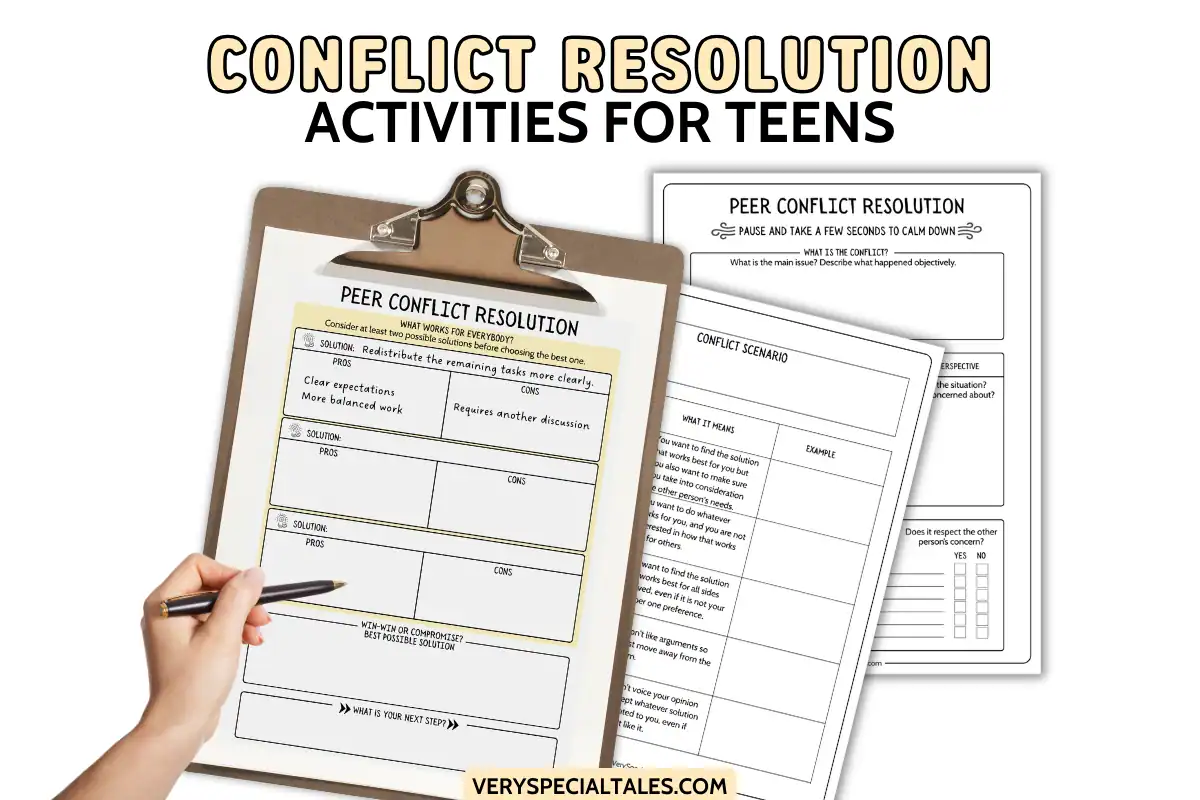
The Peer Conflict Resolution Worksheet featured in the activities section follows this process and helps teens apply the main steps to a real-life situation.
Core Conflict Resolution Skills
Effective conflict resolution is not just about choosing the right strategy. It also depends on developing a set of underlying skills that shape how teens think, communicate, and respond during disagreements.
The following key skills support effective conflict resolution and help teens navigate disagreements more constructively:
Emotional Regulation
The ability to pause before reacting. Teens need to recognize when emotions are rising and choose a response rather than react impulsively.
Why it matters: Most conflicts escalate because of unmanaged reactions, not the original issue. Strong emotions can also affect judgment and interfere with thoughtful decision-making.
Self-Awareness
Understanding personal triggers, values, and typical conflict patterns.
Why it matters: Teens who recognize “I tend to shut down” or “I get defensive quickly” are better able to adjust their approach.
Perspective-Taking
The ability to consider how the other person sees the situation.
Why it matters: When we pause to understand how the other person sees the situation, we are less likely to react defensively and more likely to respond constructively.
Assertive Communication
Expressing needs and boundaries clearly without aggression or passivity.
Why it matters: Assertive communication promotes clarity and respect. It allows us to express our needs and feelings clearly while also acknowledging and respecting the other person’s perspective.
Active Listening
Listening to understand rather than simply to respond.
Why it matters: Listening works on two levels. When we listen actively, we ensure we fully understand what the other person is saying. At the same time, feeling genuinely heard reduces defensiveness and makes constructive dialogue possible.
Strategic Thinking
Choosing the most appropriate conflict strategy for the situation.
Why it matters: Not every conflict requires collaboration, and not every issue should be ignored. Strategic thinking allows teens to assess the context, the importance of the issue, and the potential consequences before selecting a response.
Flexibility
Willingness to compromise or adjust expectations when needed.
Why it matters: When we fixate on a single outcome, we limit our ability to see alternatives. Flexibility expands possibilities and increases the chances of finding a practical solution.
Problem-Solving
Generating realistic solutions that move the situation forward.
Why it matters: Effective conflict resolution focuses on generating workable solutions. It shifts attention from what went wrong to what can be done next.
Conflict Resolution Activities for Teens
Conflict resolution activities help teens practice and explore the core elements that strengthen their negotiation and problem-solving skills. Some activities focus on applying specific strategies, others guide reflection on the steps of the process, and several are designed to develop the underlying skills that make effective conflict resolution possible. And like any skill, improvement comes with practice.
Conflict Resolution Activities for Teens
1. Rewrite the Conversation
Present a tense exchange, for example:
“You never do your part. I’m tired of covering for you.”
“Maybe if you stopped acting like the boss, I’d actually want to help.”
Ask teens to rewrite it using assertive, respectful language. Discuss how tone and wording can completely change the outcome.
Related resource: Assertive Communication Worksheets for Teens
2. Text Message Reframe
Present a reactive text, for example:
“You clearly don’t care. Forget it.”
Ask teens to rewrite the message in a calm, clear way that communicates the real concern without escalating the situation. Encourage them to keep it sounding like a real text, using natural short forms if they wish, but shifting the tone to something more constructive.
This activity also builds communication skills, but in a different format than the previous one. While rewriting a full conversation allows teens to practice assertive language with nuance and depth, text-based communication requires clarity in fewer words.
Since much of teen conflict now happens through short messages, this exercise also invites reflection on the limitations of digital communication and how tone can easily be misinterpreted.
3. Strategy Selection Drill
Another key skill in conflict resolution is choosing the right strategy for the situation. Not every disagreement requires the same response.
Present a brief teen conflict scenario and ask teens to decide whether avoidance, compromise, collaboration, or mediation is the best fit. They must justify their choice in one or two sentences.
4. Perspective Flip Exercise
Perspective-taking is essential in conflict resolution. Misunderstandings often grow when people assume negative intent without considering other explanations.
Present a situation, such as a friend canceling plans at the last minute. Ask teens to briefly write the situation from both perspectives. Then discuss how seeing the other side may change the response they choose.
5. Conflict Consequences Mapping
Good conflict resolution requires thinking beyond the immediate reaction. Teens benefit from learning to consider long-term impact before acting.
Present a scenario, such as someone spreading a rumor. Ask teens to list possible reactions and map the short-term and long-term consequences of each. This activity strengthens decision-making and reduces impulsive responses.
6. Compromise Mapping
Compromise is a practical conflict resolution skill that allows both sides to move forward when full agreement is not possible. It requires flexibility and willingness to adjust expectations.
Present a situation where two teens want different things, for example, how to spend time during a school event. Ask teens to list what each person wants and identify realistic adjustments both sides could make. This activity helps them see compromise as a structured process rather than a personal loss.
7. Win-Win Planner
Collaboration goes a step further than compromise. Instead of splitting the difference, the goal is to design a solution that fully addresses both sides.
Present a disagreement, such as conflict over leadership roles in a club or team. Ask teens to outline a plan where responsibilities are clearly defined and both individuals feel valued. This activity strengthens problem-solving skills and reinforces that conflict can lead to better outcomes when handled thoughtfully.
8. Taking Space as a Conflict Strategy
An important conflict resolution skill is recognizing when stepping back may be wiser than engaging immediately. Taking space can prevent escalation, but it should be intentional rather than avoidant.
Ask teens to brainstorm situations where choosing to step away might be the healthiest option. Then have them discuss how to tell the difference between taking space to cool down and avoiding an issue that needs to be addressed. This activity gives teens practice in using judgment and thinking strategically about their response.
9. Active Listening Drill
Listening is foundational to effective conflict resolution. Many disagreements persist because one or both sides feel unheard.
Pair teens and assign one speaker and one listener. The listener must summarize what they heard before responding.
This activity could be an eye-opening experience. Reformulating what the other person said requires deeper attention and thoughtful interpretation. It gives teens the opportunity to notice how much more they understand when they truly focus on the other person’s message.
Related resources: Active Listening Activities for Teens
10. Repairing the Trust Plan
Conflict resolution does not end with solving the disagreement. Rebuilding trust is often necessary afterward.
Present a scenario where trust has been damaged and ask teens to outline specific steps to repair it, such as acknowledgment, consistent behavior, or follow-through. This activity emphasizes accountability and long-term relationship health.
11. Accountability and Apology Builder
Taking responsibility is a core conflict resolution skill. A genuine apology can de-escalate tension and restore connection.
Ask teens to draft an apology that includes acknowledgment of the behavior, ownership of the impact, and a concrete plan for change. Discuss the difference between explaining and making excuses.
Related resources: Learning How To Apologize
12. Conflict Case Study Discussion
Analyzing real situations helps teens connect theory to practice in a structured way. Instead of reacting emotionally, they learn to evaluate conflict more objectively.
Present a realistic teenage conflict scenario. Ask teens to work through it using a guided framework:
• What triggered the conflict?
• Which conflict resolution strategy was used?
• At which step did the process break down?
• Which core skill was missing or underused?
• What alternative response could have led to a better outcome?
Working through the scenario this way helps teens see how strategies, steps, and skills fit together in real situations.
Conflict Resolution Games for Teens
13. Four Corners: Teen Strategy Edition
Physical movement can make decision-making more active and engaging. Choosing a position publicly also encourages teens to justify their reasoning.
Label each corner of the room with a strategy, such as avoidance, compromise, collaboration, or mediation. Read a teen conflict scenario, then ask participants to move to the corner that best fits. Invite a few to explain their choice. This builds strategy awareness and critical thinking.
14. Strategy Speed Round
Quick thinking under pressure is an important conflict resolution skill. In real life, teens often need to respond without long preparation.
Present brief conflict situations one at a time and ask teens to name an appropriate strategy in one sentence. This activity reinforces strategy recognition and builds confidence in selecting responses efficiently.
Conflict Resolution Worksheets for Teens
15. Conflict Resolution Steps Worksheet (Peer Conflict Resolution)
Structured reflection strengthens problem-solving and reduces impulsive reactions. Writing things down helps teens slow their thinking and evaluate options more objectively.
The Peer Conflict Resolution Worksheet, available at the end of this post, guides teens through defining the issue, considering perspectives, evaluating solutions, and choosing a realistic next step. It provides a clear structure that they can use independently or with adult support.

16. Conflict Resolution Strategies Worksheet
Use the Conflict Resolution Strategies Worksheet (available for download) to examine how each approach, collaborating, competing, compromising, avoiding, and accommodating, might play out in a specific scenario.
This activity helps teens see how the same conflict can unfold differently depending on the strategy chosen.
💡Tip: Revisit the teen group project example shared earlier in this post:
Two teens are working on a group project. One feels they are doing most of the work, while the other believes the tasks were divided fairly.
Complete the worksheet using this scenario to compare how each strategy could shape the outcome.
17. Conflict Resolution Workbook for Teens
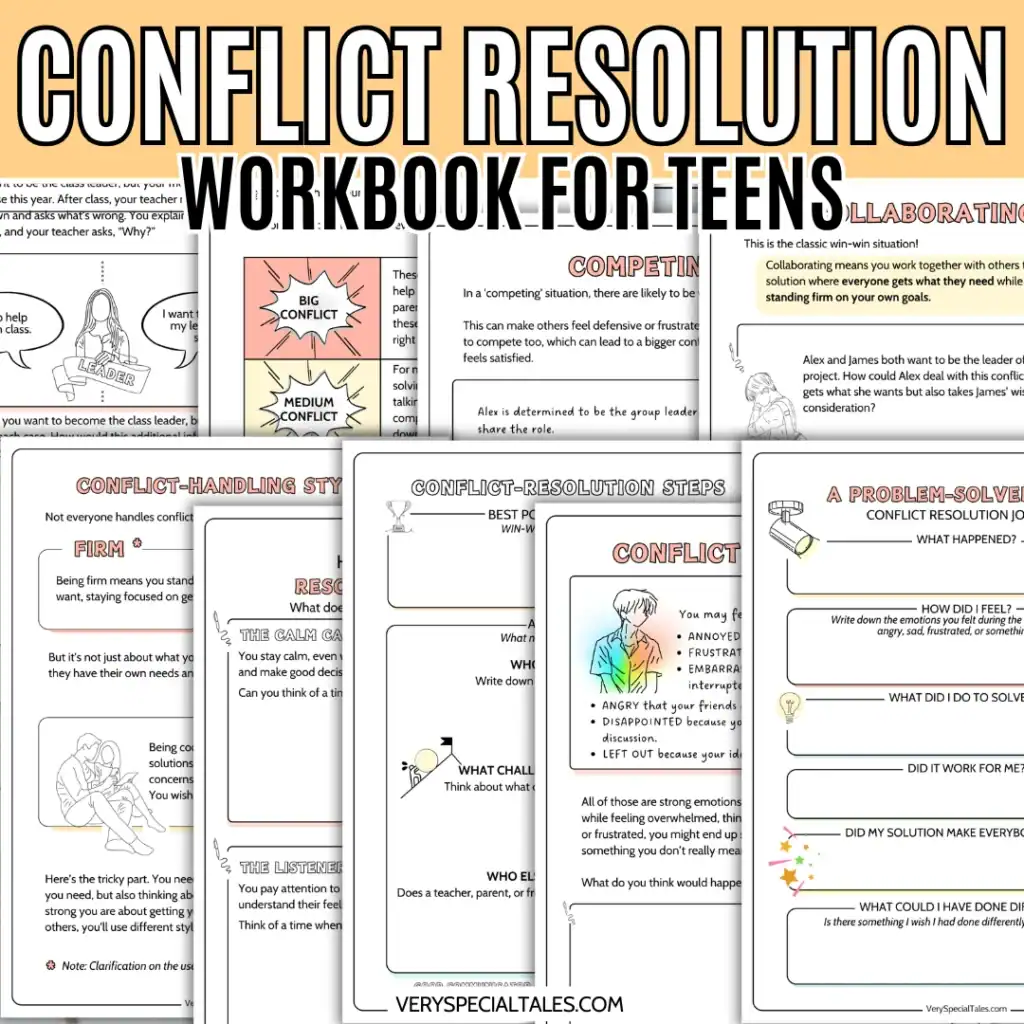
If you are looking for a more comprehensive and structured approach, the Conflict Resolution Workbook for Teens provide guided tools that go beyond a single activity.
This resource covers understanding everyday teen conflicts, exploring conflict resolution strategies, managing emotions during disagreements, identifying personal needs, strengthening listening skills, and finding fair solutions. It also walks students through the steps of conflict resolution and includes realistic conflict scenarios for practice.
18. Conflict Reflection Journal
Self-awareness improves future conflict resolution. Teens who reflect on past disagreements are more likely to adjust their responses next time.
Ask teens to reflect on a recent conflict, identify which strategy they used, and consider whether another approach might have worked better. The focus is on learning, not self-criticism.
Free Conflict Resolution Worksheets for Teens
Download the two printable worksheets mentioned in this post:
- Peer Conflict Resolution Worksheet (Conflict-resolution steps)
- Conflict Resolution Strategies Worksheet
Enter your email below to receive the download.


I thoroughly enjoy all of the resources you offer and I am grateful for the freebies because working in a low socio economic school system requires becoming very creative and resourceful with extremely limited funding.