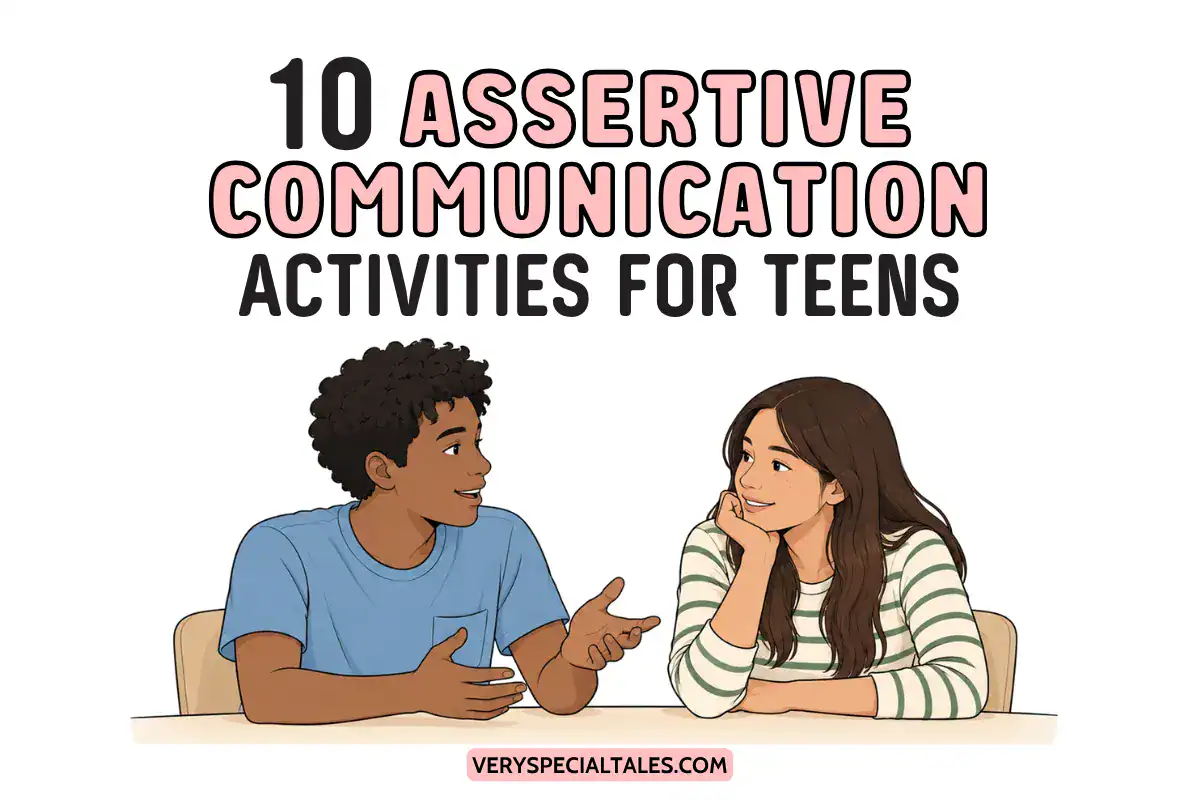
Assertive Communication Activities for Teens: Assertive communication means speaking up for ourselves while still respecting other people. It is an important communication skill for teens that can help them express what they think and feel, ask for what they need, set boundaries, say no, and handle disagreements or difficult conversations more confidently.
In this post, we’ll explore 10 practical assertive communication activities for teens. Most work well as group activities, and I’ve also included assertive communication worksheets for teens who would benefit from more structured practice.
Some of the activities build on specific assertiveness skills, such as using I-statements or understanding passive, aggressive, and assertive communication. Where relevant, I’ve linked to other resources that explore these topics in more detail.
1. Say It Three Ways: Passive, Aggressive, and Assertive
Skill practiced: Recognizing and using passive, aggressive, and assertive communication.
Give your teen a situation and ask them to respond to it in three different ways: passively, aggressively, and assertively. They need to create all three responses themselves.
For example:
- A friend keeps interrupting you while you are talking.
- Your sibling borrows your charger without asking.
- Your group wants to use an idea you disagree with for a school project.
After each one, compare the responses. What changed? Look at whether the speaker actually communicated what they wanted or needed, whether they respected the other person, and whether the message was clear.
You can also role-play the three versions. Hearing the words out loud can make the differences much easier to notice.
If you need a quick reminder of the differences between these styles, our post on Assertive Communication Skills for Kids explains passive, aggressive, and assertive communication with examples.
2. Turn Blaming Statements Into I-Statements
Skill practiced: Using I-statements to express feelings, needs, and concerns without blaming.
Give teens a blaming statement and ask them to communicate the same concern using an I-statement. The goal is to explain what is happening and how it affects themselves without attacking the other person.
Try these:
- “You never listen to me.”
- “You always leave me out.”
- “You’re so annoying when you keep coming into my room.”
For example, “You never listen to me” might become:
“I feel frustrated when I’m interrupted because I don’t get to finish what I’m saying. I’d like you to let me finish first.”
In the example above, we used the common four-part structure: I feel… / when… / because… / I would like… This format is useful when teaching and practicing I-statements. In real conversations, though, we don’t always need to use all four parts. Two- or three-part I-statements may better reflect how we actually communicate.
Want to explore I-statements in more detail? Our post on I-statements includes more examples and activities for teens.
3. Where Would You Draw the Line?
Skill practiced: Identifying and communicating personal boundaries.
Boundaries are personal. Something that bothers one teen may be completely fine with another. Give teens different situations and ask them where they would draw the line.
For example:
- A friend picks up your phone to look at a photo you mentioned.
- A friend posts a picture of you online without asking first.
- Someone continues messaging you after you have said you need to study.
For each situation, ask:
Would this bother you? If so, at what point would it become a problem? What could you say?
A teen might be comfortable with a friend looking at a photo but not scrolling through the rest of their camera roll. Another teen may not want anyone touching their phone at all.
Once they have identified the boundary, have them practice putting it into words:
- “Please ask before you use my phone.”
- “I don’t want photos of me posted without checking with me first.”
Learning about boundaries is an important part of assertive communication. The goal of this activity is to help teens think about their own boundaries and practice putting those limits into words so they can communicate them clearly to others.
4. Practice Saying No
Skill practiced: Saying no clearly and handling pressure to change your answer.
Give teens a request and ask them to respond with a clear no. Then make the activity more realistic by adding a second response from the other person.
Try:
- “Can I copy your homework? I didn’t have time to do mine.”
- “Can I borrow your new jacket for the party?”
- “Come with us. You can study later.”
A simple response might be:
“No, I’m not comfortable letting you copy my homework.”
Then add some pressure:
“Come on. I’d do it for you.”
Can the teen respond again without becoming aggressive or giving in just because they have been asked twice?
They might repeat the same message:
“I know, but I’m still not comfortable with it.”
Being assertive also means knowing that it’s okay to say no. Teens can give a reason if they want to, but they don’t always need to explain or justify their decision.
This is also a good opportunity to talk about overexplaining. When saying no feels uncomfortable, it can be tempting to give a long explanation or keep adding reasons. A clear, simple answer may be enough.
As an extra activity, ask teens to create a list of short ways to say no that feel natural to them:
- “I’ll pass.”
- “No, thanks.”
- “Not for me.”
- “I’d rather not.”
- “No, I’m good.”
In the next activity, they can practice sticking with a short answer when someone keeps pushing.
5. Try the Broken Record Technique
Skill practiced: Handling peer pressure and sticking to a decision.
In the previous activity, teens practiced short, clear ways to say no. But what happens when the other person doesn’t accept the answer and keeps pushing?
The broken record technique involves calmly repeating the same message instead of getting drawn into an argument or coming up with new reasons each time.
One person applies the pressure while the other practices sticking with their response.
For example:
Friend: “Come to the party. Everyone is going.”
Teen: “No, I’m not going tonight.”
Friend: “Come on! You’ll have fun.”
Teen: “I know, but I’m not going tonight.”
Friend: “You can’t stay home all weekend!”
Teen: “Maybe, but I’m not going tonight.”
Then swap roles and try other situations:
- A classmate keeps asking to copy your homework after you’ve said no.
- A friend keeps asking you to share something someone told you privately.
- Someone keeps trying to persuade you to join a plan you’ve already declined.
Encourage the person applying the pressure to make it increasingly difficult: “Come on,” “Just this once,” “Why not?” “I’d do it for you.” This makes the role-play more realistic and gives the teen practice holding their answer when saying no becomes harder.
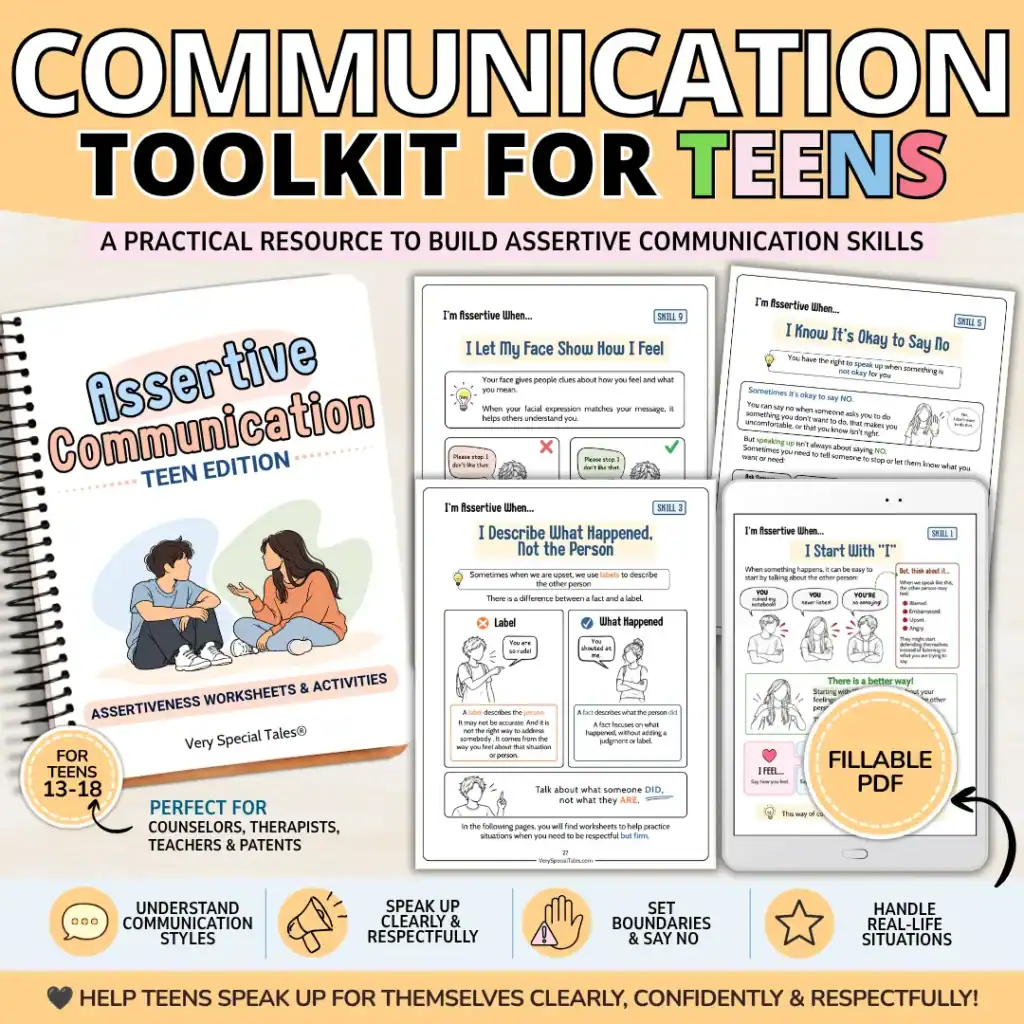
Looking for a more in-depth assertive communication resource for teens? The Assertive Communication Workbook for Teens is a printable resource with worksheets, activities, real-life scenarios, and role-play practice to help teens build and practice assertive communication skills.
6. Same Words, Different Message
Skill practiced: Using voice and body language to support an assertive message.
Choose one short sentence and say it several different ways. Keep the words exactly the same while changing things such as volume, speed, steadiness, posture, personal space, or gestures.
Try:
- “Please give that back.”
- “I don’t agree.”
- “Can I finish what I was saying?”
For example, say “Can I finish what I was saying?” very quietly while looking down. Try it again very loudly while moving close to the other person. Then try a version that feels clear, firm, and respectful.
Ask the listener what they noticed. Which parts of the delivery changed how the message came across?
There isn’t one “correct” assertive voice or posture. Different situations may call for different things. The point is to notice how the words, voice, and body language work together.
7. What Would You Say Next?
Skill practiced: Staying assertive when the other person pushes back, disagrees, or does not immediately accept your response.
Real conversations rarely end after one perfectly worded sentence. Give teens the beginning of a conversation and ask them to continue it.
Example 1: Saying no
Friend: “Can I copy your answers?”
Teen: “No, I’m not comfortable with that.”
Friend: “Seriously? It will only take me two minutes.”
What could you say next?
Example 2: Setting a boundary
Teen: “Please don’t share screenshots of our messages.”
Friend: “Why? There’s nothing private in them.”
What could you say next?
Example 3: Making a request
Teen: “Could you turn the music down while I study?”
Sibling: “But I’m listening to it!”
What could you say next?
After the teen responds, continue for another turn or two. The other person might agree, disagree, suggest a compromise, or keep pushing.
This helps teens practice something that is easy to overlook: being assertive does not mean the other person will automatically agree with you.
8. What Does That Message Really Mean?
Skill practiced: Communicating clearly and assertively in texts and messages.
When we talk face-to-face, our tone of voice, facial expression, and body language add information to our words. In a text or message, much of that information is missing. Short replies can sometimes leave the other person guessing what we actually mean.
Take a simple message:
“Fine.”
Depending on the situation, the person writing it could mean:
- I really am fine with it.
→ “That’s fine with me.” - I don’t agree, but I’m willing to go along with it.
→ “It wouldn’t be my first choice, but I’m okay with it.” - I’m annoyed and don’t want to keep discussing it.
→ “I’m getting frustrated, so I’d rather leave this for now.”
Then give teens other short or ambiguous messages and ask them to do the same thing:
- “Whatever.”
What are three different things the person might mean? How could they make each meaning clearer? - “Sure.”
Could they be genuinely agreeing? Reluctantly agreeing? Annoyed? How could they communicate each one more clearly? - “Do what you want.”
Does the person genuinely not mind, or do they disagree but don’t want to continue the conversation? What could they write instead?
9. Assertiveness Continuum: When Would You Speak Up?
Skill practiced: Deciding when something matters enough to speak up and recognizing situations where assertiveness feels easier or harder.
Draw a line with “I probably wouldn’t speak up” at one end and “I would definitely speak up” at the other.
Give teens different situations and ask them to place each one somewhere on the continuum:
- You receive the wrong meal at a restaurant.
- A friend makes a joke about you that you don’t like.
- A teacher marks an answer wrong, but you think your answer is correct.
Then change some of the details. Would their answer change?
For example, imagine you receive the wrong meal at a restaurant. If you really don’t mind and what they brought looks good, you might decide to keep it. But if you had been looking forward to the meal you ordered, staying quiet because you feel uncomfortable speaking up could mean giving up something that matters to you.
You can explore other changes too:
- What if the joke only bothered you a little? What if it keeps happening?
- What if the grade makes no difference to your result? What if it changes your final grade?
- What if speaking up means talking to a close friend? What if it means talking to someone you don’t know well?
There doesn’t need to be one correct place for each situation on the continuum. Ask teens to think about how important the issue is to them, what they want to happen, and how comfortable they feel speaking up.
10. Use Assertive Communication Worksheets for More Practice
Skill practiced: Bringing different assertiveness skills together and practicing them in a structured way.
If you want to explore assertive communication in more depth, our Assertive Communication Workbook for Teens provides structured practice with the skills teens may need in real-life situations.
The workbook includes explanations, worksheets, activities, and plenty of real-life scenarios and role-play practice, giving teens opportunities to apply assertive communication to a wide range of situations.
Other Communication Resources for Kids & Teens
Other Assertive Communication Resources
- How To Build an I-Statement: Learn the 4-step I-statement formula, with examples of shorter 3-step and 2-step I-statements for everyday conversations.
- 10 Assertive Communication Skills: Explore the key skills that can help kids and teens communicate more clearly and assertively.
Other Communication Resources
- 50 Communication Games & Activities for Kids
- Fun Conversation Starters for Kids
- Self-Introduction Worksheets for Kids
- Teaching Kids to Listen
- Turn-Taking Activities for Kids
- Social Skills Activities for Kids
- Conversation Dice Activity
Save this ideas for later: