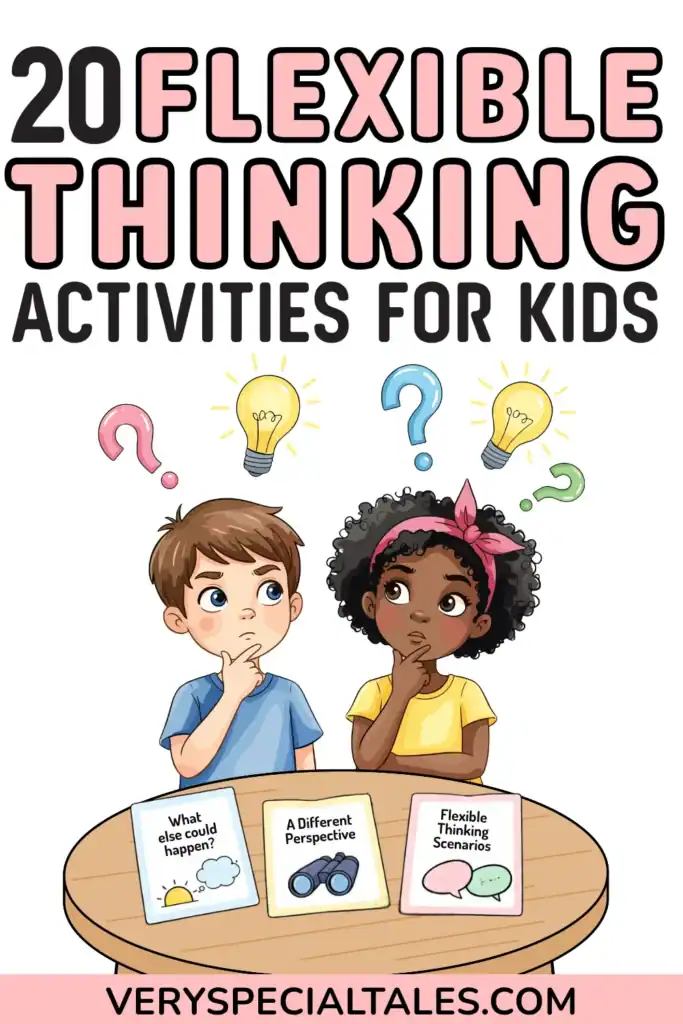
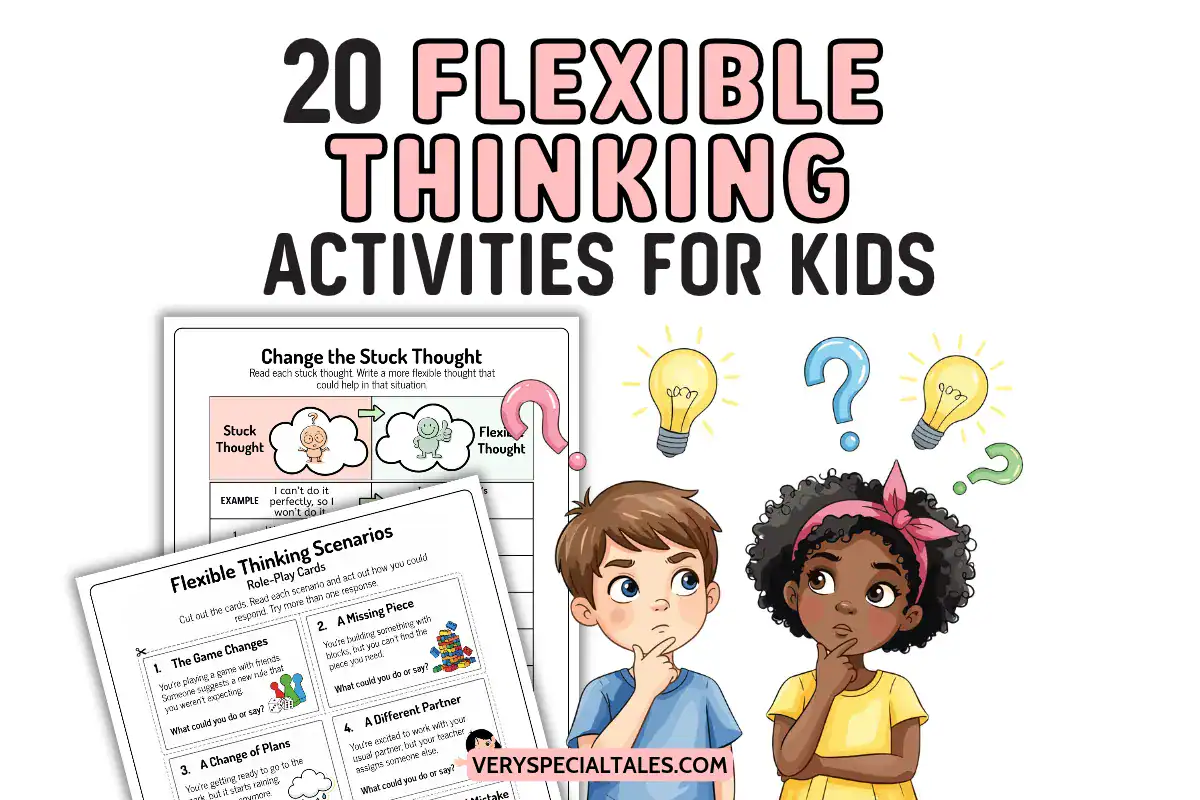
Discover how to help kids develop flexible thinking skills, with everyday examples, 20 flexible thinking activities for kids, and a free two-page printable worksheet to practice this skill.
The game rules change. The park is closed. A friend wants to play something else.
For some kids, these are minor disappointments. For others, adapting to unexpected changes can be much harder.
Flexible thinking helps kids adjust when things don’t go as planned, try a different approach when something isn’t working, and recognize that there’s often more than one way to do things.
What is Flexible Thinking?
Flexible thinking is the ability to change how you think or act when something doesn’t go as expected. It means being able to switch to a new plan, see a situation in a different way, or find another solution to a problem.
Flexible thinking (or cognitive flexibility) is one of the three core executive functions, along with working memory and inhibition (including self-control). Like other executive function skills, it develops quickly during the preschool years and continues to improve through adolescence as the brain develops.
What Rigid Thinking Can Look Like in Kids
All kids get stuck in their thinking sometimes. But for some children, difficulty adapting to changes or considering other possibilities can make everyday situations much harder.
Examples of rigid thinking in everyday situations include:
- Gets very upset when plans change, even small ones
- Insists that games or activities be done one specific way
- Has difficulty switching from one activity or task to another, especially when the change is unexpected
- Keeps using the same strategy even when it isn’t working
- Struggles to accept another child’s idea during play
Flexible Thinking Examples
What does flexible thinking actually look like? These kid-friendly flexible thinking examples compare stuck thinking with flexible thinking and show how the same situation can be approached in different ways. You’ll find more examples in the activities section below.
1. The park is closed.
- Stuck thought: Today is ruined.
- Flexible thought: I’m disappointed, but we could ride our bikes instead.
2. A friend wants to play a different game.
- Stuck thought: If we don’t play my game, I’m not playing.
- Flexible thought: We could play their game first and mine after.
3. A drawing doesn’t turn out as expected.
- Stuck thought: I messed it up. I’m throwing it away.
- Flexible thought: Maybe I can turn that line into something else.
How to Help Kids Develop Flexible Thinking
Flexible thinking develops over time, and there are plenty of opportunities to practice it at home and at school.
A few simple ways to encourage flexible thinking include:
- Explore different possibilities. When discussing a problem, encourage children to think of more than one solution. Ask, “What else could work?”
- Make a Plan B together. When something doesn’t go as expected, help children explore alternatives rather than immediately providing a solution.
- Model flexible thinking. Talk through situations where you need to change your own plans or try a different approach.
- Practice small changes. Introduce manageable variations to familiar games or activities so children can practice adapting to different rules or approaches.
- Give children time to adjust. When possible, warn them about changes ahead of time. For example, “We have five more minutes at the playground, then we need to leave.” If plans change unexpectedly, give them time to process the change before discussing alternatives.
- Notice flexible thinking. When a child tries a different approach or adapts to a change, point it out: “You found another way to make it work!”
The activities below offer more ways to practice flexible thinking through games, challenges, and situations children can relate to.
20 Flexible Thinking Activities for Kids
1. Switch the Rules
Choose a game children already know well, such as Simon Says, tag, or rock-paper-scissors. Play a round using the usual rules, then introduce a change:
- Simon Says: Do the opposite of what Simon says.
- Tag: Players must hop instead of run.
- Rock-paper-scissors: Rock now beats paper instead of scissors.
After a round, let children invent their own rule changes.
2. What Else Could It Be?
Show children an everyday object, such as a spoon, sock, or cardboard box. Ask, “What else could this be?” Encourage them to come up with as many different ideas as possible. Silly answers count!
For example, a spoon could become a microphone, a tiny shovel, or a drumstick.
Take turns suggesting ideas, or set a one-minute timer and see how many possibilities children can think of.
3. The Plan B Challenge
Give children a situation where the original plan is no longer possible, and ask them to come up with alternative plans.
For example:
- You planned to play outside, but it starts raining.
- You want to make cookies, but you’re missing an ingredient.
- Your favorite book is already checked out at the library.
Challenge children to think of at least two different Plan B options for each situation.
4. One Problem, Three Solutions
Give children a problem and challenge them to find three different ways to solve it.
For example, two friends want to use the same toy. They could take turns, play together, or find another toy they both enjoy.
Try other situations, such as disagreeing about which game to play or not knowing how to complete a school assignment.
5. Change the Ending
Read a familiar story or a short scenario, but stop before the ending. Ask children to imagine a different way the story could finish.
Challenge them to come up with several endings: a happy ending, a funny ending, or a completely unexpected one.
6. Find Another Way
In this activity, children experiment with different approaches to a practical challenge.
Ask them to build a bridge or tower using blocks. Once they’ve completed it, challenge them to build it again using a different design or materials. You could also introduce a restriction, such as building the tower without using the largest blocks.
7. Sort It Another Way
Gather a collection of everyday objects, such as buttons, blocks, crayons, or small toys. Ask children to sort them into groups using a rule of their choice.
Then mix everything up and challenge them to find a completely different way to group the same objects.
For example, a box of crayons could be sorted by color, color family (warm or cool colors), length, condition (broken or unbroken), or personal preference (favorites and least favorites).
8. Flexible Thinking Scenarios
Role-playing everyday situations is a fun way for children to practice responding when things don’t go as expected.
Give children a scenario to act out, then introduce an unexpected change they need to adapt to. For example, children could pretend they’re building something with blocks, but a piece they need is missing.
Encourage them to act out different ways they could respond.
You’ll find more ready-to-use flexible thinking scenarios in the free worksheet at the end of the post.

9. Yes, And… Storytelling Game
Start a story with a simple sentence, such as “One morning, a dinosaur appeared in our backyard.”
The next person continues the story by adding a new idea, starting with “Yes, and…” Take turns building the story, accepting each new twist even when it takes the story in an unexpected direction.
10. The Changing Clues Game
Choose a mystery object and give children clues one at a time. Start with a clue that could fit several objects, then add information that might make them reconsider their first guess.
For example:
- It’s round.
- You can find it in a kitchen.
- You can cut it into slices.
- It can make you cry.
Encourage children to change their guesses as new clues appear.
11. Create a Flexible Thought
Give children a situation and a stuck thought, then challenge them to come up with a more flexible thought.
For example:
Situation: Your friend doesn’t want to play your favorite game.
Stuck thought: “If we can’t play my game, I’m not playing.”
Flexible thought: “Maybe we can choose a game we both enjoy.”
Want more practice? Our free Change the Stuck Thought worksheet gives children eight rigid thoughts to turn into more flexible ones. You can download it at the end of this post.
12. Stuck Thought or Flexible Thought?
Write different thoughts on cards or slips of paper. Ask children to sort them into two groups: Stuck Thoughts and Flexible Thoughts.
For example:
- “There’s only one right way to do this.”
- “Maybe I can try it a different way.”
- “This is ruined.”
- “I can fix this or start again.”
Once they’ve sorted the cards, discuss what makes each thought stuck or flexible.
13. Alternative Interpretations
This activity helps children practice moving beyond their first interpretation of a situation and considering other possible explanations.
Describe an everyday situation and give children an initial interpretation.
For example: “Your friend walks past without saying hello. You think they’re ignoring you. What else could explain what happened?”
Challenge children to come up with at least three alternative explanations, such as their friend didn’t see them, was distracted, or was in a hurry.
14. The Silly Instructions Game
This activity challenges children to set aside their expectations and figure out how to complete an unusual or absurd task.
Give children a familiar task, such as drawing a house or building a tower, then surprise them with a silly instruction.
For example:
- Draw a house with the roof at the bottom.
- Draw a person with their feet where their hands should be.
- Draw a tree with its roots in the sky and its branches underground.
Let children take turns inventing silly instructions for each other.
15. How Many Ways Can You…?
This activity challenges children to move beyond the first solution that comes to mind and explore as many different ways of completing the same task as they can.
Give the child a simple challenge.
- How many ways can you get across the room? (hop, crawl, tiptoe, walk backward)
- How many ways can you make the number 10? (5 + 5, 2 + 8, 12 − 2)
- How many ways can you say hello without words?
16. Flexible Words to Try
Sometimes, a simple phrase can help children move away from a stuck thought and consider another possibility.
Introduce a few flexible thinking phrases:
- “There’s more than one way.”
- “I can try Plan B.”
- “Different can still be good.”
- “Maybe I can try something else.”
Ask children to choose their favorites and practice using them in pretend situations. They can also write their chosen phrases on a card to keep at their desk or in their backpack.
17. Two Things Can Be True
Present pairs of statements that seem contradictory, such as:
- “I love my friend” AND “Sometimes my friend annoys me.”
- “I’m excited about going to a new school” AND “I’m nervous about it.”
- “I enjoyed the game” AND “I didn’t like losing.”
Ask children whether both statements can be true and invite them to explain why.
This activity helps children recognize that two different feelings or experiences can be true at the same time.
18. The Opposite Day Challenge
Challenge children to do a familiar activity in an unusual order or in a different way.
For example, they could draw a picture starting with the background instead of the main subject, build something using their nondominant hand, or tell a familiar story starting from the ending.
Let children invent their own Opposite Day challenges.
19. Small Changes Practice
This activity helps children get comfortable with small changes to familiar routines and activities.
Choose something children already enjoy and introduce a small variation. For example:
- Take a different route during a familiar walk.
- Change the order of activities during playtime.
- Play a familiar game in a different place.
- Try a different way of organizing school supplies.
Start with changes children find manageable, and let them suggest their own variations as they become more comfortable.
20. From Mr. Rigid to Mr. Flexible
Introduce children to Mr. Rigid, a character who likes everything to stay exactly the same. He always sits in the same chair, wants to play games his way, and gets frustrated when plans change.
Now imagine Mr. Rigid could become Mr. Flexible!
Ask children to brainstorm how his life might change if he learned to think more flexibly.
For example:
- He might feel less frustrated when things don’t go his way.
- He could find more solutions when he faces a problem.
- He might enjoy new games and activities.
- He could have more fun playing with friends who have different ideas.
Invite children to come up with as many benefits as they can.
Related Resources for Building Flexible Thinking
Flexible thinking connects with other skills, including problem-solving, managing frustration, and developing a growth mindset. If you’d like to explore these areas further, you may find these resources helpful:
- Frustration Tolerance Workbook for Kids: Explore strategies for handling mistakes, setbacks, and unexpected changes.
- Growth Mindset Cards: Help children practice more helpful ways of thinking when something feels difficult.
- Problem-Solving Workbook for Kids: Practice exploring different solutions when the first approach doesn’t work.
Other Executive Functioning Resources
- Decision-Making Activities for Kids
- Critical Thinking Activities for Kids
- Working Memory Activities for Kids
- Memory Games and Activities for Kids
- Time Management Activities for Kids
- Problem-Solving Skills in Kids
- Problem-Solving Activities for Teens
- Attention Games for Kids
- Goal Setting Activities for Kids
- Flexible Thinking Activities for Kids
- Stop Think Act (Worksheets and Activities)
- How Big is my Problem (Printable)
Flexible Thinking Worksheets (Free Download)
Ready to practice? I’ve put together two free printable worksheets to help kids practice flexible thinking:
- Flexible Thinking Scenarios: Eight role-play cards featuring everyday situations where children can practice adapting to changes, handling unexpected problems, and trying different responses.
- Change the Stuck Thought: A worksheet where children practice turning rigid thoughts into more flexible ones.
Download both worksheets below and use them at home, in the classroom, or during counseling sessions.