A child can love their new baby brother and wish he’d go back to the hospital. They can be excited about starting a new school and sad about leaving their old friends.
These are examples of mixed feelings, when we experience different, sometimes contradictory emotions about the same situation.
For children, recognizing mixed feelings can be confusing. They may understand that they’re happy about something but struggle to explain why they’re also nervous, disappointed, or sad.
In this post, we’ll explore what mixed feelings are, how children’s understanding of them develops, and everyday situations that bring up conflicting emotions. You’ll also find 8 mixed feelings activities for kids and a free printable worksheet to help children identify and talk about their emotions.
What Are Mixed Feelings?
Mixed feelings, also called mixed emotions, happen when we experience two or more different emotions about the same situation at the same time.
These feelings can sometimes seem contradictory.
For example, a child might:
- Feel excited about going to summer camp and nervous about sleeping away from home.
- Feel proud of winning a game and sad that their friend lost.
- Love their younger sibling and feel frustrated when they interrupt their games.
Both feelings can be true at the same time.
How Children’s Understanding of Mixed Feelings Develops
Children’s understanding of mixed feelings develops gradually. Research suggests that even very young children can recognize mixed emotions, but understanding how two seemingly contradictory feelings can exist at the same time becomes easier as they grow older.
A study of children aged 3 to 5 found that 49% recognized mixed emotions in a story character, while only 12% reported experiencing mixed emotions themselves (Smith et al., 2015).
As children grow older, they become better at understanding that opposing emotions can exist at the same time, even toward the same person or situation (Harter & Buddin, 1987). They also become more likely to report experiencing mixed emotions themselves (Larsen et al., 2007).
Can children learn to recognize mixed feelings?
One study found that 6- and 7-year-olds improved their understanding of mixed emotions when guided to consider different aspects of a situation. Younger preschoolers benefited less from this approach.
The practical takeaway: Help children identify what makes them feel one way and what makes them feel another way about the same situation.
5 Examples of Mixed Feelings in Kids
Mixed feelings often come up during changes, new experiences, relationships, and situations where something positive and something difficult happen together.
Here are five examples children may recognize:
- Starting a new school: Feeling excited about making new friends and nervous about not knowing anyone.
- Welcoming a new sibling: Loving the baby and feeling jealous of the attention they receive.
- Winning a competition: Feeling proud of winning and sad that a close friend didn’t win.
- Receiving an unwanted gift: Feeling grateful that someone thought of them and disappointed with the present.
- A canceled event: Feeling disappointed about missing an activity and relieved because they were nervous about participating.
These examples show how two different feelings can be connected to the same experience. Feeling one emotion doesn’t cancel out the other.
Why Is It Important for Kids to Understand Mixed Feelings?
Recognizing mixed feelings can help children in several ways:
- Make sense of their reactions. A child may understand why they feel both upset and excited before a school trip. It may also help them recognize what they need.
- Express their emotions. Children may find it easier to explain how they feel when they understand that they can experience more than one emotion about the same situation.
- Understand other people’s perspectives. A child might recognize that a friend can be happy about winning a competition but also feel sad that someone else lost.
How to Help Kids Understand Mixed Feelings
Children may need help recognizing that different emotions can exist together, especially when one feeling is stronger than the other.
1. Acknowledge Both Feelings
When a child expresses mixed feelings, acknowledge both emotions.
For example:
- “You’re excited about your birthday party, and you’re sad that your best friend can’t come.”
- “You love your brother, and you’re angry that he broke your toy.”
Recognizing both feelings helps children understand that one doesn’t cancel out the other.
2. Use “And” Instead of “But”
Using “and” can help children express two feelings without suggesting that one takes away from the other:
- “I’m happy about moving, but I’ll miss my friends.”
- “I’m happy about moving, and I’ll miss my friends.”
Encourage children to try: “I feel ______ and ______.”
3. Explore Different Parts of a Situation
Help children consider what might be contributing to each feeling.
For example, if a child is excited about a sleepover, ask:
- “What are you looking forward to?”
- “Is there anything you’re worried about?”
This can help them recognize feelings they might not have noticed.
4. Share Your Own Examples
Use everyday situations to show that adults experience mixed feelings too:
- “I’m looking forward to our vacation, and I’m nervous about the long flight.”
- “I’m happy we finished our project, and I’m going to miss working on it together.”
8 Mixed Feelings Activities for Kids
These activities help children recognize, express, and explore mixed feelings through games, discussions, and creative activities.
1. Feelings Blends: Mixing Colors and Emotions
Ask children to think of a situation that brings up two different feelings and choose a paint or play dough color to represent each one.
For example, yellow could represent excitement and blue could represent nervousness about starting a new school.
Let children mix the colors and discuss how both feelings can exist together.
Note: Mixing colors creates a new color, but experiencing two emotions doesn’t necessarily create a third emotion.
2. Feelings Pie Chart
Draw a circle and divide it into sections to represent the different emotions a child might experience in one situation.
For example, before a school trip, a child might feel:
- 60% excited
- 30% nervous
- 10% sad about leaving their family
The percentages don’t need to be exact. They’re simply a way to explore which feelings are stronger.
Ask children whether they think the proportions might change as the event gets closer.
3. From “But” to “And”
Give children sentences about mixed feelings and ask them to replace “but” with “and.”
For example:
- “I love my sister, but she annoys me sometimes.”
- “I’m happy about moving, but I’ll miss my friends.”
- “I’m proud I tried, but I’m disappointed I didn’t win.”
Discuss how changing one word can help express both feelings without suggesting that one cancels out the other.
Extra challenge: Ask children to write their own “but” sentences and change them into “and” statements.
4. Mixed Feelings Scenarios (Free Worksheets)
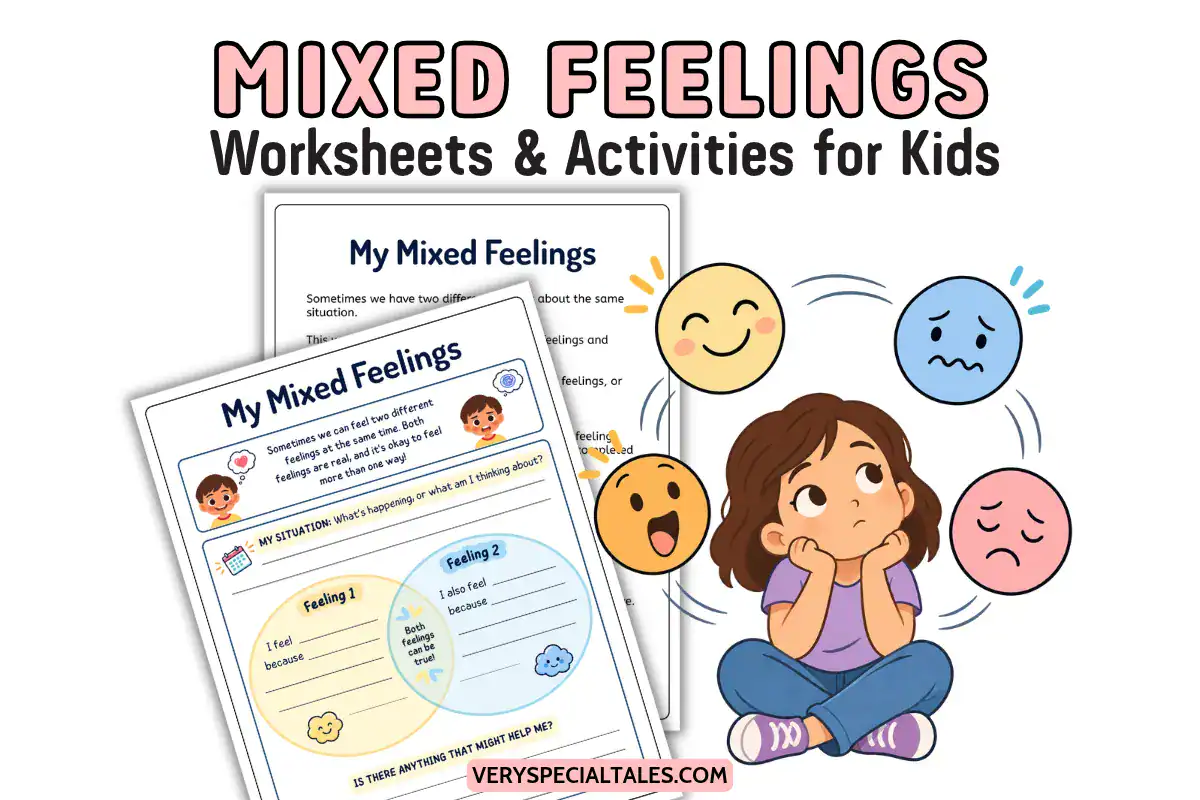
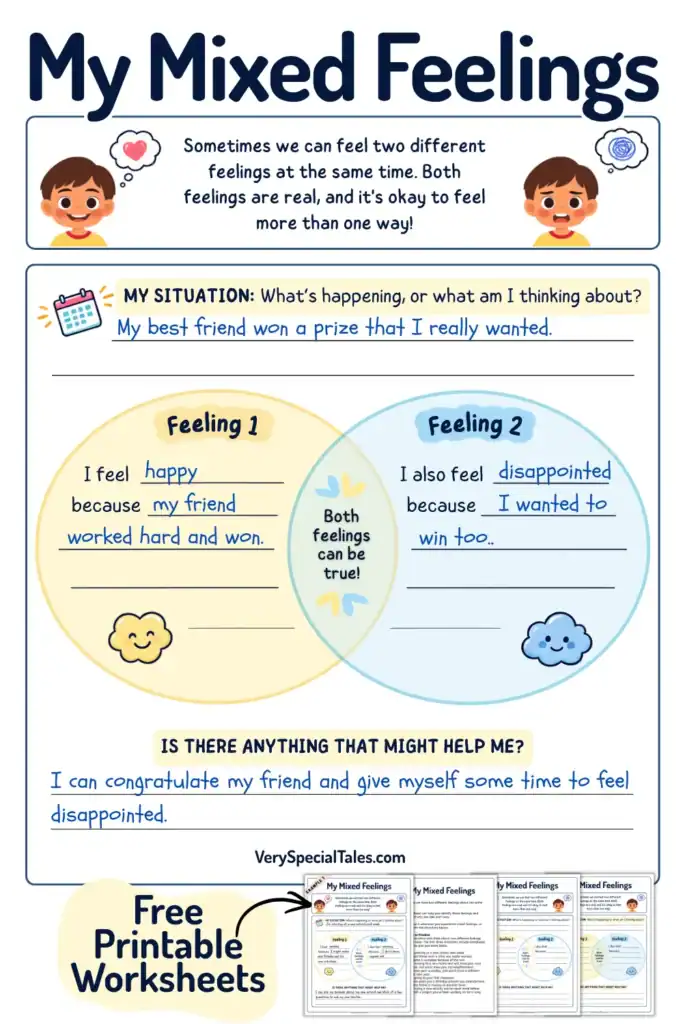
Use our free Mixed Feelings Worksheets to help children recognize and explore two different emotions about the same situation.
The printable includes ten everyday situations to practice with, three completed examples, and a blank worksheet children can use to explore their own mixed feelings.
Children identify two emotions, explain what might be contributing to each one, and consider whether anything might help.
For a group activity, compare answers and discuss how different children might feel about the same situation.
5. Mixed Feelings Story Detectives
While reading a book or watching a short video, pause when a character experiences a change, difficult decision, or unexpected event.
Ask children:
- What might the character be feeling?
- Could they be experiencing another emotion at the same time?
- What clues in the story support your ideas?
This is also an opportunity to explore how different people can interpret the same situation.
6. Mixed Feelings Charades
Give children situations that might bring up two different emotions. Have them act out the situation without speaking while others guess the feelings involved.
For example, a child might act out opening a birthday present and feeling grateful for the gift but disappointed because they already have it.
Afterward, discuss whether it was easy to recognize both feelings and why we can’t always tell how someone feels from their expressions.
7. Mixed Feelings Drawing
Ask children to divide a sheet of paper into two sections and draw two different feelings connected to the same experience.
For example, a child who is moving might draw their exciting new bedroom on one side and the friends they’ll miss on the other.
They can label each emotion and explain what contributes to it.
8. What Do My Feelings Need?
Present a situation involving mixed feelings and discuss what might help.
For example:
Emma is excited about her first sleepover but worried about sleeping away from home.
Ask children what Emma is looking forward to, what she’s worried about, and what might help her feel more comfortable.
They might suggest bringing a familiar toy, finding out where she’ll sleep, or making a plan with her parents.
Not every mixed feeling needs a solution, but recognizing different emotions can help children identify what support they might need.
Other Feelings And Emotions Resources
Emotions Bundle for Kids
Want more activities to help children recognize, understand, and express their emotions? Our Emotions Bundle brings together worksheets, games, and hands-on activities for exploring feelings:
- Three emotions workbooks: Activities to recognize basic emotions, explore 15 different feelings and moods, and learn about emotions through games.
- Emotions flashcards: 26 emotion cards for identifying feelings and discussing everyday situations.
- Hands-on activities: Emotions drawing activities and playdough mats for exploring feelings in creative ways.

Other Feelings and Emotions Articles:
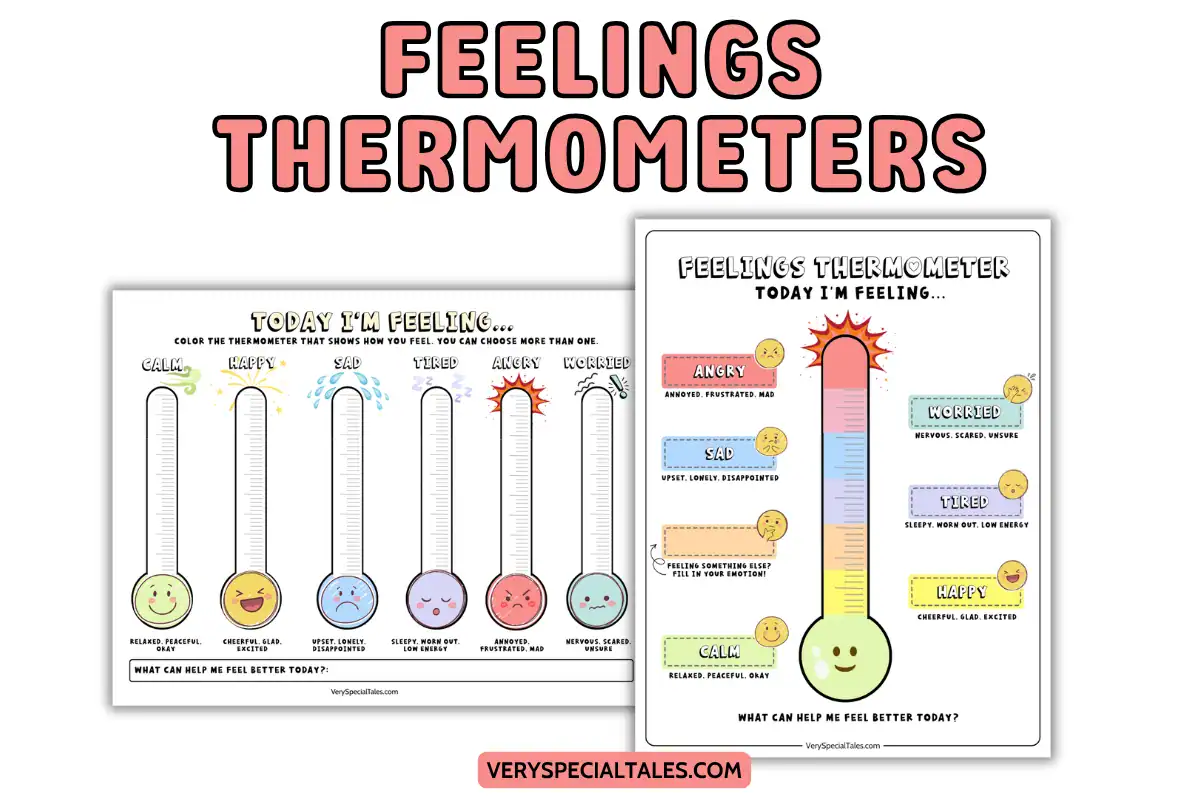
- Anger Thermometers
A more focused tool to explore how anger builds and what to do at each stage. - Emotion Charts (Feelings Charts)
Visual charts that show a wide range of emotions to help kids identify and name how they feel, with space to add coping strategies. - Mood Trackers for Kids
Simple tools that help children notice patterns in their feelings over time. - Emotion Wheels
Circular charts that group related emotions together, helping kids expand their emotional vocabulary. - Thoughts–Feelings–Behaviors (CBT Triangle)
A simple framework that helps kids understand how their thoughts, feelings, and actions are connected, and what they can do to respond in helpful ways.
Free Mixed Feelings Worksheets for Kids (Printable PDF)
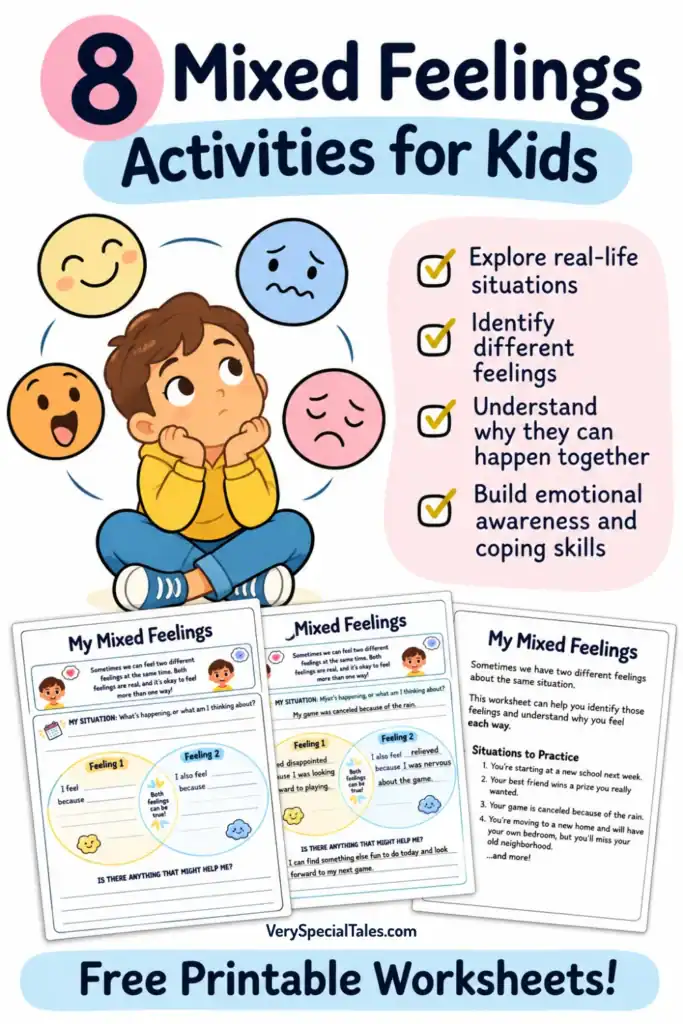
We’ve created a free set of Mixed Feelings Worksheets to help children practice recognizing and understanding different emotions they might experience at the same time.
The printable includes:
- A blank Mixed Feelings Worksheet where children identify two emotions, explore why they feel each way, and consider what might help.
- Three completed examples showing how to use the worksheet with different situations and emotions.
- Ten everyday situations children can use to practice identifying mixed feelings.
We’ve also included color and ink-friendly versions so you can choose what works best for you.
.