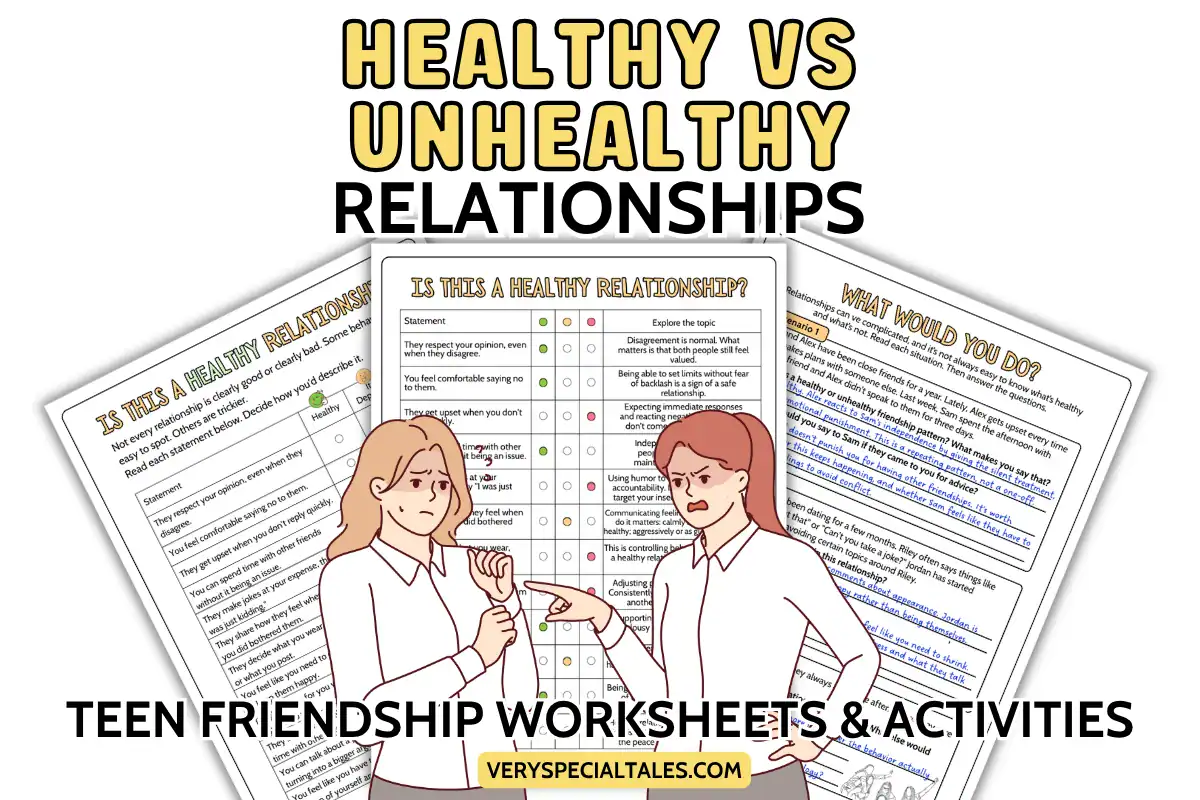
Most teens are navigating friendships and romantic relationships without ever being taught what a healthy one looks like, or how to spot the signs when something isn’t right. This post explores healthy vs. unhealthy relationships for teens. You’ll find five practical activities for the classroom or a counseling session, plus a free Healthy vs. Unhealthy Relationships Worksheet to download.
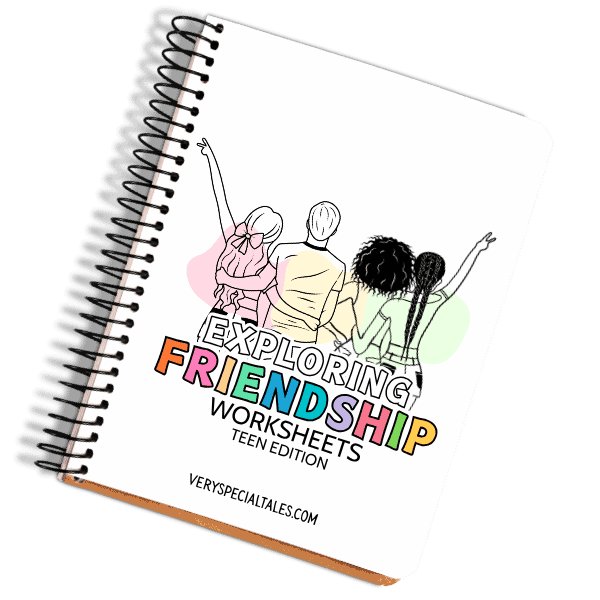
Want a ready-to-use friendship activity pack for teens? Get the Friendship Workbook for Teens, a printable resource covering what makes a good friend, how to identify the qualities teens value in relationships, and how to work through common friendship challenges. No prep needed, just print and go!
What Makes a Relationship Healthy?
Healthy relationships don’t mean no conflict. Every friendship and romantic relationship has tension sometimes. What healthy means is that the tension gets worked through, with both people still feeling respected on the other side.
Whether we’re talking about a friendship or a romantic relationship, the same core qualities matter. Healthy adolescent relationships are built on mutual trust, honesty, and good communication. They also provide a safe environment where young people can respect themselves and others while expressing their thoughts and feelings. (Source: HHS Office of Population Affairs)
In practice, that looks like this:
- Mutual respect. Each person values who the other is. They can disagree without it turning into criticism of who the person is.
- Trust. There’s no need to check up on each other constantly. Each person gives the other the benefit of the doubt.
- Honesty. Both people can say how they actually feel, including the uncomfortable stuff, without it becoming a big deal.
- Good communication. They can talk through problems without it becoming an argument about who’s a worse person.
- Independence. Both people still have their own friends, their own interests, and their own identity outside the relationship.
- Equality. No one person holds more power or makes all the decisions. Neither person is walking on eggshells.
Signs of an Unhealthy Relationship
Unhealthy relationships rarely start out looking obviously bad. They often start with something that almost looks like love: constant attention, intense feelings, the sense that this person can’t live without you.
Over time, those patterns can shift into something more concerning. Unhealthy relationships show up through disrespect, controlling behavior, dishonesty, hostility, or intimidation.
Some signs to look for:
- Jealousy framed as caring. “I just worry about you when you’re with other people.” Jealousy isn’t love. A caring partner gives you space.
- Controlling behavior. One person decides what the other wears, who they hang out with, or what they post online.
- Constant contact demands. Needing to know where you are every minute, or getting upset if you don’t respond quickly.
- Isolation. Slowly pulling away from friends and family, either because the other person takes up all the space or actively discourages those connections.
- Put-downs disguised as jokes. Teasing that always seems to land on your insecurities, followed by “I was just kidding.”
- Guilt-tripping. Feeling responsible for the other person’s mood, emotions, or decisions.
- Walking on eggshells. Constantly adjusting your behavior to avoid upsetting the other person.
These patterns show up in friendships, too, not just romantic relationships.
Why Teens Don’t Always Recognize the Signs
One of the hardest things about unhealthy relationships is that they can feel completely normal from the inside. According to the CDC, many teens think behaviors like teasing and name-calling are just a normal part of being in a relationship. They don’t report them, sometimes because they’re embarrassed, and sometimes because they’re afraid of what will happen if they do.
The teen years are also a time when relationships feel enormous. The developing brain makes emotions more intense, and the social stakes of belonging feel very high. When a teen has never experienced a relationship that felt different, it’s hard to know what “different” even looks like.
Why the Teen Years Are Such an Important Window
Research shows that knowing how to establish and maintain healthy relationships during adolescence helps young people develop into well-functioning adults, with healthier connections in school, at work, and in their personal lives.
The patterns teens learn now don’t stay in the teen years. The way conflict gets handled in a 15-year-old’s friendship group shapes the template they’ll carry into adult relationships. That’s not meant to be scary. It’s actually good news, because it means what adults teach now really matters.
The CDC also notes that youth who experience dating violence in high school are at higher risk for victimization during college. Early patterns have long reach, in both directions, which is why helping teens build a clear picture of what they want and deserve in a relationship is one of the most useful things an adult can do.
What Parents and School Counselors Can Do
The goal isn’t to tell teens what to think about their relationships. It’s to help them develop their own lens for evaluating them.
Ask open questions. “What do you enjoy about spending time with them?” gets a real answer. “Why do you still talk to them?” usually shuts the conversation down.
Name the behavior, not the person. “That sounds like it felt controlling” lands differently than “they’re a bad person.” It helps teens look at what’s happening without feeling like they have to defend someone they care about.
Avoid criticizing the relationship directly. Saying things like “I don’t like how they treat you” or “I think you should stop seeing them,” even when well-intentioned, tends to backfire. Teens who feel their relationship is being criticized are more likely to defend the other person than to step back. Try staying curious instead: “How are things going with them lately?” A teen who doesn’t feel interrogated is far more likely to come to you when something doesn’t feel right.
Be a safe landing place. Let your teen know, early and often, that they can come to you with relationship problems without being lectured or losing their phone. The goal is for them to want to talk to you when something feels off.
5 Healthy vs. Unhealthy Relationship Activities for Teens
Exploring healthy and unhealthy relationships in a group setting gives teens a chance to share ideas, consider different perspectives, and build a common language around relationships. Here are five activities that work well in the classroom or a counseling group:
1. Healthy or Unhealthy Relationship? (Scenario Analysis)
Present 8-12 short situations and ask students to:
- Is this healthy, unhealthy, or not enough information?
- What are the warning signs?
- What would you do?
This works well because relationships are rarely “good” or “bad.” It encourages discussion and avoids black-and-white thinking.
Examples:
- A friend gets upset every time you spend time with someone else.
- A partner apologizes after every argument but never changes their behavior.
- A friend celebrates your successes, even when they’re disappointed.
The Healthy vs. Unhealthy Relationships worksheet, included later in this post, contains a selection of short scenarios that work well for this activity.
2. Green Flags, Yellow Flags, and Red Flags
Give teens a set of relationship behaviors (on cards or in a worksheet) and ask them to sort each one into one of three categories.
3. What Would You Do?
Give realistic dilemmas and ask:
- What is happening?
- How might each person be feeling?
- What advice would you give?
- What could happen if nothing changes?
These open-ended situations generate much richer discussions than true/false questions.
4. Relationship values ranking.
Give students a list of qualities — honesty, loyalty, independence, humor, support, respect — and ask them to choose the five they value most in a friend or partner. Comparing choices as a group helps teens get clear on what they want before they’re in a situation where they’re already emotionally invested.
5. Healthy vs. Unhealthy Relationships Worksheet.
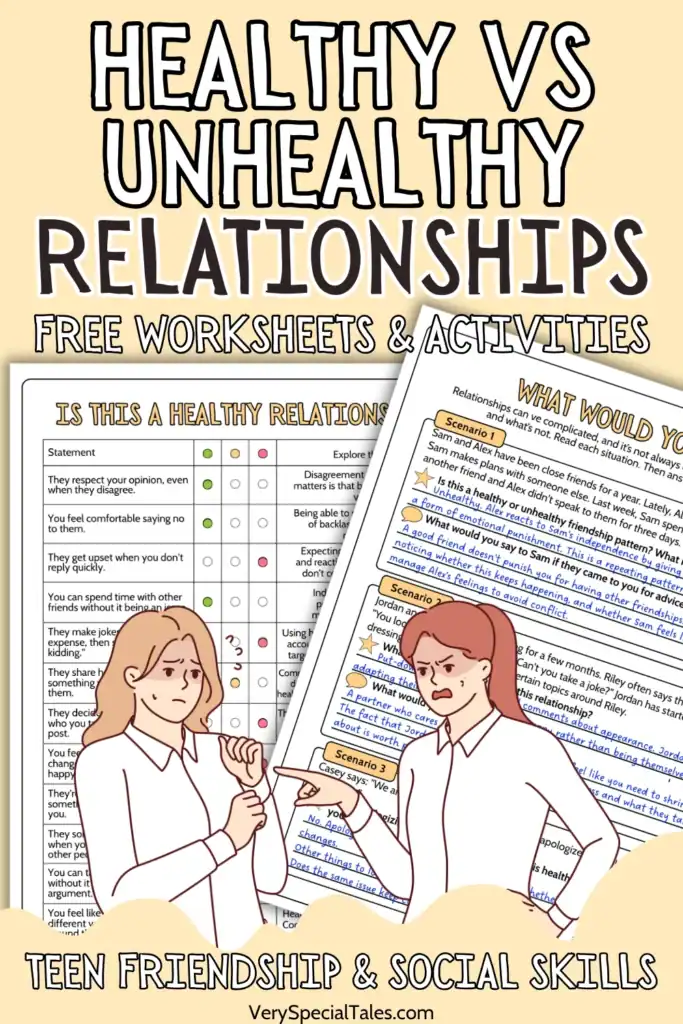
This two-page worksheet gives teens a private space to work through what they’ve learned on their own. Page 1 is a checklist of 12 relationship behaviors to sort as healthy, unhealthy, or “it depends” — including some gray-area ones worth discussing. Page 2 presents three real-life scenarios with questions to consider.
Other Social Skills Resources for Teens
Friendship Workbook for Teens
Want to go deeper? The Friendship Workbook for Teens is a 61-page printable workbook that goes beyond healthy vs. unhealthy dynamics to explore what makes friendships work, and how to navigate them when they don’t.
- The meaning of friendship: Teens explore what friendship means to them and what they look for in a close friend.
- Qualities that matter: Activities to help teens identify the qualities they value most in a friend, before they’re emotionally invested in a specific situation.
- Working through friendship issues: Practical exercises for the situations that come up most, including conflict, unhealthy relationships, feeling left out, and more.
Related Social Skills Articles
- Social Skills Activities for Teens
- Friendship Activities for Teens
- Assertiveness for Kids Worksheets
Download the Free Healthy vs. Unhealthy Relationships Worksheet for Teens
The free Healthy vs. Unhealthy Relationships Worksheet is a two-page printable that teens can use on their own or as part of a classroom or counseling session.
Page 1 is a checklist of 12 relationship behaviors to sort as healthy, unhealthy, or “it depends.” The gray-area items are the most useful — they’re the ones that start the most honest conversations.
Page 2 presents three real-life scenarios involving friendships and romantic relationships, each with questions asking teens to identify the patterns and consider what they would say to a friend in that situation.