
The #BlackLivesMatter tsunami triggered by the murder of another innocent black man, George Floyd, has swept even those of us reading the news far away from the US.
It’s been a week to read and listen to the testimonies of people whose lives are harder because of the racism that is interwoven in our societies.
It’s been a week to feel other people’s pain.
It’s been a week for reflection and introspection.
All around the world, we feel the need to start conversations about racism, discrimination, and white privilege.
Racism is a disease of society that is well spread all over the world. Kareem Abdul-Jabbar describes it in a very visual way
“Racism in America is like dust in the air. It seems invisible — even if you’re choking on it — until you let the sun in”.
Where we read “America”, we could probably read most other countries in the world.
In different degrees and manifestations, racism is present in all our societies: personal beliefs and attitudes, institutionalized, socio-economic, systemic, or unconscious.
It’s a worldwide situation with differences across societies. Some have managed to eliminate some manifestations, but others persist.
Condemning it is good, but it doesn’t feel good enough.
As part of my reading this week, I came across an article by Bronson and Merryman for Newsweek (Bronson & Merryman, September 14th, 2009) based on findings and the research for their book “NurtureShock”.
The quote that led me to that article was the following:
Explicit conversations with 5–7-year-olds about interracial friendship can dramatically improve their racial attitudes in as little as a single week.
The article has been an eye-opening experience.
We pride at home that our kids attend a diverse school where they are exposed to lots of cultures and races. And we felt that was enough to promote good racial attitudes.
After reading this article, reflecting on our reality here in New Zealand, and reading the testimonies reaching us from the US, I feel this is far from good enough.
Our duty as parents and educators is to intentionally nurture good racial attitudes in our children.
We may believe we embrace diversity because we teach vague principles like “everybody’s equal” or “we are all the same in God’s eyes”.
But research is telling us that this is not specific enough. We need to talk about race and how wrong discrimination is.
And the time to do it is in their early childhood when they are forming their own conclusions about race.
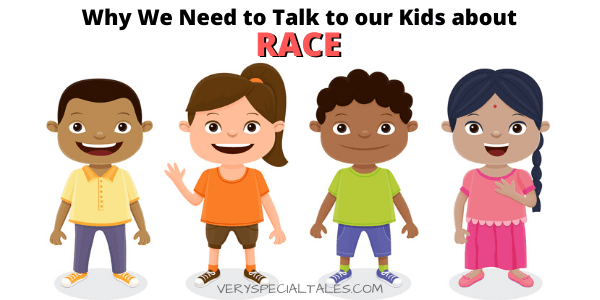
Why We Need to Address Race in our Discussions with Our Children
Our kids learn to categorize from an early age. Most of us can probably remember examples of a time when our kids thought all animals with four legs were “dogs”.
Yesterday, our kids’ babysitter was showing me a really cute video of her niece. She was squealing in delight playing with newborn kittens while she called them “goat” (she has been exposed to wild goats in her property).
In a world full of stimuli, categorizing helps our children organize and simplify their understanding of the world, and make predictions and inferences.
Kids will categorize as a group objects or living beings that share physical attributes or similarities.
Even if we don’t talk about race, our kids are not color blind.
Same as they can tell the difference in hair color, height, or gender, they can also see the difference in skin color.
This is one piece of the puzzle. We may tell them “we are all the same”, but they will still see the difference and they will need to make sense out of that reality.
Another piece of the puzzle is our tendency to develop in-group favoritism. In-group favoritism is a well-researched topic in social psychology.
Bronton & Merryman describe in the article, specific research conducted with elementary school children by Rebecca Bigler, a psychologist known for research on social stereotyping, prejudice, and children’s perceptions of discrimination.
In an experiment that assigned kids to groups that were identified by the color of their t-shirt, children showed consistent bias favoring their own group.
So, if our children are not “race-blind” and they are likely to categorize and assume their group shares their own positive characteristics, it is important to step in and discuss interracial friendship and positive racial attitudes at an early age.
Especially those of us who are in a privileged position.
And this is in our to-do list for this week.