
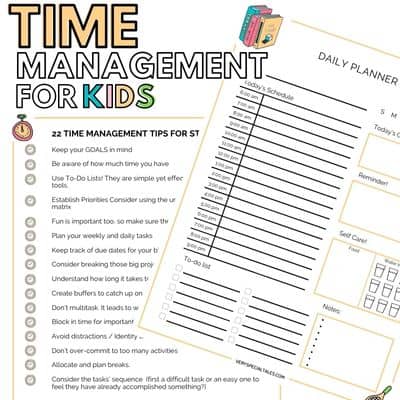
Fun Time Management Activities for Students: In this post, we will share the best tips to develop good time management skills. These tips can help high school students, college students, and even adults! We will also explore popular productivity techniques and suggest different types of time management activities for kids. Finally, you will be able to download a free PDF that includes the best tips and a daily planner.
Table of Contents
- What is Time Management
- Benefits of Time Management
- 22 Best Time Management Tips for Kids/Students
- 4 Popular Time Management Techniques
- 8 Great Time Management Activities for Students of All Ages
- Time Management Tips for Students + Daily Planner (Free PDF Download)
What is Time Management?
Time management is the ability to structure, organize and control our time based on our goals, allowing for flexibility to adapt to the changes in our environment while still protecting our priorities.
Time management is not just about the efficient allocation of work or study time. It also needs to cater to time for fun.
Benefits of Time Management for Students
Research suggests that times management has a positive effect on:
- Academic achievement
- Well-being, particularly life satisfaction
- Job performance
The meta-analysis mentioned above also found that people with strong time management skills avoid multitasking, as it leads to worse performance.
If we take a look at the specific benefits for students, learning time management skills has been associated with:
- Lower level of anxiety
- Development of good study habits
- Higher grade average
All these benefits highlight the importance of time management for our kids.
Best Time Management Tips for Kids / Students
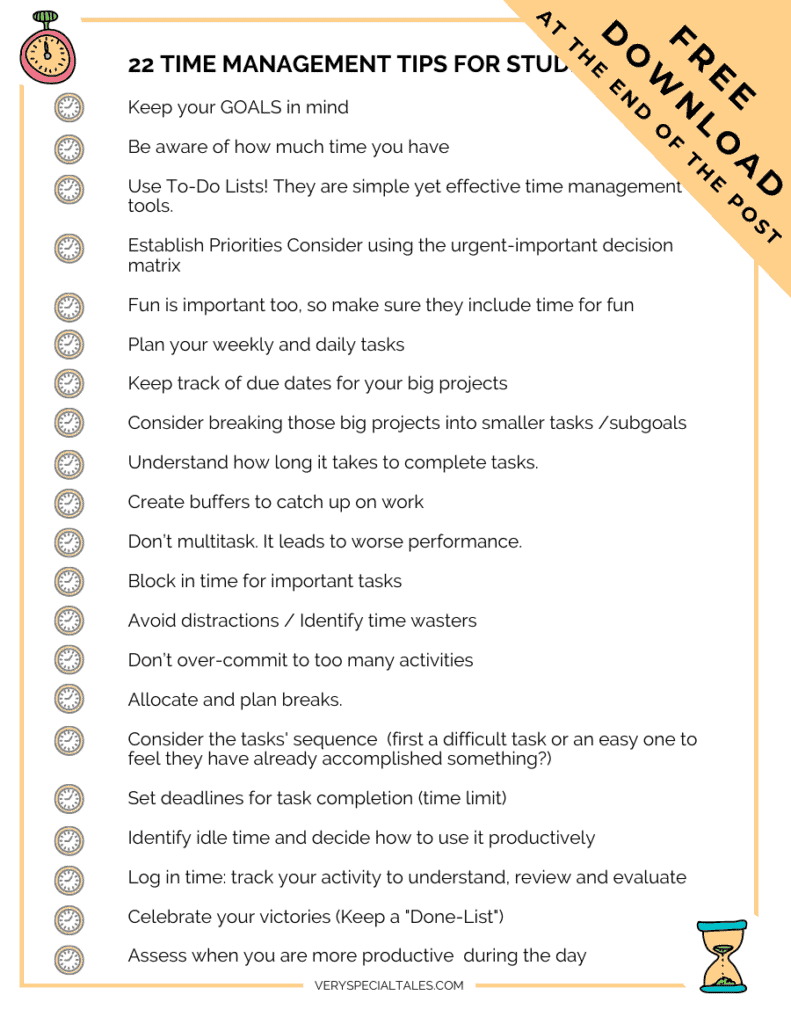
The tips listed below are very helpful advice to help your young people learn organizational skills and get into the habit of time management.
You will be able to download a free PDF including all these tips at the end of the post.
1. Think about your goals and what you would like to achieve
Goal-setting is a building block of time management.
Working towards our goals will keep your motivation levels high, which in turn leads to better focus (Dupeyrat & Mariné, 2005.)
According to a research study conducted with undergraduate engineering students, their ability to set goals and prioritize activities had a most significant positive correlation with their grade point average.
Related content:
2. Be aware of how much time you have
Time tracking can be an interesting time management activity for your child or student.
Kids tend to have very busy schedules, so this activity may help them realize there is less available time than they may have assumed:
- Once you remove the time you sleep, eat, go to school, go for sports practice, and other extra-curricular activities, how much time do you really have?
- Use a planner to create blocks of activities.
Tip: You may use the Free Daily Planner PDF available for download at the end of this post
- Use a planner to create blocks of activities.
3. Use To-Do Lists
To-do lists are a simple yet effective time management tool. Write down the list of tasks and activities you wish to complete.
4. Establish Priorities
Having a to-do list is just the first step. Understanding which are the important tasks is essential.
- Go first for your important “must-do” tasks
- Effective time management activity:
One of the most popular time management tools is the Eisenhower decision matrix popularized by Steven Covey in his best-seller The Seven Habits of Highly Effective People. This decision matrix categorizes tasks in a four-quadrant matrix according to two criteria:- Urgent: Tasks that require immediate action,
- Important: Important things, valuable tasks or activities
5. Fun is important too, so make sure to include time for fun in your to-do lists.
6. Plan your weekly and daily tasks

Create a daily schedule (and follow it!)
Short-term planning is flexible and seems to work better (but don’t forget we still work towards longer-term goals):
- Britton and Tesser (1991) identified a positive relationship between what they call short-range planning and grade point average. They hypothesize that, although long-term planning may be more important, in some environments with changing expectations, like college, a short-term window may be optimal.
- Short-term planning may be a great tool for students who tend to procrastinate.
7. Keep track of due dates for your big projects (you can’t catch up with those in the hours just before the deadline)
8. Consider breaking those big projects into smaller tasks /subgoals
9. Understand how long it takes to complete tasks.
Can I complete it in one session, or do I need to break this task into smaller chunks?
Research tells us it is extremely difficult to estimate a task’s duration. Individuals tend to underestimate or overestimate how long it takes to complete a task
10. Create buffers
This tip feels like a logical consequence to the previous tip. If our best efforts to estimate task duration stand some chance of failing, let’s make sure that we create buffers of unallocated time so that we can catch up on the tasks we couldn’t finish
- For example, the end of the week is a great time to catch up on what you couldn’t finish during the week.
11. Don’t try to multitask
Don’t try to do too many things at once.
Research shows that doing several things at the same time leads to worse performance, so focus on one thing at a time.
12. Block in time for important tasks
13. Avoid distractions / Identify time wasters
Our environment is full of distractions that will derail our focus. If your kid is studying with Minecraft opened in the background, how long is it going to take before they go for “just a tiny 5-minute break” than ends up being a not-so-tiny 45-minute break?
Ask your child to clean up their workstation from anything that may distract them.
14. Don’t over commit
Is your kid saying yes to too many activities?
Committing to too many activities may make focusing on important tasks and projects more difficult.
15. Allocate and plan breaks.
Everybody feels tired and less productive after intense focus on work. Remember to allocate and plan brain break activities.
16. Consider the tasks’ sequence
What works better for your kid, first a difficult task or an easy one, to feel they have already accomplished something?
17. Set deadlines for task completion.
Establish a time limit for your tasks. This is an important tip for perfectionist kids who may decide to spend extra time until they meet their perfection standards.
18. Consider how idle time is used.
Identify idle time and decide how to use it productively. It may be great for small tasks. And, also for fun! We just need to be intentional about it.
19. Track activity and log how you use your time.
20. Log daily activities.
Logging day activities can have multiple benefits:
- It helps you understand how you use time
- It allows for review and evaluation:
- Accomplishments
- Time wasters
- What worked and what didn’t work
- It helps you feel in control
21. Celebrate your victories.
If looking into a big list of different tasks feels overwhelming, start a “done” list too!
22. Assess when you are more productive.
Is your energy level at its best right after school or after a “me-time” break?
Popular Time Management Techniques
Some very popular time management techniques capture many of the principles listed above. We will review some of them in this section
The Pomodoro Technique
The Pomodoro Technique was developed in the 80’s by an Italian student, Francesco Cirillo, who kept getting distracted and struggled with focus.
It all started as a self-challenge. Can I focus for 2 minutes? 3 minutes? And as he kept winning an increasingly extended bet over time he established that his ideal unit of work was 25 minutes followed by a short period of rest (2-5 minute break)
So, where does this name come from?
Francesco Cirillo used a tomato-shaped kitchen timer to time his focus challenge. And tomato in Italian is translated as pomodoro (I’m sure you had come across this one in your pizza menu)
Time Blocking
Time blocking (or time chunking) is a time management strategy that allows you to focus your full attention on one single task for a specific time.
You divide your calendar into hourly blocks. Then you assign single tasks or a group of similar tasks to those blocks. Let’s read a couple of examples:
- You block 30 minutes to review all homework and papers you need to finalize during the week, and move them to your planner (instead of moving tasks to your planner each time you start working on a different paper)
- You block 2 hours for your science research paper, and you make sure you don’t get distracted with any other to-do’s from your list.
Eat That Frog
Mark Twain has often been credited for the quote: “If it’s your job to eat a frog, it’s best to do it first thing in the morning.”
But Brian Tracy made it even more popular when he captured this concept in his best-seller “Eat That Frog”
Eat That Frog simply means “do your more difficult (or dreaded) task first because the rest of your day will look a lot easier afterward.” You will also avoid procrastination, that productivity buster that often shows when we are facing specific tasks that we dislike.
The 80/20 rule
The concept behind the Pareto principle, also known as the 80 / 20 rule, is that 20% of the efforts we make lead to 80% of the results.
This is a powerful concept that can help your student prioritize their effort.
When you don’t have a lot of time left, stop for a few seconds and assess the key tasks you need to complete that will deliver most of the result.
Great Time Management Activities for Students of All Ages
Good news! Learning time management skills can be fun.
In this section, I will suggest time management games and activities for kids of all ages.
Mapping Circadian Rhythm
Have the teens in your group write out every single hour of the day that they are awake. Then, next to the space, have them write down a scale of how they feel throughout that day.
Try to have the group stick to 5-6 feelings throughout the day. Something like:
- hungry
- tired
- energized
- needs rest
- ready to go!
Once it is filled out, here are a few discussion points:
- How can we use our map to plan out our day?
- When should we plan to accomplish our daily responsibilities?
- When should you take a break?
- Are you trying to accomplish tasks when your body is in need of some time out or in low energy?
- Based on your map, what are the best ways to have a productive day?
Yesterday
Begin this activity by having everyone in the group write down a few short-term goals that they have. These goals can be anything from ‘making it to the last level of my video game’ to ‘earning a 4.0 this semester.
Next, have them write down 10-15 things that they did the day before. Some items on the list might be:
- cooked dinner for my siblings
- attended soccer practice
- played video games for 2 hours
Finally, have them look at their goals and compare how their previous day’s actions were matched (or not matched) to their goals
One note: the point of this activity is not to shame anyone with their daily activities. Instead, it’s a way to look at their time management and if their daily actions are bringing them closer to their goal or not.
Ribbon Challenge
Give your teens some ribbon and have them measure it out to equal 100 cm (1 m).
Each centimeter represents a year of someone’s life with the purpose being to help kids see how valuable their time is.
Begin by having everyone cut off the number of years that they have already lived.
Next, start cutting off the average amount of years that people do basic tasks. A few ideas are:
- years a person spends sleeping (26 years, according to this article)
- years a person works (15)
- years a person is eating (7)
As they remove ribbons from the originally long string, the kids will start to see the limited time they actually have. This is why time management is so important, and will help them learn the value of their daily actions.
Squares of Time
Give each teen 3 pieces of paper with 24 squares on the page. Each square will represent an hour that goes into the day.
Give them some time to think about what their basic daily routine looks like.
On the first page, participants fill out (shade or color one-hour squares) with routine activities of their day. This can look like ‘take a shower, eat breakfast, walk to school’.
The second page is for the non-productive time they use. This can look like sleeping an extra few hours, playing video games all night, or scrolling social media.
On the third, they add everything from the other two onto it. The empty space left is productive time. With this third piece of paper, your kids can then see what activities they can reduce or eliminate to increase their productive time.
Distract No More
Give a group of kids a card with something that wastes time or is a distraction for managing their time. This can look like:
- Scrolling TouTube
- Watching tv
- Taking long baths
Once everyone has their card, each team has 3 minutes to come up with ways to prevent getting distracted. The more ways they come up with, the more they can stop wasting time and become master time managers.
How long…?
For younger kids:
In a group of students, have everyone close their eyes at the same time. Then, have them raise their hands when they think a certain time period is up.
With this activity, start with 5 seconds, then 15, 30, and work your way up to a full minute.
The point of this activity is to show that everyone views time differently. Some may think a minute is over quickly, while others think it is long. Despite what they think, everyone has the same minute in the day.
For older kids:
Choose tasks that your students usually complete in the classroom. For example, how long does it take to find some information online (choose a relevant topic) and write a three-line summary?
This is slightly different from the younger kids’ activity. Here, the student will understand that it is difficult to estimate how long a task is going to take. Some students will be happy with what they find in the first two minutes, and some others will continue browsing until you ask them to stop.
Card Conundrum
This game is a fun way to get teens invested in time management and how organization plays into it.
Organize two decks of cards. Give two volunteers each a deck of cards. At the same time, have each teen volunteer flip through the deck one card at a time until they find the Ace of Spades.
Here’s the trick- one deck has been shuffled while the other is still in order.
Usually, the teen with the mixed-up deck will complain about how unfair it is, even though it was never confirmed that both decks are shuffled.
This activity is an effective way to demonstrate the important role that good organizational skills play in real life. An organized person will be able to sit, find their work and complete it with less effort than the unorganized student.
Overcooked
Overcooked is a popular game that can serve as a time management activity for kids. This online game is can help instill the value of time management in a fun way. Using the career as a restaurant manager, each player has to serve, cook, and run a restaurant efficiently.
The Jar of Life
Shown in the video below, the jar of life is an excellent activity to show kids how to properly prioritize their time.
All you need is a few materials found around your home:
- See thru jar
- Larger rocks about the size of golf balls
- Medium-sized rocks that can fit in the jar around the larger rocks
- Small pebbles the size that you would put on the bottom of a fish tank
Each rock size represents different elements of your life and the time that you use to fill every minute of the day. That visual reminder will help kids see the value in filling their day appropriately.

Other Resources to Help Students Focus
- 30 EFFECTIVE Impulse Control Strategies for Kids
- Attention Games for Kids
- How to Use Fidget Toys in the Classroom to Help Student Focus
- Decision-Making Activities for Kids
Time Management for Students Checklist (Free PDF)
Did you find these time management tips and activities helpful?
Don’t forget to download your Time Management Tips Checklist and your Daily Planner!



This is a wonderful summary filled with great resources. This area is a make it or break it for our students for higher learning and life. Thank you!
A useful resource
Great ideas! Thanks a million!!
Thank you for this resource got important details on how to help our kids much appreciated!